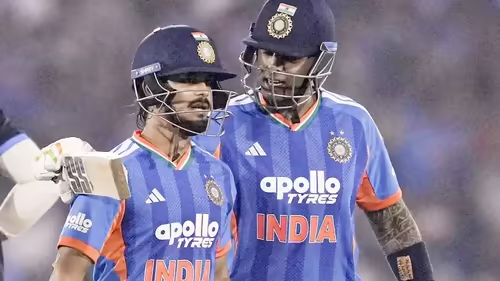
It lasted just a few seconds—but it lit up social media. During India’s high-stakes chase against New Zealand in the 2nd T20I, cameras caught Suryakumar Yadav appearing visibly frustrated with Ishan Kishan. Whispers turned into headlines: “SKY angry at Kishan!”
But as it turns out, the so-called anger wasn’t about blame or ego. It was pure, unfiltered competitive fire—the kind that fuels comebacks and defines champions. Far from a rift, the moment revealed the intense focus driving India’s new-age batting unit. And when the dust settled, Kishan’s explosive 76 and SKY’s masterful 82 sealed a commanding seven-wicket victory.
Table of Contents
- The Moment That Sparked the Headlines
- What Really Happened Between SKY and Kishan?
- How the Partnership Turned the Chase Around
- The Bigger Picture: India’s Free-Flowing T20 Philosophy
- Why This Dynamic Matters for the Future
- Conclusion: Passion, Not Problems
- Sources
The Moment That Sparked the Headlines
Midway through India’s chase of 185, Ishan Kishan—who was already racing toward his 76 off 32 balls—attempted a risky single. Suryakumar Yadav, at the non-striker’s end, gestured sharply, seemingly questioning the call. His expression was intense, his body language urgent.
To casual viewers, it looked like frustration. To seasoned observers, it was classic high-pressure communication—two elite batters locked in the zone, ensuring every run counted. There was no shouting, no turning away—just a split-second alignment of intent.
Yet, the clip went viral, with fans speculating about tension between two of India’s most dynamic hitters. The narrative needed correcting—and fast.
What Really Happened Between SKY and Kishan?
Post-match, Suryakumar Yadav himself cleared the air. Far from being angry, he was impressed by Kishan’s fearless approach. “Ishan played an unbelievable knock,” SKY said. “He took the game away from them. That’s exactly the kind of intent we want.”
The on-field moment? Simply a case of two aggressive players momentarily misreading a run—but instantly syncing back up. In T20 cricket, where margins are razor-thin, such micro-adjustments are normal. What matters is the outcome: they added 98 runs in under 8 overs, dismantling New Zealand’s bowling attack.
This wasn’t conflict—it was chemistry under pressure.
How the Partnership Turned the Chase Around
New Zealand had posted a competitive 184/8, thanks to half-centuries from Finn Allen and Daryl Mitchell. India’s chase began shakily, losing Yashasvi Jaiswal early. Enter Ishan Kishan.
His innings was a clinic in controlled aggression:
- 8 fours and 5 sixes in just 32 balls
- Strike rate of 237.50
- Targeted spinners and short balls with surgical precision
When Kishan fell in the 8th over, Suryakumar Yadav—fresh off his own return from injury—took charge. His 82 off 47 balls was a blend of innovation and composure, featuring scoops, ramps, and cover drives that left fielders frozen.
Together, they executed the exact brand of cricket Team India has been preaching: free-flowing, fearless, and finisher-ready.
The Bigger Picture: India’s Free-Flowing T20 Philosophy
Coach Gautam Gambhir and captain Suryakumar Yadav have been vocal about building a T20 side that doesn’t just win—but dominates. The emphasis is on:
- Intent from ball one – No settling in; attack is the best defense.
- Role clarity – Openers and No. 3 must clear the ropes early.
- Emotional resilience – High stakes demand high focus, not fragility.
The so-called “anger” between SKY and Kishan fits perfectly into this ethos. It shows players are fully invested—not just going through the motions. As former captain MS Dhoni once said, “In pressure situations, silence is more dangerous than a heated word.” A quick exchange means they care deeply—and that’s a good sign.
Why This Dynamic Matters for the Future
With the T20 World Cup on the horizon, India needs batters who can absorb pressure and still play freely. The SKY-Kishan combo offers exactly that:
- Versatility: Both can open or bat at No. 3/4.
- Left-right balance: Disrupts bowler rhythm naturally.
- Proven match-winning ability: Their partnership has now delivered in multiple high-stakes games.
[INTERNAL_LINK:india-t20-world-cup-squad-analysis] will likely hinge on maintaining this explosive core. Far from being a liability, their on-field intensity is an asset.
Conclusion: Passion, Not Problems
So, was Suryakumar Yadav angry at Ishan Kishan? Technically, maybe—for a second. But in the grand scheme of elite sport, that flash of intensity is a feature, not a bug. It reflects two world-class athletes giving everything to win.
Their partnership didn’t just chase down 185—it reaffirmed India’s new T20 identity: bold, expressive, and united by a shared hunger. The next time you see a heated glance between teammates, don’t assume drama. Sometimes, it’s just the sound of excellence being forged in real time.