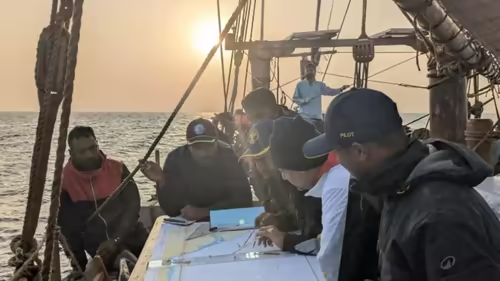
Imagine being stuck on a rusting ship in a foreign port for months—no salary, dwindling food, no communication, and no way to get home to your family. This isn’t fiction. It’s the grim reality for over 1,100 Indian seafarers in 2025 alone, making India the country with the most abandoned seafarers in the world—again .
Despite international laws and repeated warnings, the maritime industry continues to fail its most vulnerable workers. These sailors, who keep global trade afloat, are being discarded like cargo when shipowners face financial trouble. The International Transport Workers’ Federation (ITF) is scrambling to recover unpaid wages and repatriate crews, but systemic gaps remain wide open.
Table of Contents
- The Scale of the Crisis: Indian Seafarers Abandoned in 2025
- What Does Seafarer Abandonment Really Mean?
- Why Are Indian Seafarers Targeted?
- The ITF’s Role in Wage Recovery and Repatriation
- Gaps in International Maritime Law
- What Needs to Change to Protect Seafarers?
- Conclusion: A Call for Urgent Reform
- Sources
The Scale of the Crisis: Indian Seafarers Abandoned in 2025
According to data from the International Labour Organization (ILO) and the ITF, **India has topped the list of nationalities affected by seafarer abandonment for the third consecutive year**. In 2025, more than 1,100 Indian crew members were left stranded on vessels across ports in the Middle East, Southeast Asia, and West Africa .
This marks a sharp increase from 2023, when around 700 Indian seafarers were reported abandoned. Many cases involve ships that have been arrested for unpaid debts, environmental violations, or safety failures. Once detained, unscrupulous owners simply vanish—leaving crews to fend for themselves without salaries, medical care, or even basic provisions.
What Does Seafarer Abandonment Really Mean?
Under the Maritime Labour Convention (MLC) 2006, seafarer abandonment occurs when a shipowner fails to:
- Pay agreed wages for at least two months
- Cover the cost of repatriation
- Provide essential food, water, or medical care
- Communicate with or support the crew after a crisis
In practice, this means sailors can be trapped for **6, 8, or even 12 months** on derelict ships. Some report surviving on rice and lentils donated by local charities. Others suffer from depression, malnutrition, or untreated injuries. One sailor from Kochi described his ordeal: “We were treated like ghosts. No one came. No one cared.”
Why Are Indian Seafarers Targeted?
India supplies nearly **15% of the world’s seafaring workforce**—over 250,000 active sailors—making it the largest source nation globally . But this strength also makes Indian crews vulnerable:
- Cost-cutting by shipowners: Indian seafarers often accept lower wages than their Western counterparts, making them attractive hires for cash-strapped operators.
- Weak oversight on flag states: Many abandoned ships fly “flags of convenience” (like Panama or Liberia), which offer minimal regulation and accountability.
- Limited legal recourse abroad: Stranded sailors lack funds to hire lawyers or navigate foreign legal systems.
- Delayed government intervention: While India’s Ministry of Shipping has a seafarer welfare cell, response times during crises can be slow.
The ITF’s Role in Wage Recovery and Repatriation
The International Transport Workers’ Federation (ITF) has been on the front lines, working with local unions and port authorities to rescue abandoned crews. In 2025 alone, the ITF helped recover over **$4 million in unpaid wages** for Indian seafarers and facilitated the repatriation of hundreds .
However, the process is grueling. It often involves legal battles to force ship sale auctions, negotiations with port states, and coordination with embassies. Even then, many sailors receive only a fraction of what they’re owed—and some get nothing at all.
Gaps in International Maritime Law
While the MLC 2006 requires shipowners to carry **financial security insurance** to cover abandonment scenarios, enforcement is patchy. Many insurers deny claims, citing “fraud” or “non-compliance.” Worse, there’s no global mechanism to blacklist repeat-offender shipowners.
[INTERNAL_LINK:maritime-labour-convention-explained] experts argue that without mandatory public registries of shipowners and real-time monitoring of crew welfare, abandonment will remain a recurring nightmare.
What Needs to Change to Protect Seafarers?
To prevent future crises, stakeholders must act decisively:
- India should ratify and enforce stricter monitoring under the MLC, including pre-voyage verification of shipowner solvency.
- Port states must deny entry to vessels with a history of labor violations or expired insurance.
- Global shipping companies must audit their charters to avoid subcontracting to high-risk operators.
- Seafarers need direct access to emergency funds via a UN-backed repatriation guarantee scheme.
Conclusion: A Call for Urgent Reform
The repeated abandonment of Indian seafarers is not just a labor issue—it’s a moral failing of the global maritime system. These men and women keep 90% of world trade moving, yet they’re left to rot when profits dry up. Until governments, insurers, and shipping giants prioritize human dignity over cost-cutting, the cycle of Indian seafarers abandoned at sea will continue. The time for empty promises is over. Real reform starts now.
Sources
- Times of India: Indian seafarers are most abandoned in the world again
- International Transport Workers’ Federation (ITF): Seafarer Abandonment Cases Database
- International Labour Organization (ILO): Maritime Labour Convention, 2006