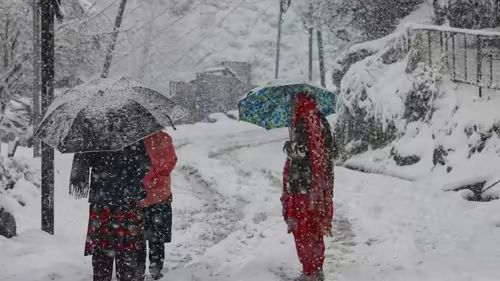
Imagine waking up to a world buried under thick snow, with howling winds so fierce they can rip roofs off buildings. That’s not a scene from a disaster movie—it’s the reality for thousands across Jammu and Kashmir this week. A brutal combination of heavy snowfall and wind gusts reaching a staggering 155 km/h has triggered unprecedented snow chaos in Jammu and Kashmir, shutting down daily life from the Kashmir Valley to the Shivalik foothills .
With national highways blocked, Srinagar airport flights grounded, schools closed, and power grids crippled, authorities are scrambling to restore order while bracing for more extreme weather. Even the revered Vaishno Devi shrine has been forced to suspend its pilgrimage—a rare move that underscores the severity of the situation.
Table of Contents
- What Happened: The Extreme Weather Event
- Transport Paralysis: Roads and Flights Grounded
- Vaishno Devi Pilgrimage Suspended: A First in Years
- Power Outages and School Closures Across the Region
- Is This the New Normal for J&K Winters?
- How to Stay Safe During Extreme Winter Weather
- Conclusion: Navigating the Aftermath of Snow Chaos in Jammu and Kashmir
- Sources
What Happened: The Extreme Weather Event
Meteorologists from the India Meteorological Department (IMD) confirmed that a powerful western disturbance collided with cold northwesterly winds, creating a perfect storm over Jammu and Kashmir . The result? Blizzard-like conditions, with snow accumulation exceeding 2 feet in higher reaches like Gulmarg and Pahalgam, and wind speeds hitting 155 km/h in some areas—equivalent to a Category 1 hurricane.
This isn’t just a snowstorm; it’s a multi-hazard event. The high winds caused massive drifting, making even cleared roads impassable within hours. In low-lying Jammu, the combination of rain and strong gusts led to widespread tree falls and structural damage.
Transport Paralysis: Roads and Flights Grounded
The lifeline of the region, National Highway 44—the only all-weather road connecting the Valley to the rest of India—was completely blocked at multiple points, including the critical Sinthan Top and Mughal Road passes. The Border Roads Organisation (BRO) deployed dozens of snow-clearing machines, but progress is slow due to continuous snowfall and avalanche risks .
At Srinagar International Airport, all commercial flights were cancelled for two consecutive days. Passengers were stranded, and airlines issued travel advisories urging against non-essential travel. Similarly, the Jammu-Srinagar railway line saw partial suspensions due to landslides near Banihal.
Key disruptions include:
- NH44 blocked between Qazigund and Jammu
- All Srinagar flights cancelled on January 23–24, 2026
- Local bus services suspended across Srinagar, Anantnag, and Baramulla
- Taxi unions advised not to operate in hilly zones
Vaishno Devi Pilgrimage Suspended: A First in Years
In one of the most symbolic impacts of the storm, the Shri Mata Vaishno Devi Shrine Board announced the suspension of the pilgrimage to the holy cave in the Trikuta Hills. Heavy snow blanketed the entire route from Katra, making the 12-km trek impossible and dangerous .
This is a rare step—last taken during major security or natural emergencies—and affects tens of thousands of devotees who visit daily. The shrine board cited “extreme weather conditions and risk to life” as the primary reasons, urging pilgrims to postpone their journeys until further notice.
Power Outages and School Closures Across the Region
The Power Development Department (PDD) reported severe damage to transmission lines, especially in Rajouri, Poonch, and parts of South Kashmir. Over 300 feeders went down, leaving entire districts without electricity for more than 36 hours in sub-zero temperatures.
Meanwhile, the education department ordered the closure of all government and private schools in Jammu and Kashmir until January 27, 2026. Online classes were also disrupted in many areas due to internet and power failures, raising concerns about academic continuity during peak exam season.
Is This the New Normal for J&K Winters?
Climate scientists warn that such extreme winter events may become more frequent. According to the India Meteorological Department, western disturbances have intensified in recent years due to changing Arctic oscillation patterns . Historical data shows a 20% increase in high-intensity snowfall events in the Himalayas since 2000.
This raises urgent questions about infrastructure resilience. Are roads, power grids, and emergency systems in J&K built to withstand these new extremes? [INTERNAL_LINK:climate-change-in-himalayas] experts argue that long-term adaptation strategies—not just reactive snow clearance—are now essential.
How to Stay Safe During Extreme Winter Weather
If you’re in or planning to travel to J&K during winter, follow these safety tips:
- Monitor official alerts from IMD and local disaster management authorities.
- Avoid non-essential travel, especially on mountain roads after snowfall.
- Keep emergency supplies—food, water, blankets, and a battery-powered radio—at home.
- Never attempt the Vaishno Devi trek without checking the shrine board’s official status.
- Report power outages immediately to PDD helplines to aid faster restoration.
Conclusion: Navigating the Aftermath of Snow Chaos in Jammu and Kashmir
The current snow chaos in Jammu and Kashmir is more than a temporary inconvenience—it’s a stark reminder of the region’s vulnerability to climate volatility. While rescue and restoration efforts are underway, the bigger challenge lies in building systemic resilience. For residents, pilgrims, and travelers alike, staying informed and prepared is no longer optional; it’s a necessity in an era of increasingly unpredictable winters.
Sources
- Times of India: Snow & winds bring chaos to J&K: Roads blocked, flights paused, power hit, schools shut
- India Meteorological Department (IMD): Official Weather Alerts and Forecasts
- Shri Mata Vaishno Devi Shrine Board: Pilgrimage Status Updates