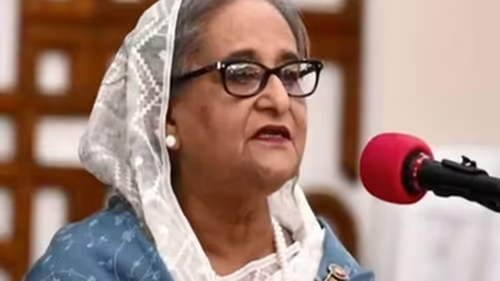
Sheikh Hasina on Bangladesh Government: A Stark Warning Against Extremism
In a powerful and politically charged address, Bangladesh Prime Minister Sheikh Hasina has issued a blunt warning to her nation: “Bangladesh does not deserve a government aligned with radicals.” The statement, reported by the Times of India, is a direct rebuke of the Bangladesh Nationalist Party (BNP) and its exiled chairman, Tarique Rahman, whose recent return to party leadership has reignited fierce political tensions .
This isn’t just political rhetoric—it’s a reflection of deepening concerns over democratic integrity, minority safety, and the future of one of South Asia’s most strategically important nations. As Bangladesh edges closer to a critical election cycle, Hasina’s words underscore a high-stakes battle for the country’s soul.
Table of Contents
- Tarique Rahman and the BNP Controversy
- Sheikh Hasina on Bangladesh Government: Democracy at Risk?
- Minority Persecution and Extremist Appeasement
- Impact on India-Bangladesh Relations
- Conclusion: A Nation at a Crossroads
- Sources
Tarique Rahman and the BNP Controversy
The immediate trigger for Hasina’s remarks was the formal reinstatement of Tarique Rahman as acting chairman of the BNP. Rahman, the son of former Prime Minister Khaleda Zia, has lived in self-imposed exile in London since 2008, following multiple convictions in Bangladesh for corruption and money laundering—charges he denies as politically motivated .
Critics, including Hasina’s Awami League, argue that Rahman’s leadership from abroad undermines the BNP’s legitimacy and raises questions about transparency. They point to his alleged past associations with Islamist groups during the BNP-Jamaat coalition era (2001–2006), a period marked by rising religious extremism and violence against minorities .
Key concerns include:
- Rahman’s inability to campaign or engage directly with voters due to his exile status.
- The BNP’s historical alliance with Jamaat-e-Islami, a party banned from elections but still influential in certain regions.
- Lack of internal party democracy, with leadership concentrated in a single family.
Sheikh Hasina on Bangladesh Government: Democracy at Risk?
Hasina’s critique goes beyond personalities—it targets the very framework of electoral fairness. She highlighted the irony that while her own party, the Awami League, is currently barred from participating in local elections under controversial legal interpretations, the BNP—which she accuses of harboring anti-democratic elements—is allowed to operate freely .
“They fear our popularity,” Hasina reportedly stated, suggesting that the ban on the Awami League is a tactic to suppress its grassroots support ahead of national polls. This claim resonates with international observers who have long criticized Bangladesh’s electoral environment as increasingly skewed.
According to Human Rights Watch and other watchdogs, successive governments have used legal mechanisms to sideline opposition voices, eroding the pluralism essential to a healthy democracy . The upcoming elections, therefore, face serious questions about their credibility—a concern that could destabilize the region.
Minority Persecution and Extremist Appeasement
One of Hasina’s most damning accusations is the current government’s failure—or unwillingness—to protect religious minorities. Under previous BNP-led administrations, Hindu, Buddhist, and Christian communities faced targeted violence, land grabs, and social marginalization .
While Hasina’s own tenure has seen improvements in minority security, critics argue that sporadic attacks continue, often met with inadequate state response. However, she positions her government as a bulwark against full-blown majoritarianism, contrasting it with what she describes as the BNP’s “appeasement of extremist forces.”
This narrative is crucial for both domestic and international audiences. For India, which shares a 4,000-km border with Bangladesh and hosts millions of Bengali-speaking citizens, the treatment of Hindus in Bangladesh is a sensitive diplomatic issue .
Impact on India-Bangladesh Relations
The political turmoil in Dhaka has direct implications for New Delhi. Over the past decade, India and Bangladesh have deepened cooperation on trade, counterterrorism, and infrastructure—most notably through the landmark Land Boundary Agreement and increased connectivity projects .
However, a potential shift toward a BNP-led government perceived as sympathetic to Islamist groups could strain this partnership. India has historically viewed the Awami League as a more reliable ally in combating cross-border militancy and maintaining secular governance.
Should the BNP return to power without clear distancing from extremist elements, it may trigger a reassessment of India’s strategic engagement—a scenario neither nation can afford amid rising regional instability.
For more on South Asian geopolitics, see our analysis on [INTERNAL_LINK:india-bangladesh-strategic-partnership].
Conclusion: A Nation at a Crossroads
Sheikh Hasina’s declaration that “Bangladesh does not deserve a government aligned with radicals” is more than a political jab—it’s a call to defend the nation’s secular foundations and democratic future. With elections looming, the stakes couldn’t be higher. The choice before Bangladeshi voters isn’t just between parties, but between competing visions: one rooted in inclusive nationalism, the other shadowed by the specter of extremism.
As the world watches, the outcome will shape not only Bangladesh’s trajectory but also the broader security and economic landscape of South Asia. For authoritative insights into global governance trends, refer to reports from International Crisis Group.
Sources
- Times of India: Bangladesh does not deserve a govt aligned with radicals, says Sheikh Hasina
- BBC News: Who is Tarique Rahman?
- Al Jazeera: The troubled history of BNP-Jamaat alliances
- Human Rights Watch: Bangladesh: Events of 2025
- Amnesty International: Bangladesh: Minority Rights Report
- Ministry of External Affairs, India: India-Bangladesh Bilateral Relations
- World Bank: Bangladesh Overview