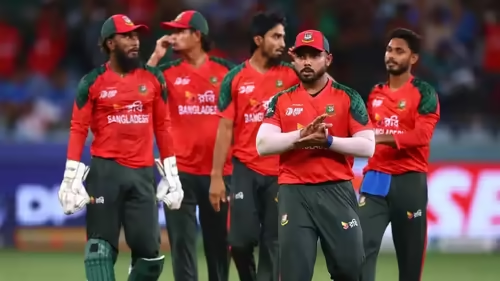
In a move that has sent shockwaves through the cricketing world, Bangladesh is teetering on the edge of a historic decision: to pull out of the upcoming T20 World Cup. This isn’t just a matter of sporting pride or a simple scheduling conflict. It’s a high-stakes gamble that could financially cripple the Bangladesh Cricket Board (BCB) and leave its players stranded on the sidelines of the sport’s biggest global stage. At the heart of this storm is a complex mix of security fears, national prestige, and a staggering potential financial hit that could reshape the future of cricket in the nation.
Table of Contents
- The Stakes of a T20 World Cup Boycott
- Why Bangladesh is Considering the Unthinkable
- The $27 Million Question: BCB’s Financial Exposure
- What This Means for the Players and Future Tours
- Conclusion: A Perilous Crossroads for Bangladeshi Cricket
- Sources
The Stakes of a T20 World Cup Boycott
A T20 World Cup boycott by any full-member nation is unprecedented in modern cricket history. For Bangladesh, the consequences extend far beyond a poor win-loss record. The decision, reportedly driven by BCB president Aminul Islam Bulbul, is rooted in deep-seated concerns about security protocols and what the board perceives as a slight to the nation’s dignity . While the specifics of the grievance remain a subject of intense speculation, the potential fallout is terrifyingly clear: a direct path to financial ruin for the BCB.
Why Bangladesh is Considering the Unthinkable
The official line from the BCB revolves around ‘security and national prestige.’ In a world where international travel and large-scale events carry inherent risks, every participating nation relies on the host country and the ICC to provide ironclad safety guarantees. It appears that Bangladesh feels these assurances have been inadequate or, worse, that their concerns have been dismissed . This perceived lack of respect has seemingly pushed the board to consider the nuclear option: withdrawal. It’s a stance that prioritizes principle over pragmatism, but at what cost?
The $27 Million Question: BCB’s Financial Exposure
This is where the situation turns from a political row into a full-blown financial crisis. The BCB is not a self-sustaining entity; it is critically dependent on funds from the International Cricket Council (ICC). According to BCB President Aminul Islam Bulbul himself, a staggering 55–60% of the board’s annual income flows directly from the ICC . This revenue is not a gift—it’s a share of the global game’s commercial success, earned through participation in ICC events like the World Cup.
A withdrawal from the T20 World Cup would almost certainly trigger an immediate suspension of this vital funding stream. The numbers are stark: multiple reports confirm that the BCB stands to lose close to BDT 325 crore, which translates to approximately **USD 27 million** [[1], [10]]. Another source cites a slightly lower but still devastating figure of $2.7 million just from the event itself, not accounting for the long-term ripple effects . This isn’t just a budget shortfall; it’s a financial hemorrhage that would force the BCB to slash its development programs, domestic tournaments, and player contracts overnight.
What This Means for the Players and Future Tours
While the BCB has assured its players that their match fees will be paid regardless of the World Cup outcome, this is a small consolation prize in a much larger tragedy . For athletes like Shakib Al Hasan and Mushfiqur Rahim, the T20 World Cup is more than just a tournament; it’s a global platform to showcase their talent, attract lucrative league contracts, and cement their legacies. By missing out, they lose invaluable exposure and experience against the world’s best.
Furthermore, the financial instability caused by the T20 World Cup boycott could have a chilling effect on future bilateral series. Other cricket boards may become hesitant to tour a nation whose own board is in financial freefall, fearing their own tours might not be commercially viable or logistically secure. This could lead to a vicious cycle of isolation and decline for Bangladeshi cricket. [INTERNAL_LINK:impact-of-icc-funding-on-associate-nations] highlights how central this funding is to the entire ecosystem of the sport.
Conclusion: A Perilous Crossroads for Bangladeshi Cricket
Bangladesh now finds itself at a perilous crossroads. On one path lies a principled stand, a defiant assertion of its national security and dignity on the world stage. On the other lies the pragmatic reality of its financial dependence on the very system it’s threatening to defy. The $27 million question is not just about money; it’s about the future of a generation of cricketers and the health of the sport in a passionate cricketing nation. The BCB’s next move will be watched closely by every stakeholder in the game, as it could set a precedent that reverberates through international cricket for years to come.
Sources
- Times of India: T20 WC row: Bangladesh stare at major financial hit
- Web Search Results: Various Indian news agencies (PTI, etc.) reporting on BCB’s financial exposure and statements from Aminul Islam Bulbul [[1], [2], [3], [4], [5], [6], [7], [8], [9], [10]].
- International Cricket Council (ICC): Official Website