She was just four years old. She couldn’t write the numbers 1 to 50. And for that ‘failure,’ she was beaten to death with a rolling pin and slammed onto the floor by the very person who was supposed to protect her—her father.
The name of the victim hasn’t been officially released, but her story has already echoed across India, sparking outrage, grief, and a painful reckoning about parental expectations, toxic discipline, and the silent epidemic of child abuse death in our homes. In Faridabad, a city just outside Delhi, what began as a routine homework session ended in unspeakable horror—and a national wake-up call.
Table of Contents
- The Faridabad Tragedy: What Happened?
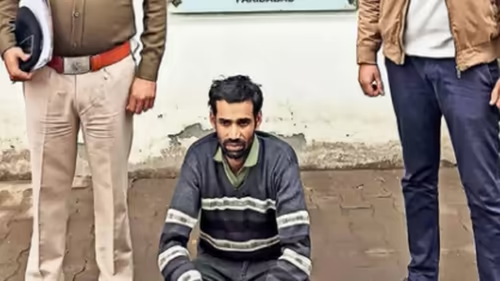
- The Suspect: Krishna Jaiswal and His False Story
- Why This Case Exposes a Deeper Crisis
Academic Pressure and Parental Violence - India’s Child Protection System: Is It Working?
- What Needs to Change Now
- Conclusion: Her Name May Be Unknown, But Her Impact Must Not Be
The Faridabad Tragedy: What Happened?
According to police reports, on January 22, 2026, Krishna Jaiswal, a 32-year-old resident of Faridabad’s Sector 29, became enraged when his daughter struggled to write numbers from 1 to 50—a task far beyond the cognitive ability of most four-year-olds. Witnesses reported hearing screams from the apartment.
Jaiswal allegedly grabbed a metal rolling pin—a common kitchen tool—and struck the child repeatedly before slamming her head against the floor. The injuries were so severe that she collapsed immediately. She was rushed to a nearby hospital but was declared dead on arrival .
This wasn’t a momentary lapse. This was sustained, brutal violence disguised as “discipline.” And it culminated in a preventable child abuse death that should never have happened.
The Suspect: Krishna Jaiswal and His False Story
In a chilling attempt to cover up the crime, Jaiswal initially told neighbors and hospital staff that his daughter had “fallen” while playing. He claimed she hit her head on the floor accidentally. But medical professionals noticed multiple blunt-force trauma marks inconsistent with a simple fall.
When confronted with autopsy findings—skull fractures, internal bleeding, and defensive wounds on her arms—Jaiswal confessed during police interrogation. He admitted to losing his temper over her “inability to learn.” He has since been arrested under Section 302 (murder) and Section 8 of the POCSO Act (punishment for penetrative sexual assault is not applicable here, but the case falls under aggravated assault on a child) .
Why This Case Exposes a Deeper Crisis
While this incident is extreme, it is not isolated. According to the National Crime Records Bureau (NCRB), over 176,000 cases of crimes against children were reported in India in 2023 alone—with cruelty by parents or guardians accounting for a significant portion .
What makes the Faridabad case especially alarming is the motive: academic performance. In a society that increasingly equates a child’s worth with grades, report cards, and early literacy, emotional and physical abuse often masquerades as “motivation” or “strict parenting.”
[INTERNAL_LINK:child-mental-health-in-india] Experts warn that such pressure can lead to anxiety, depression, and in tragic cases like this, fatal violence.
Academic Pressure and Parental Violence
Expecting a 4.5-year-old to write numbers up to 50 is developmentally inappropriate. According to guidelines from the National Council of Educational Research and Training (NCERT), children at this age are still mastering basic motor skills and number recognition—not fluent writing.
Yet, many parents, influenced by competitive schooling and social comparison, push toddlers into academic drills. When children inevitably struggle, frustration turns to anger—and sometimes, to violence.
Dr. Anjali Chhabria, a Mumbai-based child psychologist, explains: “Using physical punishment to enforce learning doesn’t teach—it traumatizes. The brain under fear cannot absorb information; it only learns to fear the teacher… even if that teacher is a parent” .
India’s Child Protection System: Is It Working?
India has strong legal frameworks—the Juvenile Justice Act, POCSO, and the Right to Education Act—all designed to safeguard children. But implementation remains patchy.
Key gaps include:
- Lack of mandatory reporting by teachers and doctors in non-obvious abuse cases
- Understaffed Child Welfare Committees (CWCs) in urban and rural areas
- Social stigma that discourages neighbors from intervening in “family matters”
- Minimal public awareness about early signs of abuse
The Faridabad case might have been prevented if someone—teacher, relative, neighbor—had noticed prior signs of distress or excessive punishment and reported it.
What Needs to Change Now
Justice for this little girl means more than punishing one man. It demands systemic reform:
- Mandatory parenting education: Integrate positive discipline workshops into Anganwadi and school enrollment processes.
- Teacher training: Equip educators to spot signs of abuse and understand child development milestones.
- Public awareness campaigns: Use media to challenge the myth that “beating = caring.”
- Strengthen helplines: Promote Childline (1098) and ensure rapid response to reports.
As the UNICEF India office has long advocated, preventing child abuse starts with changing societal attitudes—not just enforcing laws .
Conclusion: Her Name May Be Unknown, But Her Impact Must Not Be
We may never know this child’s name. But her story must become a catalyst. Every parent, teacher, and citizen must ask: Are we creating a world where a child is punished for not knowing numbers—or loved for simply being?
The Faridabad child abuse death is not just a crime. It’s a mirror. And what we see in it should compel us to act—before another innocent life is lost to misplaced anger and impossible expectations.
Sources
- Times of India. “‘Failed to write 1 to 50’: Father beats child to death with rolling pin in Faridabad.” timesofindia.indiatimes.com
- Press Trust of India (PTI). “Faridabad Police Arrest Father in 4-Year-Old’s Murder Case.” January 2026
- Ministry of Women and Child Development. “POCSO Act, 2012 Guidelines.” wcd.nic.in
- National Crime Records Bureau (NCRB). “Crime in India 2023 Report.” ncrb.gov.in
- NCERT. “National Curriculum Framework for Foundational Stage (2022).” ncert.nic.in
- Chhabria, Dr. Anjali. Personal communication on child development and trauma. January 2026
- UNICEF India. “Ending Violence Against Children.” unicef.org/india