The political landscape in Dhaka is shifting seismically, and New Delhi is watching with bated breath. At the heart of this tension is the upcoming Bangladesh election 2026, scheduled for February 12th, which isn’t just about who will govern Bangladesh—it’s about the very ideological direction of the nation and its critical relationship with India.
Following the dramatic fall of Sheikh Hasina’s long-standing government, a power vacuum has emerged, and into this void are stepping forces long suppressed: the Islamist parties, most notably Jamaat-e-Islami. This development, coupled with active US diplomatic engagement, has sparked a fierce debate: Is Washington tacitly or actively backing these groups to counterbalance other powers, and what does this mean for India’s strategic interests?
Table of Contents
- Bangladesh Election 2026: The New Players
- The US Role: Strategy or Misinterpretation?
- Why India Should Be Concerned
- Possible Scenarios for the Region
- Conclusion: Navigating an Uncertain Future
- Sources
Bangladesh Election 2026: The New Players
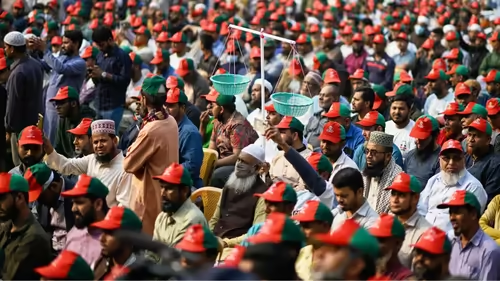
The defining feature of the Bangladesh election 2026 is the return of Islamist parties to the mainstream political arena. After years of being banned and its leaders imprisoned under the previous regime, Jamaat-e-Islami has not only been unbanned but is now a central player in the political game. The party, led by Dr. Shafiqur Rahman, has formed a powerful 11-party electoral alliance and has already finalized seat-sharing agreements for 253 constituencies .
This is a stark reversal from the past, where the Awami League government had systematically marginalized these groups. The current interim government’s decision to lift the ban has “intensified fears of an Islamist shift” within the country . Their recent policy summit in Dhaka laid out a clear vision for their return to formal politics, signaling their intent to be a major force .
Analysts warn that “political Islam could fill Bangladesh’s power vacuum,” a scenario that would have “profound impacts for the future of Bangladesh’s democracy, governance and societal values” . With the major secular party, the Awami League, effectively barred from a fair contest, the stage is set for a significant ideological realignment.
The US Role: Strategy or Misinterpretation?
The United States has been highly active in its diplomacy with Bangladesh in the lead-up to the polls. In early January 2026, Bangladesh’s National Security Adviser, Dr. Khalilur Rahman, held high-level meetings at the US State Department to discuss the elections, trade, and the Rohingya crisis . The US has publicly stated its support for a “democratic transition” in Bangladesh .
However, the US stance is more nuanced than simple backing. The new US Ambassador to Bangladesh, Brent T. Christensen, has explicitly stated that “the US doesn’t take sides in Bangladesh elections” . This position appears to be a continuation of the US view that the previous elections extending Hasina’s rule were “not credible” . Therefore, the US engagement seems aimed at ensuring a free and fair electoral process rather than endorsing any specific ideology.
Yet, from a geopolitical perspective, the US may see a pluralistic, even Islamist-inclusive, Bangladesh as a counterweight to China’s growing influence in the region. This perceived strategic calculus, whether accurate or not, is what fuels the anxiety in both Dhaka’s secular circles and in New Delhi.
Why India Should Be Concerned
For India, the stakes couldn’t be higher. A Bangladesh dominated by parties like Jamaat-e-Islami represents a direct threat to its core interests for several reasons:
- Historical Antagonism: Jamaat-e-Islami has a well-documented history of opposing Bangladesh’s independence in 1971 and has been accused of war crimes. Its leadership has often espoused anti-India rhetoric .
- Security Threats: A friendly government in Dhaka has been crucial for India’s efforts to combat cross-border terrorism and insurgency in its northeastern states. An Islamist-led government could be less cooperative on these critical security issues.
- Economic & Strategic Partnership: The “Golden Era” of Bangladesh-India ties under Hasina saw unprecedented cooperation on infrastructure, trade, and defense. The demise of her government has already “led to a deterioration in relations between Dhaka and New Delhi” , and a further slide could jeopardize billions in joint projects and strategic alignment.
Possible Scenarios for the Region
As the February 12th vote approaches, three main scenarios are emerging:
- A Secular Coalition Victory: A broad coalition of remaining secular and centrist parties manages to unite and win, keeping the Islamists at bay. This is India’s preferred outcome but seems increasingly unlikely given the fragmented opposition.
- An Islamist-Led Government: The Jamaat-led alliance secures enough seats to form a government or become the dominant partner in a coalition. This would mark a tectonic shift in South Asian geopolitics and trigger a major reassessment of India’s Bangladesh policy.
- Prolonged Instability: The election results in a hung parliament or widespread unrest, leading to a prolonged period of political uncertainty. This scenario, while avoiding an outright Islamist victory, would still be detrimental to regional stability and economic growth.
The election will also serve as a test of whether “democratic recovery is possible during a time of political turbulence” in Bangladesh .
Conclusion: Navigating an Uncertain Future
The narrative that the US is directly “backing” Islamists in the Bangladesh election 2026 is likely an oversimplification of a complex diplomatic dance. Washington’s primary goal appears to be a credible democratic process, not the promotion of a specific religious ideology. However, the unintended consequence of its pressure on the previous regime has been to create the space for these very forces to flourish.
For India, the challenge is immense. It must navigate this new reality without appearing to interfere in Bangladesh’s internal affairs, while simultaneously protecting its vital national security and economic interests. The next few weeks will be critical in determining the future of one of India’s most important bilateral relationships and the broader stability of South Asia. One thing is certain: the status quo is gone, and a new, uncertain chapter for the region is about to begin.
Sources
- Political Islam could fill Bangladesh’s power vacuum, April 7, 2025.
- Bangladesh After Hasina: Political Upheaval, Shifting Alliances, March 5, 2025.
- Islamist Resurgence and India’s Strategic Dilemma.
- After the “Golden Era”: Getting Bangladesh-India Ties Back on Track, December 23, 2025.
- Bangladesh, US discuss elections, trade and Rohingya crisis, January 10, 2026.
- US to support Bangladesh’s democratic transition, January 10, 2026.
- US doesn’t take sides in Bangladesh elections, January 21, 2026.
- The US and UK say Bangladesh’s elections extending Hasina’s rule were not credible, January 8, 2024.
- Jamaat-led alliance finalizes seat sharing in 253 constituencies, January 15, 2026.
- The Bangladesh Jamaat-e-Islami’s Policy Summit 2026, January 20, 2026.
- Bangladesh at a Crossroads: Democracy, Growth, and Geopolitics, 2026.