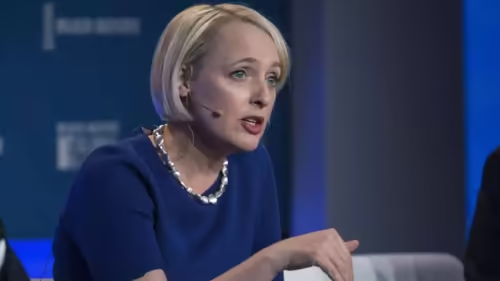
In a world drowning in AI hype, one voice cuts through the noise with a simple, brutal truth. Accenture CEO Julie Sweet isn’t just talking about the potential of artificial intelligence; she’s issuing a direct challenge to every CEO on the planet.
Her message? “In three years, you should be able to say that my company has…” become an AI-powered enterprise from the ground up . And if you can’t? Well, your leadership may be called into question.
This isn’t a vague prediction. It’s a call to action rooted in a hard-won lesson: AI leadership must be personal, hands-on, and start with the person in the corner office. Forget delegating this to the CTO or the innovation team. The buck stops with the CEO.
Table of Contents
- The Three-Year AI Ultimatum
- Why CEO-Led AI Adoption Is Non-Negotiable
- The Accenture Blueprint for Successful AI Leadership
- Practical Steps for CEOs to Become AI-First Leaders
- Conclusion: The Future Belongs to the AI Reinventor
- Sources
The Three-Year AI Ultimatum
Sweet’s vision is clear and uncompromising. She believes that in the near future, a company’s success will be directly tied to its ability to weave AI into its very fabric—not as a side project, but as its core operating system. This isn’t about having a few chatbots on the website or using AI for basic analytics. It’s about a fundamental reinvention of how work gets done, how value is created, and how decisions are made .
To drive this point home, she cites a powerful real-world example. A major client was struggling to make any meaningful progress with its AI initiatives. The solution? A radical mandate: all 300 of its top leaders were required to personally use AI tools in their daily workflows before any broader rollout could proceed . The result was transformative. Once the leaders understood the technology’s capabilities and limitations firsthand, they became its most effective champions, driving adoption and innovation throughout their teams.
Why CEO-Led AI Adoption Is Non-Negotiable
Why is this top-down approach so critical? The answer lies in the nature of transformation itself. AI isn’t just a new piece of software; it’s a catalyst for massive organizational change. And change of this magnitude requires unwavering commitment from the very top.
When a CEO leads by example, several crucial things happen:
- It signals strategic priority. When the CEO is actively engaged, it tells the entire organization that this is not a fad but a central pillar of the company’s future.
- It breaks down silos. A CEO’s mandate ensures that IT, HR, finance, operations, and marketing are all aligned toward the same AI goals, creating a unified front .
- It builds trust and reduces fear. Employees are more likely to embrace new technology if they see their leaders not just endorsing it, but actively using it and learning from it.
- It accelerates learning. Leaders who get their hands dirty gain practical insights that inform better strategy and investment decisions, moving the company beyond isolated experiments to full-scale value creation .
The Accenture Blueprint for Successful AI Leadership
Under Sweet’s guidance, Accenture has built its own formidable AI engine, recently acquiring companies like Faculty to scale its capabilities . But their internal strategy mirrors the advice she gives to clients. It’s a philosophy centered on human-centric AI, where the technology is a tool to amplify human potential, not replace it .
For Sweet, great leaders use AI to “expand what’s possible” for their people and their customers . This means focusing on outcomes like building more trust, fostering greater innovation, and creating new opportunities. It’s a vision that goes far beyond mere cost-cutting or efficiency gains.
This approach is backed by a massive investment in learning. Accenture spends over a billion dollars annually on leadership development, with a heavy emphasis on continuous learning and adaptation—a trait Sweet herself values highly, even asking new hires what they’ve learned in the past six months [[9], [8]]. In the age of AI, the ability to learn is the ultimate competitive advantage.
The Mindset of an AI Reinventor
Sweet often describes the ideal leader as a “reinventor” . This mindset requires a blend of clarity, humility, and the courage to challenge established ways of working . It’s about being confident enough to lead through uncertainty while remaining humble enough to learn from failures and from the teams on the front lines.
Practical Steps for CEOs to Become AI-First Leaders
So, what can a CEO do today to meet Sweet’s three-year challenge? Here’s a practical roadmap:
- Get Your Hands Dirty. Don’t just read reports. Use AI tools yourself. Experiment with them for your own tasks—drafting emails, analyzing market data, summarizing reports. Personal experience is irreplaceable.
- Mandate Leader-Led Training. Follow the client example. Require your entire executive team and senior leaders to undergo immersive, hands-on AI training. Their buy-in is your biggest asset.
- Focus on Value, Not Just Tech. Shift the conversation from “What AI can we use?” to “What business problems can AI solve for our customers and our employees?” Connect every initiative to a clear value stream.
- Build a Culture of Experimentation. Give your teams the confidence, resources, and freedom to experiment with AI, but pair it with a commitment to making hard investments in the ideas that prove their worth .
- Communicate Relentlessly. Be the chief storyteller for your AI journey. Share your own learnings, celebrate wins (big and small), and address fears openly and honestly.
For more on building a future-proof digital strategy, see our guide on [INTERNAL_LINK:building-a-digital-first-culture].
Conclusion: The Future Belongs to the AI Reinventor
Julie Sweet’s three-year ultimatum is not a threat; it’s a gift. It’s a clear, actionable benchmark for what success looks like in the new era of business. The companies that will thrive are not those with the most advanced algorithms, but those with the most committed, hands-on, and adaptive leaders.
The path to becoming an AI-first company is paved with learning, experimentation, and a willingness to be personally transformed. As Sweet’s own journey from lawyer to tech CEO shows, reinvention is possible for anyone willing to lead from the front . The clock is ticking. In three years, what will you be able to say about your company?
Sources
- Times of India: Accenture CEO Julie Sweet to CEOs: ‘In three years, you should be able to say…’
- Fortune: Accenture CEO Julie Sweet: ‘Every leader needs to think of themselves as a reinventor’
- Forbes: Why CEOs Must Lead AI Adoption
- Accenture Newsroom: Accenture to Acquire Faculty to Scale AI Capabilities