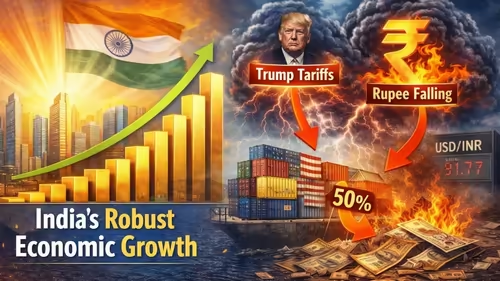
India’s much-celebrated growth story is sailing into choppy waters. Just as the economy shows signs of robust recovery—with GDP expanding at over 7%—a perfect storm of external threats is brewing on the horizon. Former U.S. President Donald Trump is once again wielding the tariff stick, geopolitical tensions are flaring, and the Indian rupee is slipping against the dollar. In this high-stakes environment, Finance Minister Nirmala Sitharaman’s India Budget 2026 isn’t just another fiscal exercise—it’s a strategic shield that must defend the nation’s economic momentum. But can it? Leading economists are divided, and the stakes couldn’t be higher .
Table of Contents
- The Triple Threat Facing India’s Economy
- Why India Budget 2026 Is a Pivotal Moment
- What Economists Say About Key Risks
- Budget Tools to Counter External Shocks
- Beyond the Numbers: A Strategic Vision for Resilience
The Triple Threat Facing India’s Economy
Three major external risks are converging to test India’s economic resilience:
- Trump Tariff Threats: With U.S. elections heating up, Donald Trump has floated the idea of imposing 60%+ tariffs on Chinese goods—and potentially extending them to other nations benefiting from China+1 supply chain shifts, including India . This could severely impact Indian exports in electronics, textiles, and pharmaceuticals.
- Falling Rupee: The rupee has been under consistent pressure, hovering near record lows. A weaker currency makes imports like crude oil and electronics more expensive, fueling inflation and widening the current account deficit.
- Stalled India-U.S. Trade Deal: Despite years of negotiations, a comprehensive bilateral trade agreement remains elusive. Without it, Indian exporters lack preferential access and remain vulnerable to sudden U.S. policy shifts .
These aren’t isolated issues—they feed into each other, creating a feedback loop of uncertainty that can deter investment and slow growth.
Why India Budget 2026 Is a Pivotal Moment
The India Budget 2026 arrives at a crossroads. On one hand, India is the world’s fastest-growing major economy, with strong domestic demand and a young workforce. On the other, global headwinds threaten to derail this momentum. The Budget must therefore do more than balance books—it must signal confidence, boost manufacturing resilience, and insulate the economy from external shocks. As one senior economist put it, “This isn’t just a budget; it’s a geopolitical statement” .
What Economists Say About Key Risks
We spoke to leading voices to unpack the biggest vulnerabilities:
- Dr. Raghuram Rajan (Former RBI Governor): “The biggest risk isn’t tariffs alone—it’s the uncertainty they create. Businesses delay investment when they can’t forecast trade rules. The Budget must prioritize predictability.”
- Dr. Surjit Bhalla (Economist & Columnist): “A falling rupee isn’t inherently bad if it boosts exports. But without export competitiveness—due to logistics costs and skill gaps—it only hurts. Budget 2026 must fix fundamentals, not just offer subsidies.”
- Ms. Sonal Varma (Nomura): “Geopolitical realignments mean India can’t rely on old trade patterns. The Budget should incentivize ‘friend-shoring’ and deepen ties with the EU, UAE, and ASEAN—not just wait for a U.S. deal.”
The consensus? Reactive measures won’t suffice. The India Budget 2026 needs a proactive, long-term architecture for economic security.
Budget Tools to Counter External Shocks
Finance Minister Sitharaman has several levers at her disposal:
- Boost PLI Schemes: Expand Production-Linked Incentives to sectors like semiconductors, medical devices, and green tech to reduce import dependence.
- Strengthen Forex Reserves: Use prudent fiscal management to support RBI’s ability to stabilize the rupee without depleting reserves.
- Tax Rationalization: Simplify GST and reduce corporate tax anomalies to improve ease of doing business and attract FDI.
- Invest in Infrastructure: Accelerate spending on ports, roads, and digital infrastructure to cut logistics costs—a key barrier to export competitiveness.
For authoritative data on global trade trends, refer to the World Trade Organization (WTO) Statistics Portal.
Beyond the Numbers: A Strategic Vision for Resilience
Ultimately, the success of the India Budget 2026 won’t be measured just by fiscal deficit targets or GDP projections. It will be judged by whether it builds an economy that can withstand the next Trump tweet, the next oil shock, or the next global recession. This means embedding flexibility, innovation, and self-reliance into the core of India’s economic model. It also means recognizing that in today’s world, economic policy is inseparable from foreign policy. A strong Budget can’t just spend wisely—it must position India as an indispensable, reliable partner in a fragmented global order. For deeper insights into India’s economic strategy, see our analysis on [INTERNAL_LINK:india-economic-resilience-post-pandemic].
Key Risks & Potential Budget Responses
| Risk | Potential Budget Response |
|---|---|
| Trump Tariffs | Expand export subsidies, diversify trade partners |
| Falling Rupee | Boost forex reserves, curb non-essential imports |
| Trade Deal Uncertainty | Accelerate FTAs with EU, UK, GCC |
| Global Slowdown | Increase capex in infrastructure & green energy |
Conclusion
The India Budget 2026 stands at the intersection of opportunity and vulnerability. While external risks like Trump tariffs and rupee volatility are real, they also present a chance for India to double down on its structural reforms and emerge stronger. The Finance Minister’s challenge is clear: craft a budget that doesn’t just react to crises but preempts them. If done right, India’s growth story won’t just survive the storm—it will sail through it with even greater confidence.
Sources
- Times of India: Trump tariffs, falling rupee: Key risks to India’s growth story; can the Budget protect it?
- World Trade Organization (WTO): Trade Statistics
- Reserve Bank of India (RBI) Reports