Table of Contents
- A Tournament in Turmoil
- The Venue Dispute: Why Bangladesh Said No
- The ICC Ultimatum and the Path to Replacement
- Why Scotland is the Frontrunner
- Historical Precedent: Has This Happened Before?
- What This Means for the T20 World Cup 2026
- Conclusion: A Defining Moment for Cricket Governance
- Sources
A Tournament in Turmoil
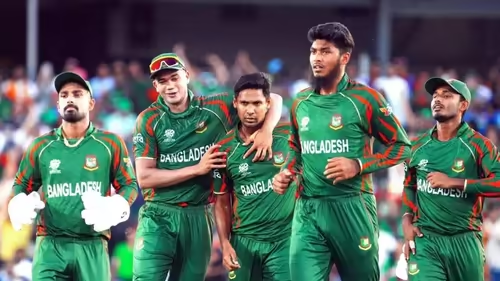
The build-up to the T20 World Cup 2026 has been thrown into chaos. In an unprecedented move, the Bangladesh Cricket Board (BCB) has officially refused to send its national team to play their matches in India, citing a lack of justice from the International Cricket Council (ICC) . This bold stance has triggered a chain reaction, with the ICC issuing a stark 24-hour ultimatum and identifying Scotland as the most likely replacement . This isn’t just a scheduling hiccup; it’s a full-blown diplomatic and sporting crisis that threatens the integrity of one of cricket’s biggest events.
The Venue Dispute: Why Bangladesh Said No
The core of this conflict lies in a simple, yet highly sensitive, request. The BCB had formally asked the ICC to shift Bangladesh’s group stage matches away from India, expressing concerns over security and fairness . However, the ICC firmly rejected this plea. In their official response, the global governing body stated there was an “absence of any credible security threat” to justify such a move . This rejection was perceived by Bangladeshi officials as a profound injustice, leading them to dig in their heels and declare they would not participate under these conditions .
The ICC Ultimatum and the Path to Replacement
Faced with a potential no-show from a full member nation, the ICC acted swiftly and decisively. They issued a 24-hour ultimatum to the BCB, demanding a final confirmation of their participation in the T20 World Cup 2026 or face immediate replacement . This wasn’t an empty threat. The ICC Board had already held a meeting where a majority voted in favor of a contingency plan to bring in a replacement team should Bangladesh refuse to budge . With the deadline looming, all signs point to the ICC executing this plan, effectively sidelining Bangladesh from the tournament they had qualified for.
Why Scotland is the Frontrunner
So, why Scotland? The choice is based on a clear, objective criterion: the ICC’s official T20I team rankings. Scotland, led by Richie Berrington, was the highest-ranked team that failed to qualify for the main event through the regular channels . This makes them the logical and fair successor to fill the vacant spot in Group C . While they may have missed out on qualification, their consistent performance in the Associate circuit has positioned them perfectly for this unexpected opportunity. Their potential inclusion would be a historic moment for Scottish cricket, granting them a place on the sport’s grandest T20 stage.
Historical Precedent: Has This Happened Before?
While rare, this isn’t the first time an ICC event has seen a last-minute team replacement. The most notable precedent occurred during the 2016 ICC Under-19 World Cup in Bangladesh. On that occasion, Australia withdrew from the tournament and were subsequently replaced by Ireland . However, the current situation is far more complex and high-stakes, involving a senior men’s World Cup and a full member nation making a political stand against the host country and the sport’s governing body. The scale and implications of the T20 World Cup 2026 crisis are unmatched in recent cricket history.
What This Means for the T20 World Cup 2026
The ripple effects of this decision will be felt across the tournament. For fans, it means a major team they expected to see will be absent, replaced by a plucky underdog. For the commercial partners and broadcasters, it’s a significant disruption to their planning and marketing strategies. Most importantly, it raises serious questions about the ICC’s ability to manage geopolitical tensions and ensure a level playing field for all its members. The handling of this crisis will be a critical test of the organization’s leadership and its commitment to the spirit of the game. It also sets a dangerous precedent where political disputes can directly interfere with sporting competition at the highest level.
Conclusion: A Defining Moment for Cricket Governance
The standoff between the BCB and the ICC over the T20 World Cup 2026 is more than just a logistical problem. It’s a defining moment that exposes the fragile intersection of sport, politics, and international governance. As Scotland stands ready to potentially take the field in Bangladesh’s place, the cricketing world watches with bated breath. The outcome will not only shape the tournament itself but could also redefine the relationship between the ICC and its member nations for years to come. One thing is certain: the drama surrounding this World Cup has already begun, long before the first ball is bowled.
Sources
- Times of India: “T20 WC: The last time a replacement team played in an ICC event, Bangladesh was involved”
- Various news reports on the BCB’s refusal and the ICC’s ultimatum [[1], [2], [3], [5], [6], [7], [8], [10], [11], [13], [15]]
- Reports on Scotland as the replacement team [[4], [12], [14]]
- Historical context on ICC replacements
- ICC Official Website: Information on T20I Team Rankings and tournament regulations