Introduction: A Political Firestorm Over Trade and Jobs
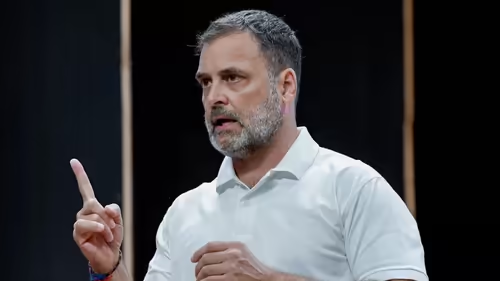
The political temperature in India has just spiked. Congress leader Rahul Gandhi has reignited a fierce debate by once again labeling the Indian economy as “dead,” this time directly linking the crisis to the Modi government’s handling of a major international trade dispute. The catalyst? A punishing 50% tariff imposed by the United States on key Indian exports, particularly textiles—a sector that is a lifeline for millions of workers and small businesses across the country .
Gandhi’s message is clear and direct: “Modi ji, you are accountable.” He argues that the Prime Minister’s silence and inaction in the face of this economic assault have left a crucial industry hanging by a thread . This isn’t just a political jab; it’s a claim with serious economic and social consequences. So, what’s the real story behind these tariffs, and is the “dead economy” label justified?
Table of Contents
- The US Tariff Bomb: What Happened?
- Rahul Gandhi’s ‘Dead Economy’ Charge and Its Context
- Impact on India’s Textile Heartland
- The Modi Government’s Response (or Lack Thereof)
- What’s Next for India-US Trade?
- Conclusion: Is the Economy Really ‘Dead’?
- Sources
The US Tariff Bomb: What Happened?
In a move that sent shockwaves through India’s export sector, the United States implemented a significant hike in import tariffs on a range of Indian goods, effective from August 27, 2025 . The most severe impact was felt by the textile and apparel industry, which now faces a staggering 50% duty on its products entering the US market .
This wasn’t a minor policy adjustment. For an industry already grappling with global competition and rising input costs, this tariff acts as a massive barrier. It effectively prices many Indian products out of one of their largest and most important markets. Reports indicate that US buyers have already begun pausing or canceling orders from Indian suppliers, creating immediate uncertainty and financial strain .
Rahul Gandhi’s ‘Dead Economy’ Charge and Its Context
Rahul Gandhi has seized on this crisis to renew his long-standing criticism of the Modi government’s economic management. He has not only called the new tariffs “economic blackmail” but has also fully endorsed former US President Donald Trump’s earlier description of the Indian economy as “dead” [[8], [24]].
On social media platform X, Gandhi posted a video with a stark message: “50 per cent US tariffs and uncertainty are badly hurting India’s textile exporters. Job losses are mounting. Mr. Modi has offered no relief or even spoken about tariffs, even though more than 4.5 crore jobs and lakhs of businesses are at stake” [[5], [10]]. His central argument is one of accountability. He contends that while the livelihoods of millions are at risk, the Prime Minister remains silent, failing to provide a clear strategy or diplomatic pushback against the US measures .
Impact on India’s Textile Heartland
The textile industry is not just another sector; it’s a cornerstone of the Indian economy. It is the second-largest employer after agriculture, supporting over 45 million people, many of whom are in the MSME (Micro, Small, and Medium Enterprises) space . The imposition of these tariffs threatens this entire ecosystem.
Industry experts warn that the 50% tariff could significantly weaken India’s position against competing sourcing hubs like Vietnam and Bangladesh, which have secured more favorable trade terms with the US . The immediate effects are already visible:
- Order Cancellations: US buyers are halting new orders, leaving Indian manufacturers with idle capacity and mounting costs .
- Job Insecurity: With reduced demand, factories are forced to cut shifts or lay off workers, directly impacting household incomes across states like Tamil Nadu, Gujarat, and Maharashtra.
- MSME Distress: Smaller units, which lack the financial buffers of larger corporations, are facing a survival crisis, with many calling for urgent government relief on domestic costs like power and raw materials .
The Modi Government’s Response (or Lack Thereof)
The BJP-led government has largely dismissed Gandhi’s “dead economy” remarks as politically motivated, often countering with data from international agencies like the IMF that project healthy GDP growth for India . However, critics argue that macro-level GDP figures can mask the deep distress in specific, employment-heavy sectors like textiles.
The core of Gandhi’s attack is the perceived absence of a strong, public, and proactive response from the Prime Minister’s Office. While official trade negotiations may be happening behind closed doors, the lack of a clear, reassuring public stance has fueled anxiety in the business community. The upcoming Budget 2026 is now seen as a critical test of the government’s intent to shield the sector from this external shock [[11], [17]].
What’s Next for India-US Trade?
Despite the current tension, there is a glimmer of hope on the horizon. Many analysts believe that a formal India-US trade deal is a distinct possibility in 2026, which could help resolve these tariff issues and stabilize the relationship . Such a deal would be crucial not just for the textile industry but for other sectors like automobiles and clean energy that have also been affected by the broader trade friction .
For now, all eyes are on New Delhi. The government’s next moves—both in its diplomatic engagement with Washington and its domestic support for the affected industries—will be pivotal in determining whether this crisis can be averted or if Gandhi’s dire warnings will prove prophetic.
Conclusion: Is the Economy Really ‘Dead’?
Labeling an entire economy as “dead” is a dramatic political statement. India’s economy, as a whole, continues to show signs of activity and growth. However, Rahul Gandhi’s renewed focus on the dead economy narrative, in the context of the US textile tariffs, highlights a critical vulnerability. It underscores how a single, targeted trade policy from a major partner can inflict severe localized damage, threatening millions of jobs and the health of a key industrial sector. Whether this constitutes a “dead” economy is debatable, but it is certainly a moment of profound crisis that demands a robust and visible response from the nation’s leadership. The government’s accountability in navigating this challenge will be a major political and economic story in the months to come.
Sources
- Times of India: ‘You are accountable’: Rahul targets PM Modi over US tariffs
- Economic Times: USA Tariff Hike to 50% Threatens India’s $10+ billion Textile Export Market
- Reuters: India pushes back after US levies doubled
- [INTERNAL_LINK:india-us-trade-relations]
- [INTERNAL_LINK:modi-government-economic-policy]