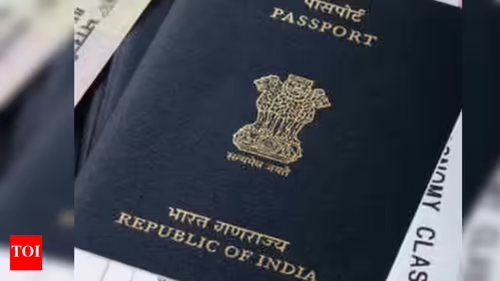
Imagine this: You apply for a passport on the same day as your friend. They’re holding their shiny new booklet in just four working days. You’re still waiting… six weeks later. This isn’t a glitch—it’s the reality of passport processing time in India.
A recent analysis has laid bare a stark and frustrating truth: where you live in India can be the single biggest factor in how quickly you get your passport. From the lightning-fast offices in Kerala and Goa to the painfully slow queues in parts of Chhattisgarh, the system is anything but uniform .
Table of Contents
- The 4-Day vs. 40-Day Reality
- Why Kerala and Goa Lead the Pack
- The Bottleneck in Raipur and Other Slow Zones
- The Hidden Culprit: Police Verification
- How to Navigate the System Smarter
- Conclusion: A Call for Standardization
- Sources
The 4-Day vs. 40-Day Reality
The data is jarring. In states like Kerala and Goa, the average passport processing time India-wide is a mere 4 to 5 working days for Tatkal applications . This efficiency is a boon for travelers and students on tight deadlines.
Contrast that with Raipur in Chhattisgarh, where applicants have reported waiting periods stretching up to 40 days—even for urgent Tatkal requests . That’s a tenfold difference based purely on geography. Even within the same state, disparities are common; for instance, Mumbai processes passports in about 10 days, while Nagpur takes over 22 .
Why Kerala and Goa Lead the Pack
So, what’s the secret sauce in Kerala and Goa? It’s a combination of factors:
- Streamlined Workflows: These regional passport offices have invested in efficient internal processes and digital record-keeping.
- Proactive Staffing: They often have adequate staffing levels to handle application volumes without massive backlogs.
- Strong Coordination: There’s typically better coordination between the Passport Seva Kendra (PSK) and local police verification units, which is a critical link in the chain .
The Bottleneck in Raipur and Other Slow Zones
In slower regions, the problem is often systemic. Offices may be understaffed, overwhelmed by application volume, or hampered by outdated infrastructure. The most significant drag, however, comes from a stage that’s outside the direct control of the passport office itself: the police verification process.
The Hidden Culprit: Police Verification
While the passport office might be ready to print your document in a week, the entire process remains on hold until the local police station submits a clear verification report. This stage is notorious for its unpredictability.
In well-oiled systems like those in South India, police verification can be completed in a matter of days. But in other areas, it can take weeks due to manpower shortages, administrative delays, or even simple miscommunication. Since the standard passport processing time India guidelines include this step, it becomes the primary reason for the massive 30-45 day window cited nationally [[4], [5]].
How to Navigate the System Smarter
If you’re not in a fast-track zone, don’t despair. Here are some practical tips to potentially speed up your journey:
- Choose Tatkal Wisely: If you have a genuine emergency, the Tatkal service is your best bet, though it comes at a higher fee and requires valid proof.
- Pre-Police Verification: Some PSKs offer the option for pre-police verification. If you can arrange this before your appointment, it can shave off significant time.
- Double-Check Your Documents: Any error or missing document will immediately send your application back to square one, adding weeks to your wait.
- Follow Up Politely: Use the official Passport Seva portal to track your status and don’t hesitate to make a polite inquiry if your application seems stuck in the verification stage for an unusually long time.
Conclusion: A Call for Standardization
The current state of passport processing time in India is a tale of two countries. For some, it’s a model of efficiency; for others, it’s a test of patience. While individual strategies can help, the real solution lies in a nationwide push for standardization. The government’s efforts to modernize the system, including the planned rollout of biometric e-passports, are promising steps . However, until the police verification process and regional office capacities are brought onto a level playing field, the 4-day vs. 40-day gap will remain a frustrating reality for millions of citizens.
Sources
- Times of India: “In 4 or 40 days: Location decides how fast your passport arrives” [[6], [7]]
- Passport Seva Official Portal Guidelines [[4], [5]]
- Government of India Press Release on e-Passport Rollout
- [INTERNAL_LINK:indian-passport-application-guide]
- [INTERNAL_LINK:travel-documents-for-indians]