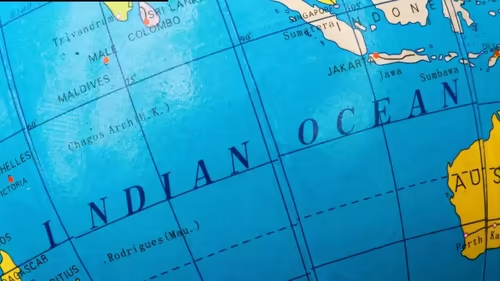
Imagine a spot on our planet where gravity is so weak that the ocean itself is pulled down by a staggering 106 meters (348 feet) compared to the global average. It’s not science fiction—it’s a very real and massive feature lurking in the Indian Ocean, officially known as the Indian Ocean Geoid Low (IOGL). Often dubbed the world’s largest and deepest “gravity hole,” this mysterious anomaly has baffled scientists for over 75 years .
For decades, this gravitational dip was a ghost in the data, a prominent blip on geophysical maps with no clear origin story. But recent, cutting-edge research is now pulling back the curtain on this deep-Earth mystery, revealing a dramatic tale of ancient oceans, tectonic collisions, and plumes of hot rock from the planet’s core. Let’s dive into what we know.
Table of Contents
- What is the Indian Ocean Geoid Low?
- How Big and Deep is This Gravity Hole?
- The 75-Year Mystery: What Causes the Indian Ocean Gravity Hole?
- Why Does This Gravity Anomaly Matter to Us?
- Conclusion: The Ghost of an Ancient Ocean
- Sources
What is the Indian Ocean Geoid Low?
To understand the Indian Ocean gravity hole, we first need to grasp what a “geoid” is. Think of the geoid as an imaginary map of the Earth’s true gravitational shape. If the oceans were perfectly still and only influenced by gravity and the planet’s rotation, the surface of the water would form this geoid shape. It’s bumpy and uneven because gravity isn’t uniform across the globe.
Where there’s extra mass underground—like a dense mountain range or a thick chunk of the mantle—gravity is stronger, and the geoid bulges upwards. Conversely, where there’s a mass deficit—less dense material or even a void—gravity is weaker, and the geoid dips down. This dip is a “geoid low” .
The IOGL is the most extreme example of this phenomenon on Earth. It’s a vast, circular region of significantly weaker gravity located just south of the Indian peninsula .
How Big and Deep is This Gravity Hole?
The scale of the IOGL is almost incomprehensible. It’s not a small pothole; it’s a continental-scale depression in the fabric of our planet’s gravity.
- Depth: The geoid here plunges to a record low of -106 meters relative to the global average . This means the sea level is effectively 106 meters lower in this spot.
- Size: It covers a mind-boggling area of approximately 3 million square kilometers (about 1.2 million square miles) . To put that in perspective, that’s roughly the size of India itself.
- Location: It’s centered in the western Indian Ocean, about 1,200 kilometers (746 miles) southwest of the southern tip of India .
The 75-Year Mystery: What Causes the Indian Ocean Gravity Hole?
For generations, the origin of this massive gravity anomaly in Indian Ocean was one of geophysics’ greatest puzzles. A simple mass deficit wasn’t enough of an explanation; scientists needed to know *why* that mass deficit existed in the first place.
The breakthrough came from sophisticated computer models and a deeper understanding of plate tectonics. The leading theory, supported by multiple recent studies, points to a dramatic geological event from our planet’s deep past .
The Ghost of the Tethys Ocean
Roughly 140 million years ago, the Indian tectonic plate broke away from the supercontinent Gondwana and began its rapid northward journey toward Asia. On its way, it bulldozed over the ancient Tethys Ocean. As the Indian plate moved, the dense floor of the Tethys Ocean was forced down into the Earth’s mantle in a process called subduction .
However, this wasn’t the end of the story. Researchers believe that remnants of this sunken Tethys seafloor didn’t just sink quietly. Instead, they disturbed the boundary between the Earth’s upper and lower mantle, triggering a cascade of events. This disturbance caused plumes of hot, low-density magma from deep within the African Large Low Shear Velocity Province (LLSVP)—a massive structure at the core-mantle boundary—to rise up towards the surface .
These rising plumes of hot, buoyant rock are the key. Because they are less dense than the surrounding mantle, they create the exact kind of mass deficit needed to produce a negative geoid anomaly—a gravity hole . This dynamic interplay between the sinking slabs of the ancient Tethys and the rising plumes from the deep mantle is now considered the most plausible explanation for the IOGL .
Why Does This Gravity Anomaly Matter to Us?
You might be wondering, “This is all happening hundreds of kilometers underground. Why should I care?” Understanding features like the IOGL is crucial for several reasons:
- Precise Measurements: The geoid is the fundamental reference surface for measuring precise heights, from mountain peaks to sea-level rise. Ignoring its bumps and dips would make GPS and other satellite navigation systems wildly inaccurate.
- Understanding Earth’s Engine: The IOGL is a direct window into the churning, dynamic processes in the Earth’s deep interior. Studying it helps us understand how heat moves from the core, how tectonic plates interact over millions of years, and how our planet’s internal engine drives surface geology .
- Climate and Oceanography: While the effect is subtle, variations in the geoid influence ocean currents and circulation patterns over long timescales, which can have downstream effects on climate.
For those interested in our planet’s hidden mechanics, the IOGL is a prime example of how events from tens of millions of years ago continue to shape our world today. You can learn more about related geological wonders in our guide on [INTERNAL_LINK:earth-mantle-plumes].
Conclusion: The Ghost of an Ancient Ocean
The Indian Ocean gravity hole is far more than just a scientific curiosity. It’s a colossal scar on our planet’s gravitational field, a testament to the violent and majestic dance of tectonic plates over geological time. What was once a 75-year-old mystery now stands as a powerful case study in how the Earth’s surface and its deepest interior are inextricably linked. The IOGL is, quite literally, the ghost of the ancient Tethys Ocean, its final echo still pulling at the waters of the Indian Ocean today.
Sources
- Live Science: Indian Ocean gravity hole was caused by extinct ancient sea
- AGU Journals: Unravelling the crustal and upper mantle structure of the Indian Ocean Geoid Low
- Nature Geoscience: The origin of the Indian Ocean geoid low
- Times of India: The world’s largest and deepest gravity hole sits in the Indian Ocean