Table of Contents
- An Astronaut’s Eye View of Her Ancestral Home
- Sunita Williams’ India from Space: The Emotional Revelation
- The Science Behind Nighttime Earth Imagery
- Her Indian Roots and a Lifelong Connection
- Why This Moment Matters for India
- Conclusion: A Bridge Between Earth and Orbit
- Sources
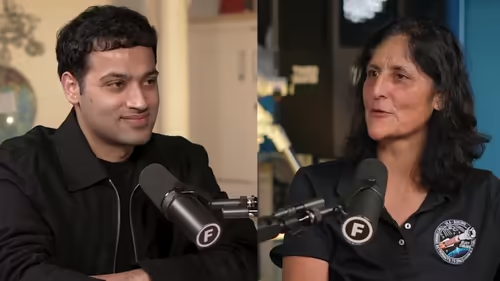
Few experiences can match the awe of seeing Earth from space—especially when that view includes the land of your ancestors. For NASA astronaut Sunita Williams, that moment came not once, but repeatedly during her missions aboard the International Space Station (ISS). In a recent, deeply moving conversation on entrepreneur Raj Shamani’s podcast, Williams offered a poetic and unforgettable description of what India looks like from orbit: “like a web of connected nerves.” This vivid metaphor has since captured the imagination of millions, blending science, emotion, and cultural pride into a single, luminous image.
An Astronaut’s Eye View of Her Ancestral Home
Born in Euclid, Ohio, to an Indian-American father of Gujarati descent and a Slovenian-American mother, Sunita Williams has always embraced her multicultural identity. But it was during her time floating 400 kilometers above Earth that her connection to India became viscerally real. As she gazed down at the subcontinent—particularly at night—she didn’t just see borders or cities. She saw life, energy, and connectivity.
“When you look at India from space at night, it’s not just dots of light,” she explained on the podcast. “It’s this intricate, glowing network—like a nervous system. You can almost feel the pulse of the people, the movement, the stories unfolding below.”
Sunita Williams India from space: The Emotional Revelation
Williams’ description goes beyond mere observation—it’s a reflection of how space travel can transform perception. From the ISS, national boundaries vanish. What remains are patterns of human activity: highways lit like synapses, cities glowing like neural clusters, and rural areas shimmering with the soft hum of community life.
Her comparison to “connected nerves” is scientifically resonant. Just as neurons transmit signals across the brain, India’s infrastructure—roads, power grids, communication networks—creates a visible web of interdependence. At night, this becomes strikingly clear:
- The Indo-Gangetic Plain lights up like a central processing unit.
- Mumbai and Delhi appear as bright hubs, radiating outward.
- Even smaller towns along national highways form delicate filaments of light.
This perspective isn’t just beautiful—it’s humbling. As Williams noted, “From up there, you don’t see religion, politics, or conflict. You just see humanity trying to connect.”
The Science Behind Nighttime Earth Imagery
NASA and other space agencies have long used nighttime satellite imagery to study urbanization, energy use, and even economic development. The famous “Black Marble” images from the Suomi NPP satellite show exactly what astronauts like Williams witness firsthand.
India’s nighttime footprint has grown dramatically over the past two decades, reflecting rapid electrification and urban expansion. According to NASA’s Earth Observatory, the country’s lit area increased by over 60% between 2012 and 2023—making it one of the fastest-growing light sources on the planet .
For more on how scientists interpret these images, explore the NASA Earth Observatory, a trusted source for satellite-based environmental insights.
Her Indian Roots and a Lifelong Connection
Williams has never shied away from her heritage. She’s visited India multiple times, spoken at schools in Gujarat, and even carried a small idol of Lord Ganesha on her space missions—a quiet tribute to her father’s roots. During her record-breaking 195-day mission in 2006–2007, she performed a zero-gravity yoga pose in honor of her Indian identity, delighting fans worldwide.
On the Raj Shamani podcast, she revealed that spotting India from orbit was a ritual for her. “I’d set alarms to make sure I was near the Cupola—the ISS’s observation window—when we passed over the subcontinent. It felt like checking in on family.”
This emotional tether underscores a powerful truth: space exploration isn’t just about technology—it’s deeply human. And for millions of Indians and Indian-Americans, Williams’ words validate a sense of belonging on a cosmic scale.
Why This Moment Matters for India
In an era where India is rapidly advancing its own space program—with missions like Chandrayaan-3 and the upcoming Gaganyaan crewed flight—Williams’ testimony serves as both inspiration and affirmation. She represents what’s possible when diaspora talent bridges cultures and continents.
Her description also counters outdated narratives of India as a “developing” nation defined by darkness or poverty. From space, India shines—not just with electricity, but with ambition, density, and dynamism. As one astrophysicist put it, “What Sunita saw wasn’t just light—it was the glow of 1.4 billion dreams.”
For readers interested in India’s space journey, see our feature on [INTERNAL_LINK:india-space-program-gaganyaan].
Conclusion: A Bridge Between Earth and Orbit
Sunita Williams’ account of seeing Sunita Williams India from space is more than a poetic anecdote—it’s a reminder of our shared fragility and interconnectedness. In comparing India to a “web of connected nerves,” she didn’t just describe geography; she captured the essence of a civilization alive with energy, resilience, and unity. As India continues its ascent in space and science, her words stand as a beacon: no matter how far we go, we never lose sight of home.
Sources
- Times of India: “Sunita Williams describes seeing India from space as connected nerves on Raj Shamani’s podcast” (January 2026)
- NASA Earth Observatory – “Night Lights and Urban Growth in South Asia”
- Raj Shamani Podcast Episode featuring Sunita Williams (YouTube, January 2026)
- Official NASA Biography of Sunita Williams