Elon Musk’s Aging Reversal Claim: A Scientific Breakthrough or a Societal Time Bomb?
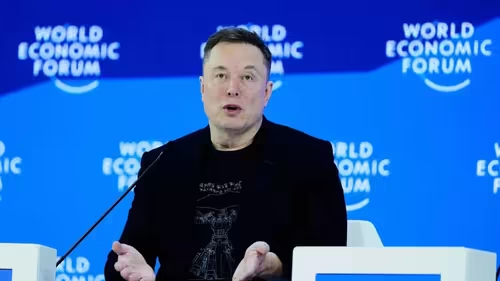
At the World Economic Forum in Davos, tech titan Elon Musk dropped a bombshell that sent ripples through the scientific and philosophical communities. He didn’t just predict longer lives; he declared that aging reversal is a “very solvable problem” and that humanity is on the cusp of cracking the code to turn back our biological clocks .
But in a twist that reveals his characteristic blend of futurism and pragmatism, Musk also conceded that death itself has its “benefits” for society. This duality—chasing immortality while acknowledging the necessity of an exit strategy—paints a complex picture of our potential future. So, what’s the real story behind Musk’s claims? Is the science there, and what would a world without aging actually look like?
Table of Contents
- Musk’s Bold Vision at Davos
- Is Aging Reversal Really a “Solvable Problem”?
- The Dark Side of Immortality: Why Death Has “Benefits”
- Tesla Optimus and the AI-Driven Future
- Conclusion: Navigating Our Longevity Future
- Sources
Musk’s Bold Vision at Davos
Making his debut at the WEF, Musk was characteristically optimistic about humanity’s technological trajectory. His core message was clear: aging isn’t an immutable law of nature but a technical challenge waiting to be solved. He stated, “I think we’ll figure out ways to extend life and maybe even reverse aging. I think that’s highly likely” .
This isn’t just idle speculation from a billionaire. Musk’s companies, from Neuralink to his investments in AI, are all pieces of a grand puzzle aimed at enhancing and extending human capability. His vision is one of a future where humans merge with AI to become a multi-planetary, effectively immortal species.
Is Aging Reversal Really a “Solvable Problem”?
Musk’s confidence seems to be backed by a growing wave of scientific momentum. In 2026, a new consensus is indeed emerging among longevity researchers that aging is less a natural process and more a biological condition that can be targeted and treated .
Breakthroughs are happening at a rapid pace:
- UK scientists have successfully reversed the biological age of human skin cells by a staggering 30 years .
- Researchers are identifying key proteins and using Yamanaka factors to reset the epigenetic clock—the very software of our cellular age [[21], [23]].
- The field of AI-driven drug discovery is accelerating the hunt for compounds that can slow or reverse age-related decline .
So, while we may not have a magic “age reversal” pill tomorrow, the foundational science is moving from the realm of science fiction into credible, peer-reviewed research. The question is no longer if we can do it, but when and how.
The Dark Side of Immortality: Why Death Has “Benefits”
This is where Musk’s statement gets truly fascinating. He didn’t just stop at the promise of eternal youth. He acknowledged a profound truth: a society where nobody dies of old age—known as a state of “negligible senescence”—comes with massive, potentially destabilizing consequences.
What are these “benefits” of death that Musk alludes to?
- Population Control: Without natural attrition, the global population would explode unless birth rates plummeted to unprecedented levels .
- Social Stagnation: New generations bring fresh ideas, perspectives, and drive for change. An immortal elite could lead to a rigid, unchanging social order.
- Economic Strain: While a larger, healthier workforce could boost the economy, it could also create immense pressure on resources, housing, and job markets for younger people .
In essence, death acts as a societal reset button, making space for innovation and preventing the accumulation of outdated power structures. It’s a stark reminder that every technological solution creates a new set of problems to solve.
Tesla Optimus and the AI-Driven Future
Musk’s comments on aging weren’t made in a vacuum. They were part of a broader narrative about the future of intelligence and labor. At the same WEF event, he reiterated Tesla’s plan to sell its humanoid Optimus robot to the public by the end of 2027 .
This is a crucial piece of the puzzle. If humans live much longer and healthier lives, the nature of work will fundamentally change. Optimus and other advanced AI agents could handle the bulk of physical and cognitive labor, freeing humans to pursue more creative or leisurely endeavors. Musk also predicted that AI models will surpass all human intelligence combined in the near future, suggesting that our biological limitations may soon be our least concern .
For more on the robotics revolution, check out our deep dive on [INTERNAL_LINK:future-of-humanoid-robots].
Conclusion: Navigating Our Longevity Future
Elon Musk’s vision of aging reversal is both exhilarating and terrifying. The science is advancing faster than many imagined, bringing the dream of a long, healthy life within reach. However, his sobering acknowledgment of death’s societal role forces us to confront the ethical, economic, and philosophical challenges that lie ahead.
The future isn’t just about living longer; it’s about building a society that can handle the immense responsibility of that longevity. As we stand on the brink of this new era, the conversation must shift from pure technological possibility to thoughtful societal design. For further reading on the ethical implications of life extension, the Stanford Encyclopedia of Philosophy offers a comprehensive overview [https://plato.stanford.edu/entries/longevity/].
Sources
- Conversation with Elon Musk @WEF 2026 (Transcript)
- Elon Musk: Tesla’s Optimus Robot Will Go on Sale in 2027
- Living to 120: From “Blue Zones” to Bio-Hacking, Is Aging a…
- human trials start 2026 UK scientists reversed aging in mice
- NUS Medicine researchers identify key protein that could reverse ageing
- 9 Anti-Aging and Longevity Startups to Watch in 2026 – Cure.
- Societal effects of negligible senescence
- Opportunities and challenges of a world with negligible senescence