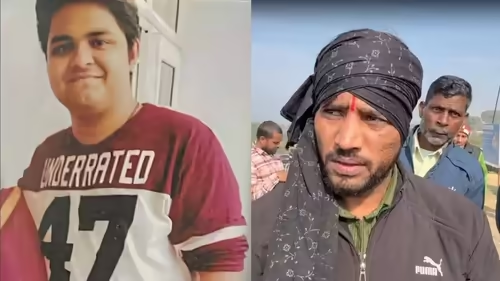
Introduction: A Hero’s Story Turns into an Allegation of Intimidation
The tragic death of 27-year-old software engineer Yuvraj Mehta in Noida has not only highlighted the dangers of unsecured construction sites but has also sparked a serious controversy over police conduct. At the heart of this storm is Moninder Singh, a delivery executive who bravely tried to rescue Mehta from a water-filled pit. Now, Singh has come forward with explosive allegations that he was pressured by the police to alter his account of that fateful night .
Table of Contents
- The Tragic Night: What Happened to Yuvraj Mehta?
- The Hero and His Allegations: Moninder Singh’s Story
- Noida Techie Death: The Police’s Official Stance
- The Legal Implications of Police Pressure on Witnesses
- Public Outcry and the Path Forward
- Conclusion: Seeking Justice Beyond the Headlines
- Sources
The Tragic Night: What Happened to Yuvraj Mehta?
On the foggy night of January 16, 2026, Yuvraj Mehta was returning home from work when his car veered off the road and plunged into a deep, water-filled pit near a construction site in Noida’s Sector 150 . The pit, which was reportedly unmarked and unprotected, became a death trap. Mehta managed to stay afloat for nearly two hours, clinging to his vehicle, before succumbing to exhaustion and drowning .
The Hero and His Allegations: Moninder Singh’s Story
Moninder Singh, a 26-year-old delivery executive, was a key eyewitness to the final moments of the Noida techie death. He arrived at the scene shortly after the accident and, without hesitation, jumped into the frigid water in a desperate attempt to save Mehta . Tragically, he was just minutes too late.
However, Singh’s story took a dark turn when he was summoned to the police station. He now alleges that officers pressured him to stay silent and avoid speaking to the media. More disturbingly, he claims he was forced to record a video statement using a script dictated by the police . “I was scared at the time,” Singh admitted, explaining why he initially complied. “But I’ve decided to stand by the truth,” he later declared .
Noida Techie Death: The Police’s Official Stance
In response to the growing public outcry, the Noida police have registered an FIR based on a complaint from Yuvraj Mehta’s father, naming the builders of the MZ Wiztown Planners project for negligence . An SIT (Special Investigation Team) has been formed to probe potential lapses by the local Knowledge Park police station . While the department has not directly addressed Singh’s specific allegations of coercion, the formation of the SIT suggests a recognition of the case’s sensitive nature and the need for a transparent investigation.
The Legal Implications of Police Pressure on Witnesses
Singh’s allegations of being pressured to give a scripted statement raise serious legal and ethical concerns. In India, while every individual is competent to testify in court under Section 118 of the Indian Evidence Act, 1872 , the practice of coercing witnesses is a known issue within the policing system .
Such tactics, often referred to as part of a “culture of coercion,” are widely condemned as they undermine the very foundation of justice . Forcing a witness to provide a false narrative is not only unethical but can also be a criminal offense, potentially falling under charges of intimidation or even attempting to fabricate evidence. This situation underscores the critical need for robust witness protection protocols and a shift towards more professional and humane policing practices .
Public Outcry and the Path Forward
The Noida techie death case has ignited a national conversation. The public is demanding two things: accountability for the builders whose negligence created the deadly hazard, and a thorough, independent investigation into the police’s handling of the case, particularly their treatment of the heroic eyewitness.
This case has become a symbol of a larger systemic problem. It highlights the vulnerability of ordinary citizens who step forward to help, only to find themselves caught in a web of potential institutional pressure. For justice to be truly served, both the circumstances of Mehta’s death and the conduct of the authorities in its aftermath must be scrutinized with equal rigor.
Conclusion: Seeking Justice Beyond the Headlines
The story of Yuvraj Mehta is a heartbreaking reminder of the fatal consequences of civic negligence. But the subsequent allegations from Moninder Singh add another layer of complexity, pointing to a possible failure within the system meant to deliver justice. As the SIT continues its probe, the eyes of the nation are watching. The hope is that this case will not only bring closure to a grieving family but also serve as a catalyst for much-needed reforms in how eyewitnesses are treated and how such tragedies are investigated. For more on civic safety and infrastructure failures, see our coverage on [INTERNAL_LINK:urban-infrastructure-safety].
Sources
- Times of India: Noida techie death: Delivery exec who tried to rescue Yuvraj alleges police pressure
- Hindustan Times: Two more builders arrested, fresh FIRs deepen probe into Noida techie’s death
- Centre for Policy Research: Status of Policing in India Report 2025
- Indian Evidence Act, 1872 – Section 118