Table of Contents
- Trump’s Shocking Openness to Putin’s Peace Offer
- What Is the Board of Peace?
- The Legal and Ethical Quagmire of Frozen Russian Assets
- Global Reactions and Diplomatic Fallout
- Could This Impact Ukraine Reconstruction Efforts?
- Conclusion: A Risky Gamble with Global Stakes
- Sources
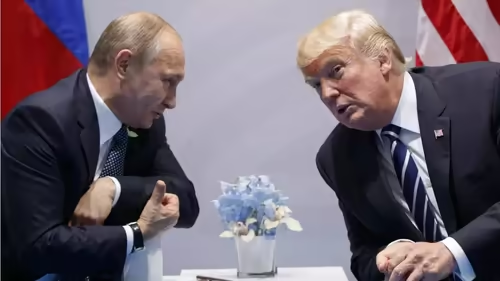
In a development that blurs the lines between diplomacy, legality, and political theater, former U.S. President Donald Trump has publicly endorsed a controversial idea from Russian President Vladimir Putin: using **frozen Russian assets** to fund Trump’s newly established “Board of Peace.” Calling the proposal “very interesting,” Trump suggested he’d accept the money—if it came from Putin’s personal funds . But the reality is far more complex, and potentially dangerous.
Trump’s Shocking Openness to Putin’s Peace Offer
During a recent public appearance, Trump confirmed he had signed the charter for the Board of Peace, an entity he claims will “oversee global peace efforts” . The announcement came shortly after Putin floated the idea of contributing $1 billion to the initiative, hinting that these funds could be drawn from the roughly $300 billion in Russian central bank assets currently frozen by Western nations following the 2022 invasion of Ukraine .
Trump’s response was characteristically ambiguous yet revealing: “If it’s his own money, I’d take it,” he said, referring to Putin . This statement immediately ignited a firestorm. Critics argue that even entertaining such a notion legitimizes Russia’s aggression and undermines the unified Western stance on sanctions.
What Is the Board of Peace?
On the surface, the Board of Peace sounds like a noble, if vague, diplomatic endeavor. According to its charter, the body aims to “mediate international conflicts, promote dialogue, and support post-war reconstruction” . However, details remain scarce. There’s no clear governance structure, no independent oversight, and no transparency about funding sources or operational protocols.
Experts warn that without institutional legitimacy—such as UN backing or multilateral endorsement—the Board risks becoming a vehicle for personal diplomacy or even propaganda. As one foreign policy analyst noted, “Peace initiatives require trust, neutrality, and accountability. This has none of the three” [INTERNAL_LINK:us-foreign-policy-analysis].
The Legal and Ethical Quagmire of Frozen Russian Assets
The core of the controversy lies in the source of the proposed funds. The $300 billion in frozen Russian assets are not Putin’s personal wealth—they belong to the Russian Central Bank and are held primarily in European and U.S. financial institutions . These assets were immobilized under international law as a direct response to Russia’s illegal annexation of Ukrainian territory.
Using them for any purpose—especially one tied to a political figure like Trump—raises serious legal questions:
- Ownership vs. Control: Freezing assets is not the same as confiscating them. Legally, they still belong to Russia.
- Precedent Risk: Diverting them to a private peace board could set a dangerous precedent, encouraging other sanctioned regimes to seek similar loopholes.
- Ukraine’s Claim: Kyiv and its allies have been pushing to use these assets to directly fund Ukraine’s reconstruction—a cause with broad international support .
The U.S. Treasury and EU officials have repeatedly stated that any use of these assets must be lawful, transparent, and aligned with collective security goals—not private initiatives.
Global Reactions and Diplomatic Fallout
Unsurprisingly, the international community has reacted with alarm. European leaders, already wary of Trump’s past praise for Putin, see this as further evidence of his willingness to bypass democratic norms for personal gain.
“This isn’t peace-building—it’s transactional diplomacy at its most reckless,” said a senior EU diplomat who spoke on condition of anonymity . Meanwhile, Ukrainian officials expressed deep concern, fearing the proposal could dilute momentum for legitimate asset seizure efforts aimed at compensating their war-torn nation.
Even within the U.S., bipartisan criticism has emerged. Senator Chris Murphy (D-CT) called the idea “a gift to authoritarianism,” while some Republican foreign policy veterans warned it could damage America’s credibility as a global leader [INTERNAL_LINK:us-congress-ukraine-support].
Could This Impact Ukraine Reconstruction Efforts?
Absolutely. The timing couldn’t be worse. Just weeks ago, the G7 reaffirmed its commitment to explore legal pathways to use frozen Russian assets for Ukraine’s rebuilding . Trump’s Board of Peace proposal—however informal—threatens to muddy those waters.
If even a fraction of public or political attention shifts toward this unvetted initiative, it could delay or derail the carefully coordinated international effort to hold Russia financially accountable. For Ukraine, whose infrastructure needs an estimated $486 billion in repairs, every dollar—and every diplomatic signal—matters .
Conclusion: A Risky Gamble with Global Stakes
Donald Trump’s interest in Putin’s offer to fund the Board of Peace with frozen Russian assets is more than just a headline—it’s a geopolitical flashpoint. While framed as a peace initiative, it risks undermining the rule of law, weakening Western unity, and diverting resources from where they’re needed most: Ukraine. As the world watches, one thing is clear: true peace isn’t built on ambiguous deals with autocrats, but on justice, accountability, and collective action.
Sources
- Times of India: Board of Peace – Trump calls Putin’s idea ‘very interesting’
- Reuters: Russia has $300 billion in foreign reserves frozen by the West
- U.S. Department of the Treasury: Sanctions on Russian Central Bank Assets
- G7 Statement on Use of Russian Immobilised Assets for Ukraine (January 2025)
- Brookings Institution: The legal case for using frozen Russian assets to rebuild Ukraine
- World Bank: Ukraine Reconstruction Costs Top Half a Trillion Dollars