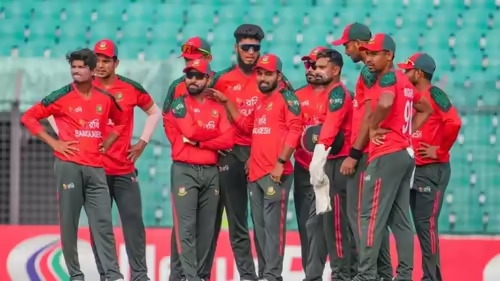
The world of cricket is reeling from a seismic announcement that has thrown the upcoming T20 World Cup 2026 into disarray. In a move that has sent shockwaves through the sport, the Bangladesh national cricket team has officially refused to travel to India for the tournament, citing serious and unaddressed security concerns. This isn’t just a team decision; it’s a directive from the highest levels of the Bangladeshi government, leaving the International Cricket Council (ICC) with a major logistical and political headache on its hands [[1], [7]].
Table of Contents
- Bangladesh’s Official Statement and Government Stance
- The ICC Response and the Scotland Replacement
- T20 World Cup 2026 Host Nations and Schedule
- Why This Decision Matters for Cricket
- Conclusion
- Sources
Bangladesh’s Official Statement and Government Stance
The decision stems from a long-standing and deeply held concern within Bangladesh regarding the safety of its players and officials in India. The Bangladesh Cricket Board (BCB) had been in communication with the ICC, requesting that their matches be moved to the co-host nation, Sri Lanka, to mitigate these perceived risks. However, the ICC reportedly dismissed this request, referring the BCB to past tournaments as evidence of adequate security protocols .
This response was deemed insufficient by the Bangladeshi authorities. The final call was made at the governmental level, with the sports adviser confirming that the team would not be traveling to India under any circumstances. “Bangladesh is not travelling to India to play the World Cup due to the security risk—this is a decision made by the Bangladesh government,” a statement clarified . This underscores that the issue has transcended sport and entered the realm of international diplomacy and national security policy.
The ICC Response and the Scotland Replacement
Faced with a full-blown crisis just weeks before the tournament’s scheduled start, the ICC has taken a hardline approach. Rather than compromise on the hosting arrangements, the governing body has activated its contingency plan. Multiple reports confirm that if Bangladesh maintains its refusal to participate, they will be replaced by Scotland [[6], [8], [24]].
Scotland, who were the highest-ranked team not to qualify for the main event through the global qualifying pathway, is now on standby. While the ICC has not yet formally contacted Cricket Scotland, the writing appears to be on the wall [[21], [22]]. This potential last-minute inclusion would be a historic moment for Scottish cricket but arrives under the most controversial of circumstances.
The ICC’s position seems to be one of zero tolerance for what it may view as political interference in a sporting event. By refusing to relocate Bangladesh’s matches and instead opting for a replacement, the ICC is sending a clear message about the sanctity of its pre-determined tournament structure.
T20 World Cup 2026 Host Nations and Schedule
The T20 World Cup 2026 is set to be a landmark event, co-hosted by India and Sri Lanka from February 7 to March 8, 2026 [[11], [13]]. This will be the 10th edition of the tournament and features an expanded format with 20 teams competing across eight venues—five in India and three in Sri Lanka .
The final is scheduled to be held in Ahmedabad, India, with the semi-finals taking place in Kolkata and Mumbai . The co-hosting arrangement was designed to share the load and showcase the sport across the subcontinent. However, the Bangladesh situation has cast a significant shadow over these plans, particularly for the group stage matches that were slated to be played in India.
Here’s a quick overview of the tournament’s key details:
| Detail | Information |
|---|---|
| Dates | February 7 – March 8, 2026 |
| Host Nations | India & Sri Lanka |
| Participating Teams | 20 (potentially 19 if replacement is not finalized) |
| Total Matches | 55 |
| Final Venue | Ahmedabad, India |
Why This Decision Matters for Cricket
This standoff between Bangladesh and the ICC is far more than a simple scheduling dispute. It highlights several critical issues facing modern international cricket:
- Geopolitics and Sport: The line between sport and politics has been blurred. A national government’s security assessment is now directly impacting a global sporting calendar, a precedent that could have future ramifications.
- Player Welfare vs. Commercial Interests: While the ICC must protect its commercial partners and broadcast schedules, the primary concern of any board should be the safety of its players. The BCB’s stance, however controversial, is rooted in this principle.
- The Integrity of Qualification: Replacing a qualified team like Bangladesh with a non-qualifier like Scotland, while a practical solution, undermines the grueling qualification process that other teams went through. It raises questions about fairness and the value of earning a spot on the field.
For fans of the game, this controversy is a bitter pill to swallow. The prospect of missing out on seeing stars like Shakib Al Hasan and Mustafizur Rahman compete on the world stage is a significant loss for the tournament’s competitive spirit and entertainment value.
Conclusion
The dream of a unified and exciting T20 World Cup 2026 has been dealt a severe blow. Bangladesh’s principled, albeit disruptive, stand on security grounds has created a complex dilemma for the ICC. With the clock ticking, the most likely outcome is a historic but contentious entry for Scotland into the tournament. This saga serves as a stark reminder that even in the world of sport, external geopolitical forces can have a profound and unpredictable impact. The cricketing world will be watching closely to see how this unprecedented situation unfolds in the coming days.
Sources
- Times of India: ‘They didn’t ask’: Bangladesh cricketers reveal what happened in WC meeting
- International Cricket Council (ICC): Official Website
- [INTERNAL_LINK:cricket-geopolitics]
- [INTERNAL_LINK:t20-world-cup-history]