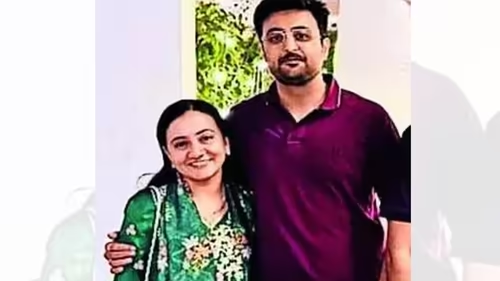
A quiet Wednesday night in Ahmedabad turned into a scene of unimaginable heartbreak when a licensed revolver—meant for protection—became the instrument of a double tragedy. Yashrajsinh Gohil, a 34-year-old civil engineer and nephew of senior Congress leader Shaktisinh Gohil, allegedly shot his wife, Rajeshwari, in what police describe as an accidental shooting death. Devastated by her passing, he then reportedly ended his own life .
The incident has sent shockwaves through Gujarat’s political and professional circles, raising urgent questions about firearm safety, mental health support, and the emotional toll of sudden loss. While investigations continue, the case underscores a grim reality: even legally owned guns can lead to irreversible consequences when handled without extreme caution.
Table of Contents
- What Happened in Ahmedabad?
- Who Was Yashrajsinh Gohil?
- The Dangers of Accidental Shooting Death at Home
- India’s Firearm Laws and Safety Gaps
- Mental Health Crisis After Traumatic Accidents
- How to Prevent Firearm Accidents in India
- Conclusion: A Call for Responsibility and Empathy
- Sources
What Happened in Ahmedabad?
According to preliminary police reports, the incident occurred late Wednesday night in the couple’s apartment in Ahmedabad’s Satellite area. Yashrajsinh, who held a valid license for a .32 bore revolver, was handling the weapon when it discharged unexpectedly, striking his wife Rajeshwari .
Despite immediate efforts to rush her to the hospital, Rajeshwari succumbed to her injuries. Overwhelmed by guilt and grief, Yashrajsinh is believed to have taken his own life shortly afterward using the same firearm. Neighbors reported hearing two distinct sounds but initially mistook them for something else—only realizing the gravity of the situation when police arrived .
Authorities have recovered the weapon and are conducting forensic tests to confirm the sequence of events. No foul play is suspected at this stage, but the investigation remains ongoing.
Who Was Yashrajsinh Gohil?
Yashrajsinh was not just any engineer—he came from a politically prominent family in Gujarat. His uncle, Shaktisinh Gohil, is a well-known Congress MP and former minister. Despite his connections, Yashrajsinh reportedly lived a low-profile life, focused on his engineering career and family .
Friends described him as soft-spoken and responsible, making the incident all the more shocking. The couple had no known history of domestic disputes, and early accounts suggest the shooting was truly accidental—a momentary lapse with catastrophic results.
The Dangers of Accidental Shooting Death at Home
This tragedy highlights a sobering truth: accidental shooting death incidents, while rare in India compared to countries like the U.S., do occur—and often involve legally owned firearms. According to data from the National Crime Records Bureau (NCRB), hundreds of deaths each year are linked to “negligent handling” of licensed weapons .
Common scenarios include:
- Cleaning a loaded gun without verifying if it’s unloaded
- Mistaking a real firearm for a toy (especially in households with children)
- Storing weapons in easily accessible locations
- Handling a gun during emotional distress
In Yashrajsinh’s case, the combination of accessibility and emotional vulnerability may have created a perfect storm. Even trained individuals can make fatal errors under stress.
India’s Firearm Laws and Safety Gaps
India has some of the strictest gun control laws in the world. Under the Arms Act, 1959, obtaining a firearm license requires background checks, police verification, and a demonstrated “genuine reason” such as threat to life . However, once a license is granted, there are few mandatory requirements for safe storage or periodic safety training.
Unlike in many Western nations, Indian law does not require gun safes, trigger locks, or regular recertification. This regulatory gap leaves room for accidents—especially when weapons are kept in homes with family members who may not be trained in firearm handling.
For more on legal firearm ownership, see our guide on [INTERNAL_LINK:gun-laws-in-india-explained].
Mental Health Crisis After Traumatic Accidents
Perhaps the most haunting aspect of this case is Yashrajsinh’s immediate response to the accident: suicide. His actions reflect an acute psychological crisis—one that might have been mitigated with access to emergency mental health support.
Experts emphasize that individuals involved in accidental shootings often experience intense guilt, shame, and PTSD-like symptoms. Without immediate counseling, the risk of self-harm spikes dramatically .
India’s mental health infrastructure remains underdeveloped, particularly in crisis intervention. There is no national 24/7 trauma hotline for such incidents, leaving many to suffer in silence.
How to Prevent Firearm Accidents in India
If you or someone you know owns a licensed firearm, these safety practices can save lives:
- Always assume the gun is loaded—even if you just checked.
- Store ammunition separately from the firearm in a locked cabinet.
- Never handle a gun when emotionally distressed—anger, grief, or anxiety impair judgment.
- Take a certified safety course—even if not legally required.
- Educate all adult household members on basic firearm safety rules.
For authoritative guidance, refer to the Ministry of Home Affairs’ guidelines on private firearm ownership (https://www.mha.gov.in).
Conclusion: A Call for Responsibility and Empathy
The Ahmedabad tragedy is not just a story of a fatal mistake—it’s a wake-up call. It reminds us that accidental shooting death can happen to anyone, even the most responsible among us. Beyond stricter regulations, we need a cultural shift: treating firearms with the reverence they demand, and ensuring that mental health support is available in the darkest moments. Our thoughts are with the families affected—and our hope is that this loss sparks meaningful change.
Sources
- Times of India. “Engineer shoots wife accidentally; distressed by death, he kills self.” https://timesofindia.indiatimes.com/india/engineer-shoots-wife-accidentally-distressed-by-death-he-kills-self/articleshow/127196330.cms
- National Crime Records Bureau (NCRB). “Accidental Deaths & Suicides in India 2024.” https://ncrb.gov.in
- Ministry of Home Affairs, Government of India. “The Arms Rules, 2016.” https://www.mha.gov.in
- World Health Organization (WHO). “Mental Health and Psychosocial Support in Emergencies.” https://www.who.int