Supreme Court’s Sharp Rebuke: The Missing Clause in the SIR Order
In a courtroom moment that has sent ripples across the nation’s political and legal landscape, the Supreme Court of India delivered a pointed observation to the Election Commission of India (ECI). The core of the issue? The ECI’s Special Intensive Revision (SIR) order for 2025-26 appears to be operating on a critical assumption that isn’t actually written down. Justice Joymalya Bagchi, presiding over the case, explicitly noted that the official SIR order “makes no mention of citizenship verification” . This simple yet powerful statement has thrown the entire basis of recent voter list purges into sharp relief.
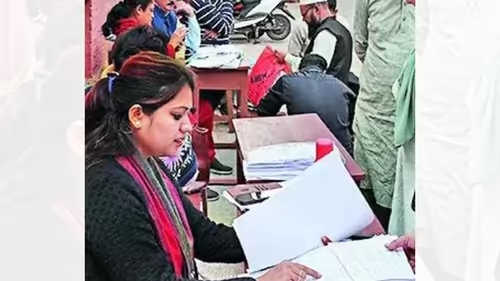
The controversy stems from the ECI’s aggressive drive to revise electoral rolls in states like Bihar, where citizens have been asked to submit documentary proof of their citizenship to remain on the voter list. This on-ground reality starkly contrasts with the official directive that governs the process. When pressed by the bench, the ECI admitted that while the term ‘citizenship verification’ is not expressly mentioned in the SIR order, they maintain that the overall process is transparent and just .
Table of Contents
- What is the SIR Order and Why Does it Matter?
- The Citizenship Verification Conundrum: Action vs. Policy
- Why the Supreme Court’s Question is a Game-Changer
- ECI’s Defense and Mounting Public Concern
- Conclusion: What Happens Next?
- Sources
What is the SIR Order and Why Does it Matter?
The Special Intensive Revision (SIR) is a periodic, large-scale exercise conducted by the Election Commission to update and clean the electoral rolls. It’s a standard procedure to add new eligible voters, remove those who have moved, passed away, or are otherwise ineligible. Normally, this is a routine administrative task. However, the current SIR cycle has become highly contentious because of its perceived focus on one specific eligibility criterion: Indian citizenship.
The SIR empowers Electoral Registration Officers (EROs) to verify the details of voters. The problem, as highlighted by the Supreme Court, is the ambiguity in their instructions. If the official order doesn’t explicitly task them with verifying citizenship, on what legal basis are they demanding documents like birth certificates, passports, or legacy data from the National Register of Citizens (NRC)? This gap between policy and practice is at the heart of the legal challenge.
The Citizenship Verification Conundrum: Action vs. Policy
The disconnect is jarring. On one hand, citizens across various constituencies are receiving notices asking them to prove their citizenship or risk being removed from the voter list. On the other, the very document that authorizes this massive operation—the SIR order—remains silent on the matter. This has led to accusations of arbitrary and potentially discriminatory action.
The Supreme Court seems to share these concerns. During the hearing, the bench questioned whether an ERO should have the power to exclude a person from the electoral rolls based on a citizenship doubt, especially when the Union government has not made a final determination on that individual’s status through established legal channels like the Foreigners Tribunals . This raises a fundamental question about the separation of powers and the potential for local officials to make decisions with profound national and personal consequences.
Why the Supreme Court’s Question is a Game-Changer
The Court’s intervention is significant for several reasons:
- Rule of Law: It reinforces the principle that any state action must have a clear basis in law or official policy. You cannot implement a de facto policy of citizenship verification without a de jure order authorizing it.
- Protection of Democratic Rights: The right to vote is a cornerstone of democracy. Creating a chilling effect where citizens fear disenfranchisement due to ambiguous bureaucratic processes undermines this fundamental right.
- Precedent Setting: The Court’s eventual ruling will set a crucial precedent for how future electoral rolls are revised and what powers can be delegated to field officers.
This case is not happening in a vacuum. It follows years of national debate on citizenship, including the controversial National Register of Citizens (NRC) exercise in Assam. The current SIR process is seen by many as a backdoor method to achieve similar ends without the formal, and legally complex, NRC framework. For more on the historical context of citizenship debates in India, see our deep dive on [INTERNAL_LINK:citizenship-act-nrc-cca].
ECI’s Defense and Mounting Public Concern
Faced with the Court’s sharp questioning, the Election Commission has stood by its process. Its primary defense is that the SIR is a “fair, just and reasonable” exercise aimed at ensuring the integrity of the electoral rolls . The ECI argues that verifying the eligibility of a voter, which inherently includes their citizenship status, is a logical and necessary part of maintaining an accurate list.
However, critics, including organizations like the Association for Democratic Reforms (ADR), have called the ECI’s approach in states like Bihar “untenable” and a defiance of established legal norms . They argue that without a clear, written mandate, the process is open to abuse, inconsistency, and can disproportionately affect marginalized communities who may struggle to produce decades-old documentation.
The ECI’s position that the process is transparent rings hollow when the foundational document itself lacks the key directive that citizens are being asked to comply with. This opacity is the root of the public anxiety and the legal challenge.
Conclusion: What Happens Next?
The Supreme Court has effectively called the Election Commission’s bluff. By highlighting the glaring omission of ‘citizenship verification’ from the official SIR order, the Court has demanded clarity, accountability, and adherence to the rule of law. The ball is now firmly in the ECI’s court. They must either amend their SIR order to explicitly include and define the parameters of a citizenship verification process—a move that would invite even greater scrutiny—or they must rein in their field officers and halt all such verification activities immediately.
For millions of Indian citizens, the outcome of this case is not just a legal technicality; it’s about the security of their most fundamental democratic right. The Court’s next steps will be watched closely by every citizen who believes that the right to vote should never be contingent on an unspoken, unwritten rule.
Sources
- Times of India: SIR order makes no mention of citizenship verification: SC to EC
- The Telegraph: Supreme Court questions ECI on citizenship enquiries during SIR
- Live Law: ‘SIR Order Makes No Mention Of Citizenship Verification’: Supreme Court To Election Commission [[4], [6], [9]]
- Article 14: EC’s Citizenship Verification In Bihar ‘Untenable’, Defies Legal Framework