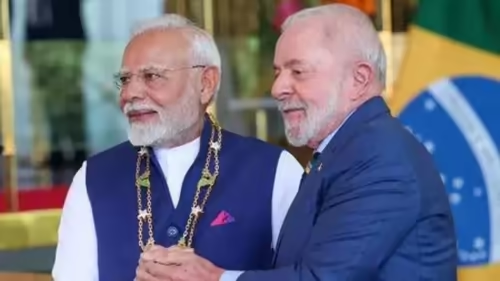
Why Lula’s India Visit Could Reshape Global Alliances
When Brazilian President Luiz Inácio Lula da Silva lands in India this February, it won’t just be another state visit. It’s a calculated geopolitical maneuver with far-reaching implications. As two of the largest democracies in the Global South, India and Brazil are positioning themselves as counterweights to Western-dominated institutions. This Lula India visit is about more than handshakes—it’s about building a new world order together.
Table of Contents
- The Official Agenda: Key Themes of the Visit
- Strategic Partnership: What Does It Really Mean?
- UNSC Reform: A United Front for Global Representation
- Gaza and Global Peace: India and Brazil’s Shared Stance
- Beyond Diplomacy: Trade, Tech, and the AI Summit
- The BRICS Factor: Setting the Stage for Kazan
- Why This Visit Matters for the Global South
- Sources
The Official Agenda: Key Themes of the Visit
Scheduled for February 19–21, 2026, President Lula’s trip to India is packed with high-stakes meetings. He will hold extensive bilateral talks with Prime Minister Narendra Modi, attend India’s flagship Artificial Intelligence (AI) summit, and lay the groundwork for the upcoming BRICS leaders’ summit later in the year . The core objective? To elevate the India-Brazil relationship from a friendly dialogue to a results-driven strategic partnership.
Strategic Partnership: What Does It Really Mean?
The term “strategic partnership” is often used loosely in diplomacy. But between India and Brazil, it carries specific weight. Both nations share common ground on multilateralism, sustainable development, and equitable global governance. Their partnership is anchored in three pillars:
- Political Coordination: Aligning votes and positions in international forums like the UN, G20, and WTO.
- Economic Cooperation: Boosting trade—which stood at just $15 billion in 2024—and exploring joint ventures in agriculture, pharmaceuticals, and renewable energy .
- Technological Collaboration: Sharing expertise in space (ISRO and AEB), digital public infrastructure, and now, artificial intelligence .
This Lula India visit is expected to produce concrete deliverables under each pillar, moving beyond rhetoric.
UNSC Reform: A United Front for Global Representation
One of the most significant outcomes of the recent Modi-Lula discussions was their joint pledge to champion UN Security Council (UNSC) reform . Both India and Brazil are members of the G4 nations (alongside Germany and Japan) pushing for permanent seats. They argue that the current UNSC structure, frozen in a post-WWII reality, fails to reflect today’s geopolitical and economic landscape.
Their unified stance is crucial. With over 2.7 billion people combined, their voices represent a massive chunk of humanity currently underrepresented in global security decisions. During his visit, Lula is expected to reaffirm Brazil’s strong support for India’s permanent membership—a gesture that could strengthen India’s diplomatic capital ahead of key UN votes.
Gaza and Global Peace: India and Brazil’s Shared Stance
On the volatile issue of Gaza, both leaders have called for an immediate ceasefire and a return to a two-state solution . While India has traditionally balanced its ties with Israel and Palestine, and Brazil has been more vocal in its criticism of Israeli actions, they converge on the principle of protecting civilian lives and upholding international humanitarian law. This shared moral ground allows them to present a coordinated voice from the Global South, advocating for peace without being drawn into partisan Western narratives.
Beyond Diplomacy: Trade, Tech, and the AI Summit
Lula’s participation in India’s AI summit is no coincidence. As both nations seek to harness AI for inclusive growth—not just corporate profit—they aim to establish ethical frameworks that prioritize human rights and development. This aligns perfectly with India’s “AI for All” philosophy and Brazil’s focus on digital sovereignty.
Moreover, the visit is expected to fast-track negotiations on a Comprehensive Economic Partnership Agreement (CEPA). Reducing tariffs on key exports—like Brazilian soybeans and Indian IT services—could double bilateral trade within five years .
The BRICS Factor: Setting the Stage for Kazan
With the BRICS bloc expanding to include countries like Egypt, Ethiopia, Iran, and the UAE, its internal dynamics are more complex than ever. The Lula India visit serves as a critical pre-summit consultation. As founding members, India and Brazil can shape the agenda for the 2026 Kazan summit, ensuring BRICS remains focused on development finance, de-dollarization, and technological self-reliance rather than becoming a mere anti-Western coalition .
Why This Visit Matters for the Global South
Ultimately, this isn’t just about two countries. It’s about offering an alternative model of international cooperation—one based on mutual respect, South-South collaboration, and multipolarity. In a world increasingly fractured by great-power rivalry, the India-Brazil axis represents a stabilizing force that prioritizes dialogue over division. For readers interested in how emerging powers are reshaping global governance, this is a pivotal moment. Learn more about this shift in our deep dive on [INTERNAL_LINK:multipolar-world-order].
Sources
[1] Times of India: Lula discusses strategic ties with PM Modi
[8] Web Search Result on India-Brazil bilateral trade data
[12] Web Search Result on ISRO-AEB space cooperation
[15] Web Search Result on India-Brazil CEPA negotiations
[20] Web Search Result on BRICS expansion and 2026 summit
For authoritative insights on multilateral diplomacy and UN reform, refer to the United Nations Department of Global Communications: https://www.un.org/en/