Table of Contents
- Melania Trump’s Surprising Message in the AI Era
- Why ‘Curiosity Over Coding’ Is the New Mantra
- AI as a Tool—Not a Master
- The Essential Human Skills AI Can’t Replace
- Reimagining Education for the Age of Imagination
- Conclusion: The Power of Asking the Right Questions
- Sources
While Silicon Valley pushes kids into Python bootcamps before they’ve mastered algebra, a powerful voice is urging a different path. Former First Lady Melania Trump has stepped into the heated debate about the future of work and learning with a refreshingly human-centered message: in the age of artificial intelligence, curiosity over coding is the most valuable skill you can cultivate .
At a time when headlines scream about AI replacing jobs—from customer service reps to radiologists—Trump’s advice cuts through the noise. She isn’t dismissing technology. Instead, she’s redefining our relationship with it. Her core argument? Machines can compute, but only humans can wonder, question, and create meaning.
Melania Trump’s Surprising Message in the AI Era
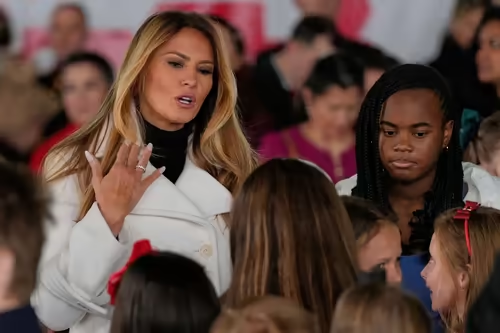
In a recent public address reported by the Times of India, Melania Trump addressed the growing anxiety around AI’s impact on employment . Rather than doubling down on technical training, she offered a counterintuitive prescription: nurture your imagination. “The most powerful skill in the AI era,” she said, “is knowing what to ask—not just how to program.”
This stance marks a significant shift from the dominant narrative that equates digital literacy solely with coding proficiency. While STEM education remains important, Trump’s emphasis on soft, cognitive, and emotional skills reframes the conversation. She warned against surrendering personal intelligence to algorithms, urging young people to use AI as a collaborator, not a crutch.
Her message resonates with a growing chorus of educators and futurists who argue that the true bottleneck in the AI revolution isn’t processing power—it’s human insight. As AI handles routine tasks, the premium shifts to those who can frame problems, spot opportunities, and navigate ambiguity.
Why ‘Curiosity Over Coding’ Is the New Mantra
The phrase curiosity over coding might sound provocative, but it’s grounded in real-world trends. Consider this: AI tools like GitHub Copilot can now write functional code faster than many junior developers. But who decides what problem needs solving? Who identifies the ethical implications? Who ensures the solution serves human needs?
These are questions of judgment, empathy, and vision—domains where human intelligence still reigns supreme. A 2023 World Economic Forum report listed analytical thinking, creativity, and resilience among the top skills for 2025—far ahead of specific programming languages .
Moreover, coding itself is becoming increasingly accessible through no-code and low-code platforms. What’s harder to automate is the spark of curiosity that leads someone to ask, “What if?” or “Why not?” That spark drives innovation across every field—from medicine to music.
AI as a Tool—Not a Master
Melania Trump was clear: AI should be used as a creative tool, not an oracle. This distinction is crucial. Too often, users treat AI outputs as gospel, blindly accepting generated text, images, or recommendations without critical evaluation.
She cautioned against what she called “intellectual outsourcing”—the habit of letting AI do your thinking for you. Whether it’s using chatbots to write essays or relying on algorithms to curate your worldview, this passive consumption erodes independent thought.
Instead, she encouraged active engagement: “Use AI to explore, to experiment, to amplify your ideas—but never let it replace your own voice or your own questions.” This aligns with best practices from digital literacy experts, who stress the importance of teaching students to interrogate AI outputs for bias, accuracy, and relevance .
The Essential Human Skills AI Can’t Replace
So what exactly should young people focus on if not just coding? Based on Trump’s remarks and broader educational research, here are the irreplaceable human skills for the AI era:
- Critical Thinking: Evaluating information, identifying logical fallacies, and making reasoned judgments.
- Emotional Intelligence: Understanding and managing your own emotions while empathizing with others.
- Interdisciplinary Imagination: Connecting ideas across fields—like blending biology with design or history with data science.
- Ethical Reasoning: Navigating complex moral dilemmas that AI systems aren’t equipped to handle.
- Question Formulation: The ability to ask novel, insightful, and meaningful questions—the very engine of discovery.
These competencies can’t be downloaded or automated. They’re cultivated through rich experiences, deep reading, open-ended dialogue, and yes—unstructured play and daydreaming. They’re the foundation of what Trump calls the “Age of Imagination.”
Reimagining Education for the Age of Imagination
This vision demands a radical rethink of education. Instead of standardized testing and rigid curricula, schools should foster environments where curiosity thrives. Imagine classrooms where students:
- Design their own research projects based on personal interests.
- Debate the societal impacts of emerging technologies.
- Use AI to prototype solutions to community problems—but must justify their choices ethically and logically.
Programs like Finland’s phenomenon-based learning or Singapore’s emphasis on “21st-century competencies” already point in this direction . The goal isn’t to produce more coders—it’s to raise thoughtful, adaptable, and imaginative citizens who can steer technology toward human flourishing.
For parents and educators, the takeaway is clear: encourage questions, not just answers. Celebrate exploration, not just efficiency. And remember that the most powerful algorithm in the world is the human mind—when it’s allowed to wonder freely.
Conclusion: The Power of Asking the Right Questions
Melania Trump’s call to prioritize curiosity over coding isn’t anti-technology—it’s pro-humanity. In a world racing to automate everything, her message is a timely reminder that our greatest asset isn’t our ability to build machines, but our capacity to dream, question, and care. As AI becomes ubiquitous, the true differentiator won’t be who can write the best code, but who can ask the most profound questions. That’s a skill no algorithm can replicate—and a legacy worth nurturing in every child.
Sources
- Times of India: Melania Trump on the most powerful skill in AI era
- World Economic Forum: The Future of Jobs Report 2023
- Harvard Graduate School of Education: Teaching Students to Think Critically About AI
- OECD: The OECD Learning Compass 2030