Zelenskyy’s Davos Dilemma: The Justice Gap Between Maduro and Putin
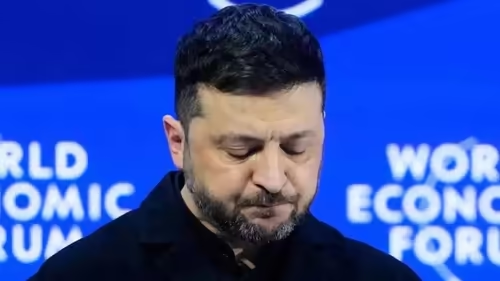
At the heart of the snowy Swiss Alps during the World Economic Forum in January 2025, Ukrainian President Volodymyr Zelenskyy delivered a message that cut through the diplomatic fog. His target? A glaring inconsistency in how the world treats its most powerful autocrats. “Maduro in jail, but not Putin,” he declared, a phrase that has since echoed across global newsrooms . This wasn’t just a casual observation; it was a direct challenge to the international community, questioning why the architect of Europe’s deadliest conflict since WWII remains a free man while another controversial leader faces trial.
Table of Contents
- Maduro’s Arrest and Zelenskyy’s Message
- The ICC Warrant Hanging Over Putin’s Head
- Putin’s Countermove: Frozen Assets and Peace Deals
- The Double Standard in International Justice
- Conclusion: A Test for the Global Order
Maduro’s Arrest and Zelenskyy’s Message
Zelenskyy’s comments were a direct response to the dramatic capture of Venezuelan President Nicolas Maduro. After being indicted by the U.S. Justice Department in 2020 on charges related to drug trafficking and corruption, Maduro was finally taken into custody and is now being held at the Metropolitan Detention Center in Brooklyn [[12], [13]]. This high-profile arrest sent shockwaves through the international political scene.
Seizing the moment, Zelenskyy, who has been a relentless advocate for his nation’s sovereignty, used the platform at Davos to draw a parallel. “If it’s possible to deal with dictators this way, then the US knows what to do next,” he stated, a remark widely interpreted as a clear call for action against Russian President Vladimir Putin . For Ukraine, which has suffered immense loss and destruction since Russia’s full-scale invasion, the contrast between Maduro’s fate and Putin’s freedom is not just puzzling—it’s a painful symbol of a broken system.
The ICC Warrant Hanging Over Putin’s Head
The notion that Putin is somehow beyond the reach of international law is a myth. In a landmark decision on March 17, 2023, the International Criminal Court (ICC) issued an arrest warrant for Vladimir Putin [[14], [15]]. The charge? The war crime of illegally deporting Ukrainian children from occupied territories to Russia. A second warrant was also issued for Maria Lvova-Belova, Russia’s Presidential Commissioner for Children’s Rights .
This makes Putin the first permanent member of the UN Security Council to be the subject of an ICC arrest warrant—a significant legal and symbolic milestone. However, the practical enforcement of this warrant remains a massive hurdle. Since Russia is not a party to the Rome Statute that established the ICC, it has no obligation to comply. Furthermore, Putin’s travel is largely restricted to countries that are either not ICC members or are unlikely to enforce the warrant, effectively shielding him from arrest .
Putin’s Countermove: Frozen Assets and Peace Deals
In a move that seems almost theatrical in its timing, Putin has recently floated a proposal that appears designed to deflect from these legal pressures. On January 21, 2026, he claimed that Russia is ready to use its frozen assets—estimated in the hundreds of billions of dollars—to fund the reconstruction of war-torn Ukrainian regions [[21], [23]]. He even suggested a $1 billion contribution from these assets to a U.S.-led “Board of Peace” aimed at resolving the Gaza conflict [[22], [28]].
This offer, however, has been met with deep skepticism from Kyiv and its Western allies. They view it as a cynical ploy to launder Russia’s image and avoid accountability for its aggression. After all, the assets in question were frozen precisely because of Russia’s illegal invasion of Ukraine. Using them for reconstruction without a genuine, just peace agreement would be seen as rewarding the aggressor—a point Zelenskyy and his government have consistently emphasized .
The Double Standard in International Justice
Zelenskyy’s core argument taps into a long-standing criticism of the international legal system: its perceived selectivity. The ability to arrest a leader like Maduro, who was captured under extraordinary circumstances, stands in sharp contrast to the inability—or unwillingness—to act on the ICC warrant for Putin.
Several factors contribute to this disparity:
- Geopolitical Power: Russia is a nuclear-armed state with a permanent seat on the UN Security Council, giving it immense power to block any international actions against it.
- Enforcement Mechanisms: The ICC relies on its member states to execute its warrants. There is no international police force to compel compliance from a nation as powerful as Russia.
- National Jurisdiction: Maduro’s arrest was carried out by the United States based on its own national indictments, a path that is far more direct than the complex, consensus-driven process of international courts .
This situation creates a dangerous precedent where justice appears to be a luxury reserved for the less powerful, while the most destructive actors can operate with impunity.
Conclusion: A Test for the Global Order
Volodymyr Zelenskyy’s pointed question from Davos is more than a political jab; it’s a fundamental test of the post-war international order. The existence of an ICC warrant for Putin is a crucial legal fact, but its value is hollow without enforcement. Until the world finds a way to bridge the gap between legal pronouncements and real-world consequences for leaders of powerful nations, Zelenskyy’s words will continue to resonate as a stark reminder of a system in crisis. The case of Maduro versus Putin isn’t just about two men—it’s about whether the principle of equality before the law can survive in a world dominated by raw power politics.