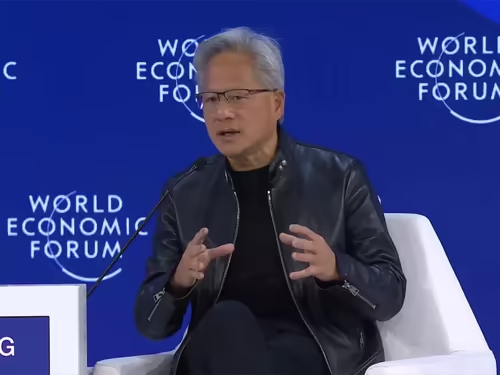
For years, the conversation around artificial intelligence has been dominated by fears of mass job displacement, with white-collar workers nervously eyeing their inboxes. But what if the real story isn’t about job loss, but a massive, unexpected job creation boom in an entirely different sector? At the 2026 World Economic Forum in Davos, NVIDIA CEO Jensen Huang flipped the script, delivering a powerful message that has sent shockwaves through the tech and labor markets.
Huang didn’t just predict growth; he painted a picture of a blue-collar renaissance, where plumbers, electricians, and construction workers are the new rockstars of the AI economy. His claim? The unprecedented global push to build AI infrastructure—the largest in human history—will drive these essential roles into the six-figure income bracket .
Table of Contents
- Huang’s Davos Revelation: The “Five-Layer Cake” of AI Jobs
- The AI Trade Jobs Boom: From Wrenches to Wealth
- The Looming Skilled Worker Crisis
- What This Means for the Future of Work
- Conclusion: A Call to Action for a New Generation of Tradespeople
- Sources
Huang’s Davos Revelation: The “Five-Layer Cake” of AI Jobs
Speaking at a high-profile panel alongside BlackRock CEO Larry Fink, Huang described the AI revolution not as a monolithic force, but as a complex, multi-layered opportunity he calls a “five-layer cake” . While much attention is paid to the top layers—software, algorithms, and applications—the foundation of this entire structure is physical. It’s made of concrete, steel, copper, and fiber optics.
“It’s wonderful that the jobs are related to tradecraft, and we’re going to have plumbers and electricians and construction and steel workers,” Huang stated emphatically . He argued that the trillions of dollars being poured into AI—what he calls the “largest infrastructure buildout in human history” —must first be physically constructed before any code can run on it. This foundational layer is where the immediate, tangible job creation is happening.
The AI Trade Jobs Boom: From Wrenches to Wealth
Huang’s most provocative claim is the direct link between this buildout and a dramatic surge in wages. He wasn’t speaking in vague terms. He was specific: “We’re talking about six-figure salaries for people who are building chip factories or computer factories or AI factories,” he declared . This isn’t just about a modest pay bump; it’s a complete transformation of career trajectories for skilled tradespeople.
Why the premium? The answer lies in the sheer scale and complexity of modern AI data centers. These aren’t your average server rooms. They are sprawling, power-hungry facilities that require:
- Advanced Electrical Systems: Massive power feeds, complex backup systems, and intricate cooling solutions that demand master electricians.
- Specialized Plumbing & Cooling: Sophisticated liquid cooling systems to manage the immense heat generated by AI chips, requiring plumbers with expertise in industrial-scale fluid dynamics.
- Precision Construction: Building structures that can support the weight of thousands of servers and withstand unique environmental stresses.
This high-stakes environment, combined with intense competition from tech giants and governments, is driving companies to offer unprecedented compensation packages to attract and retain the best talent. For anyone considering a career in the trades, this represents a golden opportunity. [INTERNAL_LINK:how-to-become-an-ai-data-center-electrician] provides a roadmap for entering this high-demand field.
The Looming Skilled Worker Crisis
However, Huang’s optimistic vision is shadowed by a significant challenge: a critical shortage of qualified workers. The very boom he describes is running headlong into a stark reality. As of late 2025, the U.S. construction industry was already facing a deficit of approximately 439,000 workers . The U.S. Bureau of Labor Statistics projects a need for nearly 400,000 additional construction workers by 2033, a demand heavily fueled by the data center explosion .
“The AI boom is driving an unprecedented wave of data center construction, but there aren’t enough skilled tradespeople in the US to keep up,” notes a recent industry analysis . This bottleneck could potentially slow down the entire AI rollout, creating a paradox where the technology’s greatest need is its biggest constraint. This shortage isn’t just a problem for the tech industry; it’s a national economic issue that requires a coordinated response from educators, policymakers, and businesses.
What This Means for the Future of Work
Huang’s prediction fundamentally challenges the narrative that AI is solely a threat to employment. Instead, it highlights a crucial truth: technological advancement often creates new, unforeseen categories of high-value work. While some entry-level white-collar roles may be automated, a massive new frontier is opening in the skilled trades .
This shift has profound implications for education and career counseling. For decades, the primary path to a secure, high-income future was seen as a four-year college degree. Huang’s vision suggests a powerful alternative: vocational training and apprenticeships in high-demand fields like electrical work and advanced plumbing could be a faster, more affordable, and equally lucrative route to a successful career. This is a major pivot in the future of work conversation, one that deserves serious attention from students, parents, and guidance counselors alike.
Conclusion: A Call to Action for a New Generation of Tradespeople
Jensen Huang’s message from Davos is clear and compelling. The AI revolution isn’t just about software engineers in Silicon Valley; it’s about electricians, plumbers, and welders across the country who will literally build the future. The promise of six-figure salaries is a powerful incentive, but it’s matched by an urgent need. The success of the entire AI endeavor may well depend on our ability to train, recruit, and empower a new generation of skilled tradespeople. For those willing to get their hands dirty, the future has never looked brighter—or more financially rewarding.
Sources
- Times of India: Nvidia CEO Jensen Huang says AI will turn these low-paying jobs in America into six-figure jobs
- Bloomberg: Nvidia’s Huang Says AI Bubble Fears Are Dwarved by ‘Largest Build-Out in History’
- U.S. Bureau of Labor Statistics: Occupational Outlook Handbook – Construction and Extraction Occupations