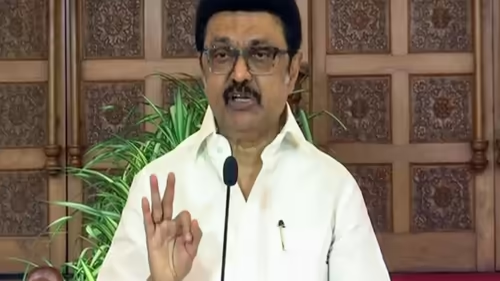
In a move that has sent shockwaves through the political corridors of Chennai and New Delhi, Tamil Nadu Chief Minister M.K. Stalin has declared an all-out assault on a cornerstone of India’s parliamentary system: the Governor’s Address. Accusing Governors of acting like “party agents,” Stalin isn’t just complaining—he’s promising to change the Constitution itself .
But what’s really behind this audacious plan? Is it a genuine push for federalism, a strategic masterstroke ahead of the 2026 elections, or a reaction to years of bitter personal and political clashes with Governor R.N. Ravi? Let’s dive deep into the controversy, the constitutional realities, and the high-stakes political game at play.
Table of Contents
- The Spark: What Ignited Stalin’s Anger?
- Constitutional Cornerstone or Outdated Formality?
- The Political Playbook: Stalin’s 2026 Strategy
- Can the Governor’s Address Really Be Scrapped?
- Conclusion: A Battle for Federalism or Power?
- Sources
The Spark: What Ignited Stalin’s Anger?
The immediate trigger for Stalin’s outburst is the now-infamous walkout by Tamil Nadu Governor R.N. Ravi from the state assembly. This marks the fourth consecutive year that Ravi has refused to deliver the full address prepared by the elected state government . His justification? He claims the speech contains “misleading statements” .
For Stalin and the DMK, this is more than a breach of protocol; it’s a direct assault on the democratic mandate of the people of Tamil Nadu. In his words, Governors like Ravi are no longer impartial constitutional heads but are “acting like party agents” . This sentiment isn’t isolated to Tamil Nadu; similar tensions have flared in Kerala and Karnataka, painting a picture of a systemic issue across states ruled by opposition parties .
Constitutional Cornerstone or Outdated Formality?
The Governor’s Address is not a mere ceremonial tradition. It is a fundamental part of India’s parliamentary democracy, enshrined in the Constitution. Article 176 of the Indian Constitution mandates that the Governor shall address the Legislative Assembly (or both houses in bicameral states) at the commencement of the first session after each general election and at the beginning of the first session each year .
The Governor’s role, as the constitutional head of the state, is largely ceremonial. Under Article 163, they are expected to act on the aid and advice of the Council of Ministers headed by the Chief Minister . Their legislative powers include summoning, proroguing, and dissolving the assembly, but these are also exercised on the advice of the cabinet .
However, the recurring conflict arises from the fact that while the speech is delivered by the Governor, its content is drafted entirely by the state government. When a Governor refuses to read it, they are effectively vetoing the government’s chosen narrative for the legislative session—a power not explicitly granted to them by the Constitution. This grey area is where the current battle is being fought.
The Political Playbook: Stalin’s 2026 Strategy
With the Tamil Nadu Legislative Assembly elections slated for April-May 2026 , every move by the DMK is under intense scrutiny. Stalin’s announcement is a masterclass in political messaging. By positioning himself as a defender of Tamil Nadu’s autonomy against an overreaching central government (symbolized by the Governor), he is rallying his core Dravidian base.
His plan to consult “like-minded opposition parties” is a strategic effort to build a united front. This could include parties like the Congress, which is part of his current alliance but has its own internal tensions with the DMK over seat-sharing , and potentially other regional forces who have faced similar issues with their own Governors. This move transforms a state-specific grievance into a national narrative of federalism versus centralization.
Can the Governor’s Address Really Be Scrapped?
This is the million-dollar question. The short answer is: it’s incredibly difficult, but not impossible.
To amend a provision like Article 176, which is part of the main body of the Constitution, the process is arduous. It requires:
- A bill to be passed by a majority of the total membership of each House of Parliament.
- It must also be passed by a majority of not less than two-thirds of the members of that House present and voting.
- Since it affects the federal structure, it may also require ratification by the legislatures of at least half of the states.
Given that the BJP-led NDA currently holds a majority in the Lok Sabha, the chances of such a bill passing in the current political climate are virtually zero. So, what is Stalin really aiming for?
The goal is likely threefold:
- Public Pressure: To keep the issue of gubernatorial overreach in the national spotlight, putting the central government on the defensive.
- Legal Precedent: To build a strong case for future legal challenges in the Supreme Court, arguing that the Governor’s refusal to read the speech is unconstitutional.
- Political Mobilization: To solidify his image as a champion of state rights, a powerful narrative in the lead-up to the 2026 polls .
Conclusion: A Battle for Federalism or Power?
M.K. Stalin’s crusade against the Governor’s Address is far more than a procedural dispute. It’s a high-stakes political gambit wrapped in the language of constitutional principle. While the practical path to abolishing the address is blocked by the current balance of power in New Delhi, the campaign itself serves as a potent tool for mobilizing support and defining the political battlefield for the crucial 2026 elections. Whether this is a genuine fight for federalism or a shrewd exercise in realpolitik, one thing is certain: the tension between the Raj Bhavan and the Secretariat in Chennai is here to stay.
Sources
- Times of India: ‘Acting like party agents’: Stalin seeks to scrap governor’s address
- Constitution of India, Article 176: General provisions for State Legislatures
- Election Commission of India: General Elections to Tamil Nadu Legislative Assembly 2026