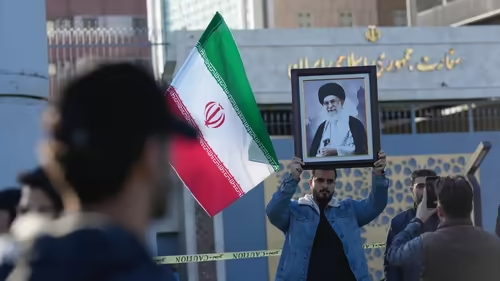
The phrase “Iran will be free” has echoed through the halls of European power, signaling a potential turning point in the long and fraught relationship between the European Union and the Islamic Republic. This bold declaration comes on the heels of a notable de-escalation from former U.S. President Donald Trump, whose previous threats had often dominated the international discourse on Iran . Now, with the political landscape shifting, the EU appears to be seizing the moment to chart its own course, most notably by pushing for the designation of Iran’s Islamic Revolutionary Guard Corps (IRGC) as a terrorist organization.
But what does this move truly mean? Is it a genuine step toward supporting Iranian civil society, or a calculated geopolitical maneuver? Let’s dive into the complex web of diplomacy, security, and human rights that defines the current EU Iran policy.
Table of Contents
- The Context: Trump’s Shifting Rhetoric on Iran
- The EU’s “Big Move”: Decoding “Iran Will Be Free”
- The IRGC Designation Debate: A Key Pillar of EU Iran Policy
- Tehran’s Response and the Risk of Escalation
- What Does the Future Hold for Iran?
- Conclusion
- Sources
The Context: Trump’s Shifting Rhetoric on Iran
For years, Donald Trump’s approach to Iran was defined by its maximum pressure campaign, which included crippling economic sanctions and stark military threats. His administration’s withdrawal from the Joint Comprehensive Plan of Action (JCPOA), the landmark nuclear deal, in 2018 marked a dramatic break from its European allies, who remained committed to the agreement .
However, recent reports indicate a toning down of these threats. While the specifics of this shift are nuanced, it has created a diplomatic vacuum that the EU is now attempting to fill. Freed from the immediate shadow of U.S. unilateralism, European leaders have found a window to assert their own strategic interests and values regarding Iran .
The EU’s “Big Move”: Decoding “Iran Will Be Free”
The statement “Iran will be free” is more than just a hopeful slogan; it’s a clear signal of the EU’s alignment with the aspirations of the Iranian people, particularly in the wake of widespread protests against the regime. This public stance represents a significant evolution in the EU Iran policy, moving beyond purely nuclear negotiations to a more holistic view that includes human rights and internal political dynamics.
This new posture is not without its critics. Some argue that such rhetoric can be counterproductive, potentially hardening the regime’s stance and endangering activists on the ground. Others see it as a necessary moral stance, asserting that the EU cannot remain silent in the face of systemic oppression.
The IRGC Designation Debate: A Key Pillar of EU Iran Policy
At the heart of the EU’s renewed strategy is the growing call to designate the IRGC as a terrorist organization. This move, long championed by the U.S. under Trump, has been a point of contention within the EU due to fears of legal complications and the potential to completely derail any remaining diplomatic channels .
Proponents of the designation argue that the IRGC is not just a military force but a central pillar of the regime’s domestic repression and its support for proxy groups across the Middle East. Listing it as a terrorist entity would be a powerful symbolic and practical step, freezing its assets and restricting its operations in Europe.
Why the EU Has Hesitated
Historically, the EU’s hesitation has stemmed from several key concerns:
- Legal Distinction: The EU has traditionally maintained a separation between its dealings with the Iranian state and its military apparatus, fearing that a blanket terrorist label could complicate all official communications.
- Diplomatic Fallout: There was a strong belief that such a move would provoke an immediate and severe backlash from Tehran, potentially ending the already fragile dialogue on the nuclear file and other regional issues .
- Internal Divisions: Member states have not always been unified on this issue, with some prioritizing economic interests and others focusing on security and human rights.
Tehran’s Response and the Risk of Escalation
Unsurprisingly, Tehran has reacted with fury to the prospect of an IRGC designation. An IRGC spokesperson dismissed the threat, stating, “We are never worried about such threats or even acting on them, because as much as our enemies give us a chance to act, we act stronger,” . This defiant stance underscores the high stakes involved.
Iran has previously warned that such a move would be a “red line” and has threatened reciprocal measures, which could include targeting European interests in the region or further destabilizing the Middle East. The EU is now walking a tightrope, trying to stand firm on its principles without triggering a full-blown crisis.
What Does the Future Hold for Iran?
The EU’s actions are part of a broader, long-term strategy. By aligning itself with the popular will of the Iranian people and taking a harder line on the regime’s security apparatus, the EU is betting on a future where a more moderate or democratic Iran emerges. This approach is a stark contrast to the transactional, deal-focused strategy of the past.
For readers interested in the broader implications of Western foreign policy, our analysis on [INTERNAL_LINK:middle-east-geopolitics] provides deeper context. The success of this new EU Iran policy will depend on its ability to maintain unity among its member states, coordinate effectively with other global powers, and, most importantly, avoid actions that could inadvertently harm the very people it seeks to support.
Conclusion
The EU’s declaration that “Iran will be free” and its push to designate the IRGC as a terrorist group mark a decisive and risky chapter in its relationship with Tehran. This shift, enabled by a change in the U.S. posture, reflects a more values-driven and assertive European foreign policy. While the path forward is fraught with danger and uncertainty, the EU appears determined to play a more active role in shaping Iran’s future, moving beyond the shadow of Trump-era threats to forge its own strategic vision.
Sources
- Times of India: ‘Iran will be free’: EU makes big move after Trump tones down threats
- Al Jazeera: EU terror designation would be ‘mistake’: Iran’s IRGC
- Council on Foreign Relations: Timeline: U.S.-Iran Relations
- Reuters: Iran condemns EU vote over ‘terrorist’ designation for IRGC