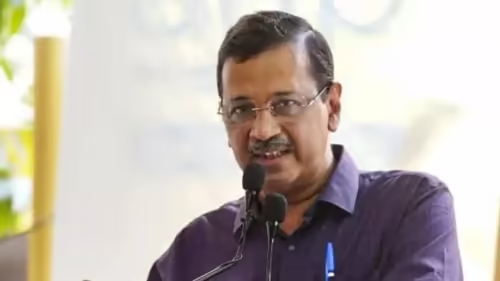
In a major legal and political development, former Delhi Chief Minister Arvind Kejriwal has been acquitted by a Delhi court in two cases filed by the Enforcement Directorate (ED). The cases centered on his alleged failure to appear before the agency in connection with the ongoing investigation into the now-scrapped Delhi excise policy . This verdict is not just a personal reprieve for Kejriwal; it’s a significant setback for the ED and a potential game-changer in the high-stakes political drama surrounding the Aam Aadmi Party (AAP).
Table of Contents
- The Verdict: A Clear Win for Kejriwal
- Background: The Delhi Excise Policy Probe
- The Kejriwal ED Case: What Were the Charges?
- Why the Court Acquitted Him: Key Reasons
- Political Fallout and Implications
- What Next for the Broader Excise Policy Investigation?
- Conclusion: A Temporary Respite or a Defining Moment?
- Sources
The Verdict: A Clear Win for Kejriwal
The court’s decision to acquit Arvind Kejriwal in the Kejriwal ED case is a decisive one. The ED had filed two separate complaints under Section 174-A of the Indian Penal Code (IPC), which deals with the punishment for non-appearance in response to a summons from a public servant. The agency had issued multiple summons to Kejriwal under the Prevention of Money Laundering Act (PMLA) as part of its probe into alleged irregularities and kickbacks in the formulation and implementation of the Delhi government’s 2021-22 excise policy .
Kejriwal’s legal team had consistently argued that his non-compliance was not out of defiance but due to his official duties as the Chief Minister of the National Capital Territory, a position that demands constant attention and carries significant constitutional responsibilities. The court appears to have found this argument compelling.
Background: The Delhi Excise Policy Probe
The controversy began in 2022 when the Delhi government introduced a new excise policy aimed at reforming the city’s liquor trade. However, the policy was soon mired in allegations of favoritism, procedural lapses, and a “South Group” cartel allegedly receiving undue benefits in exchange for a massive Rs 100 crore kickback. The policy was eventually scrapped by the Delhi government itself following intense scrutiny from the Lieutenant Governor and the central government.
The Central Bureau of Investigation (CBI) initiated a probe, which was later followed by the ED’s money laundering investigation. Several senior AAP leaders, including Deputy CM Manish Sisodia and Rajya Sabha MP Sanjay Singh, were arrested and remain in judicial custody. Kejriwal himself was named as a key conspirator in the ED’s chargesheet, though he was not arrested in this particular case.
The Kejriwal ED Case: What Were the Charges?
The specific charges against Kejriwal were narrow but strategically important for the ED. By filing cases for non-compliance with summons, the agency was attempting to build a narrative of willful obstruction and lack of cooperation. A conviction under Section 174-A IPC could have led to a jail term of up to six months, providing the ED with a legal basis to potentially seek his custodial interrogation in the main money laundering case.
This tactic has been used by investigative agencies in the past to pressure high-profile individuals into compliance. The acquittal, therefore, not only clears Kejriwal of these specific charges but also undermines the ED’s strategy of using procedural non-compliance as a tool to gain leverage in the larger investigation.
Why the Court Acquitted Him: Key Reasons
While the full judgment details are awaited, legal experts point to several probable reasons for the acquittal:
- Official Duties as a Valid Reason: The court likely accepted that the responsibilities of a sitting Chief Minister constitute a legitimate and sufficient reason for being unable to comply with every summons, especially if they conflict with critical state functions.
- Lack of Willful Intent: To secure a conviction under Section 174-A, the prosecution must prove that the non-appearance was intentional and without lawful excuse. The defense successfully argued that Kejriwal’s actions were not driven by malice or a desire to obstruct justice.
- Procedural Scrutiny: Courts are increasingly scrutinizing the use of such provisions to ensure they are not being weaponized for political or investigative overreach.
Political Fallout and Implications
This verdict is a massive political boost for Arvind Kejriwal and the AAP. It allows them to frame the entire ED investigation as politically motivated, a narrative they have been pushing since the beginning. With Delhi assembly elections on the horizon, this acquittal provides a powerful counter-narrative to the BJP’s allegations of corruption. It energizes the AAP cadre and gives Kejriwal a platform to return to the campaign trail with renewed vigor, claiming vindication from the judiciary.
What Next for the Broader Excise Policy Investigation?
It’s crucial to note that this acquittal is limited to the summons non-compliance cases. The main money laundering investigation into the Delhi excise policy is very much alive. The ED can still summon Kejriwal for questioning in that primary case, and the legal battle there is far from over. His arrest in the main case remains a possibility, though this recent win strengthens his legal position.
Conclusion: A Temporary Respite or a Defining Moment?
The acquittal in the Kejriwal ED case is a significant, albeit partial, victory. It provides Arvind Kejriwal with a crucial legal and political shield at a critical juncture. While it doesn’t end the broader probe, it forces the ED back to the drawing board and shifts the momentum in Kejriwal’s favor. For now, the man who once promised to fight corruption from within the system has won a key round in his own legal battle, setting the stage for an even more intense political showdown in the months to come.
Sources
- Times of India: Delhi excise policy probe: Court acquits Arvind Kejriwal in ED summons case
- The Hindu: Delhi court acquits Kejriwal in ED summons case
- Indian Kanoon (for legal context on Section 174-A IPC): Section 174-A in The Indian Penal Code
- [INTERNAL_LINK:delhi-excise-policy-timeline]
- [INTERNAL_LINK:aap-vs-bjp-delhi-politics]