Table of Contents
- The Trump Tariff Threat: What’s at Stake for India?
- Budget 2026: The Strategic Toolkit for Economic Defense
- What Top Economists Say India Must Do
- Which Indian Sectors Are Most at Risk?
- Beyond 2026: Building Long-Term Trade Resilience
- Conclusion: A Budget That Must Be Bold, Not Just Balanced
- Sources
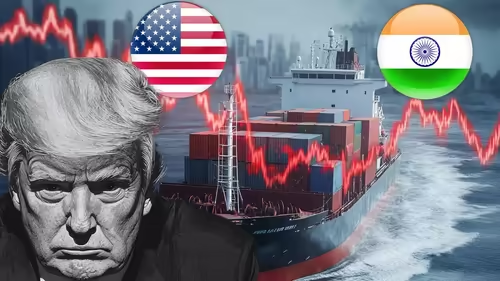
The global economic landscape is bracing for turbulence. With Donald Trump poised to return to the White House in 2025, his campaign promise of sweeping new tariffs—potentially targeting countries like India with duties as high as 60% on certain goods—has sent shockwaves through emerging markets . In this high-stakes environment, India’s Union Budget 2026 isn’t just another fiscal statement; it’s a critical national defense mechanism. Can Finance Minister Nirmala Sitharaman craft a budget that not only fuels domestic growth but also insulates the economy from an external trade storm? The answer will define India’s economic trajectory for years to come.
The Trump Tariff Threat: What’s at Stake for India?
During his previous term, Trump imposed tariffs on steel (25%) and aluminum (10%), which directly impacted Indian exporters. Now, he’s signaling a far more aggressive stance, vowing to use tariffs as a primary tool to reduce the U.S. trade deficit and protect American jobs. For India, the risks are significant:
- Export Disruption: Key sectors like pharmaceuticals, textiles, IT services, and auto components could face punitive duties, making Indian goods less competitive in the $1.2 trillion U.S. market.
- Investor Uncertainty: Trade wars create volatility, potentially deterring foreign direct investment (FDI) into India at a time when it’s competing with Vietnam and Mexico for manufacturing shifts.
- Currency Pressure: A sudden drop in export revenues could weaken the rupee, fueling imported inflation and complicating monetary policy.
In short, Trump’s tariff war isn’t just a U.S.-China issue—it’s a global challenge that India must proactively address.
Budget 2026: The Strategic Toolkit for Economic Defense
The Budget 2026 offers several levers to build economic resilience. Experts agree that a reactive approach won’t suffice; the government must be preemptive and strategic. Here’s how the budget can serve as a shield:
- Boost Domestic Manufacturing: Double down on PLI (Production-Linked Incentive) schemes, especially in electronics, solar modules, and specialty chemicals, to reduce import dependence and create export alternatives.
- Expand Market Diversification: Allocate funds to strengthen trade ties with the EU, UAE, Australia, and Latin America through dedicated export promotion councils and digital trade infrastructure.
- Strengthen MSMEs: Provide targeted credit guarantees and R&D subsidies to small businesses—the backbone of India’s export engine—so they can adapt to new global standards and compliance costs.
- Build Strategic Reserves: Use surplus forex reserves to create a “Trade Shock Absorber Fund” to stabilize key sectors hit by sudden tariff hikes.
This isn’t about isolationism; it’s about smart, diversified self-reliance [INTERNAL_LINK:atmanirbhar-bharat-export-strategy].
What Top Economists Say India Must Do
Economists consulted by leading financial dailies have offered sharp, actionable advice for the Budget 2026:
- Dr. Arvind Subramanian (Former Chief Economic Adviser): “Focus on ‘export readiness’—not just production. Invest in logistics, port efficiency, and digital customs to cut export clearance time by 50%.”
- Dr. Raghuram Rajan (Former RBI Governor): “Avoid tit-for-tat tariffs. Instead, use fiscal space to cushion affected workers and firms through temporary tax rebates and retraining programs.”
- Industry Chambers (CII, FICCI): Urge the government to fast-track Free Trade Agreements (FTAs) with the UK and EU to open alternative markets before U.S. tariffs bite.
The consensus is clear: the budget must prioritize agility over austerity.
Which Indian Sectors Are Most at Risk?
Not all industries face equal risk. Based on current U.S. import data, these sectors are most vulnerable to Trump’s proposed tariffs:
| Sector | U.S. Import Value (2025 est.) | Potential Tariff Impact |
|---|---|---|
| Pharmaceuticals | $7.2 billion | High – generics could face 25-40% duties |
| Textiles & Apparel | $5.8 billion | Very High – already under scrutiny |
| IT & Business Services | $4.1 billion | Medium – digital services tax possible |
| Auto Components | $3.9 billion | High – linked to EV supply chain tensions |
The Budget 2026 must include sector-specific mitigation plans, such as export credit insurance and innovation grants, to help these industries pivot quickly.
Beyond 2026: Building Long-Term Trade Resilience
While the immediate focus is on Trump’s 2025–2026 threat, the budget must also lay foundations for long-term resilience:
- Digital Public Infrastructure for Trade: Scale up platforms like ONDC (Open Network for Digital Commerce) to connect MSMEs directly to global buyers.
- Green Exports Push: Incentivize green hydrogen, battery tech, and sustainable textiles—areas where India can lead and avoid carbon-border tariffs.
- Skilling for Global Standards: Redirect education outlays toward certifications recognized in OECD markets, ensuring Indian labor remains globally competitive.
Conclusion: A Budget That Must Be Bold, Not Just Balanced
The Budget 2026 arrives at a pivotal moment. It cannot be a routine exercise in revenue and expenditure. To truly insulate India’s growth story from Trump’s tariff war, it must be a bold, forward-looking blueprint for economic sovereignty. By investing in diversification, empowering domestic industry, and preparing for worst-case scenarios, India can turn external threats into opportunities for deeper reform. The world will be watching—not just to see India’s numbers, but to witness its strategic resolve.