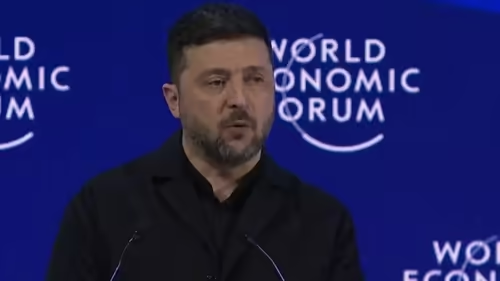
In a speech that sent shockwaves through the Alpine halls of Davos, Ukrainian President Volodymyr Zelenskyy didn’t just ask for help—he issued a stark warning to a continent he believes is sleepwalking into a dangerous future. His Zelenskyy Davos speech was a masterclass in geopolitical urgency, blending sharp criticism with a dose of dark humor and a truly baffling comment about Greenland.
Standing before the world’s most powerful leaders at the World Economic Forum 2026, Zelenskyy painted a picture of a Europe that is not just unprepared, but fundamentally “lost” . His message was clear: without a radical shift in its approach to defense and justice, Europe is doomed to repeat the same catastrophic mistakes.
Table of Contents
- The Core of Zelenskyy’s Critique: A ‘Lost’ Europe
- The ‘Groundhog Day’ Loop of Inaction
- Decoding the Bizarre Greenland Remark
- Zelenskyy’s Vision for a Stronger Europe
- The US Versus Europe Dichotomy
- Conclusion: What Next for European Security?
- Sources
The Core of Zelenskyy’s Critique: A ‘Lost’ Europe
The central theme of Zelenskyy’s address was a profound disappointment in Europe’s strategic direction. He lamented the continent’s failure to build its own credible defense capabilities, a vulnerability that has been brutally exposed by Russia’s ongoing war .
“Europe looks lost,” he declared, a phrase that instantly became the headline from Davos . This wasn’t just a casual observation; it was a direct indictment of a political and military establishment that, in his view, prioritizes bureaucracy and consensus over decisive action. He questioned Europe’s collective will to pursue justice and hold Russia fully accountable for its invasion, suggesting a lack of moral clarity that could have far-reaching consequences for the entire region’s security architecture.
The ‘Groundhog Day’ Loop of Inaction
To drive home his point about Europe’s repetitive and ineffective responses, Zelenskyy reached for a pop-culture reference: the 1993 film Groundhog Day. In the movie, the main character, played by Bill Murray, is trapped in a time loop, forced to relive the same day over and over again .
Zelenskyy used this metaphor to describe his own frustrating experience of repeatedly asking European leaders for the same critical support—air defense systems, long-range weapons, and a clear path to EU membership—only to be met with delays and half-measures . He implied that Europe itself is stuck in this loop, unable to break free from a cycle of hesitation and incrementalism that is simply not enough to deter a determined aggressor like Russia. This “Groundhog Day” existence, he warned, is a luxury Europe can no longer afford.
Decoding the Bizarre Greenland Remark
Perhaps the most head-scratching moment of the speech was Zelenskyy’s assertion that “Ukraine can defend Greenland.” On the surface, this seems geographically and strategically absurd. However, experts believe this was a pointed, albeit cryptic, jab at former U.S. President Donald Trump, who has previously mused about the U.S. purchasing the Danish territory .
Zelenskyy’s full quote was, “Ukraine respects Denmark’s sovereignty and territorial integrity,” before adding the line about defending Greenland . The subtext appears to be a warning against the transactional and imperialistic view of global territories that such comments represent. By stating Ukraine—a nation fighting for its very survival—could defend a place like Greenland, he was likely emphasizing the value of a principled defense of sovereignty over any notion of land as a commodity to be bought and sold. It was a surreal but potent reminder that the rules-based international order is under threat from multiple angles.
Zelenskyy’s Vision for a Stronger Europe
Despite the harsh criticism, Zelenskyy’s speech wasn’t purely negative. He offered a constructive path forward, positioning Ukraine not as a burden, but as a key partner in building a more secure Europe. He highlighted existing models of cooperation, such as the joint production of drones, which he claims can “make all of Europe stronger” .
His vision is one of deep integration, where Ukraine’s frontline experience and industrial capacity are woven into the fabric of European defense. He argued that investing in Ukraine’s ability to fight is the most effective way for Europe to protect itself, turning the country into a shield on the continent’s eastern flank. This pragmatic approach is a direct counter to the perceived passivity he criticized.
The US Versus Europe Dichotomy
A subtle but important thread in Zelenskyy’s address was the contrast he drew between the United States and Europe. While not lavishing praise on Washington, he framed the US as a more decisive actor, willing to take concrete steps to support Ukraine and counter Russian aggression .
This comparison served to amplify his critique of Europe. If the US, an ocean away, can act with more resolve, why can’t Europe, whose own security is directly at stake? This rhetorical device was designed to provoke a sense of shame and urgency among his European audience, pushing them to match or exceed the level of commitment shown by their transatlantic ally.
Conclusion: What Next for European Security?
President Zelenskyy’s Zelenskyy Davos speech was a pivotal moment in the ongoing debate about Europe’s role in its own defense. By calling Europe “lost” and trapped in a “Groundhog Day” of inaction, he has thrown down a gauntlet. His cryptic Greenland remark, while puzzling, underscored a deeper anxiety about the erosion of international norms. The ball is now firmly in Europe’s court. Will it heed this urgent call to build genuine defense capabilities and break free from its cycle of hesitation, or will Zelenskyy’s warnings from Davos become a self-fulfilling prophecy?