Table of Contents
- A Landscape From Another World
- Where is the Atacama Desert?
- The Mind-Boggling Rainfall Records
- Why Is the Atacama So Unbelievably Dry?
- Life in the Harshest of Conditions
- A Natural Laboratory for Science
- Conclusion: A Stark Reminder of Our Planet’s Extremes
- Sources
A Landscape From Another World
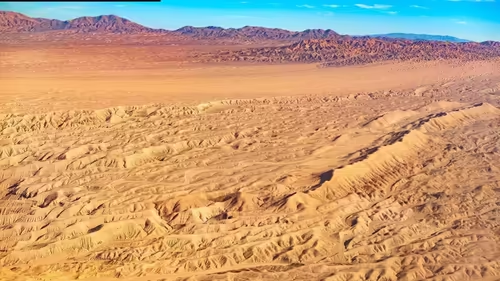
Imagine a place where the ground is so parched that it cracks into geometric patterns, where rivers are just dry scars on the earth, and where the sky can be a relentless, cloudless blue for decades on end. This isn’t science fiction; it’s the reality of the driest place on Earth: Chile’s Atacama Desert. In its most arid core, rainfall is not just rare—it’s a once-in-a-lifetime, or even a once-in-several-centuries, event. This extreme environment offers a profound glimpse into the planet’s most unforgiving climates and has become a crucial site for scientific discovery.
Where is the Atacama Desert?
The Atacama Desert stretches for over 600 miles along the Pacific coast of South America, primarily in northern Chile but also spilling into parts of Peru, Bolivia, and Argentina. It’s a land of dramatic contrasts, bordered by the towering Andes Mountains to the east and the cool waters of the Pacific Ocean to the west. Despite its proximity to the ocean, which is a major source of moisture for most coastal regions, the Atacama remains astonishingly dry—a paradox that lies at the heart of its mystery .
The Mind-Boggling Rainfall Records
The statistics surrounding the Atacama’s aridity are almost incomprehensible. The town of Arica, located within the desert, holds the Guinness World Record for the longest dry period ever recorded: a staggering 172 months—over 14 years—without a single drop of rain from October 1903 to January 1918 .
However, this record pales in comparison to what happens in the desert’s hyperarid core. Scientific studies and historical records suggest that in some of these central regions, significant rainfall may only occur a few times per century . Some weather stations in the area have never recorded any precipitation since their installation, leading experts to state that parts of the Atacama may not have seen rain for hundreds of years . The average annual precipitation across much of the desert is less than 1 millimeter (0.04 inches), with some areas receiving as little as 0.03 inches per year .
Why Is the Atacama So Unbelievably Dry?
The Atacama’s extreme dryness is the result of a perfect storm of geographical and meteorological factors working in concert:
- The Rain Shadow Effect: The massive Andes Mountains to the east act as an impenetrable wall, blocking moisture-laden clouds coming from the Amazon Basin. By the time any air mass crosses the mountains, it has lost all its moisture.
- The Pacific Anticyclone: A large, stable high-pressure system sits over the southeastern Pacific Ocean. This system causes air to sink, which warms it and prevents cloud formation, effectively creating a permanent atmospheric lid that suppresses rain.
- The Cold Humboldt Current: The cold ocean current flowing northward along the Chilean coast cools the air above it. This cool, dense air is less likely to rise and form the convective clouds needed for rainfall, further stabilizing the atmosphere .
This unique combination of factors creates a natural fortress against precipitation, making the Atacama a true hyperarid desert.
Life in the Harshest of Conditions
If you think the Atacama is a barren wasteland, think again. Life, in its most resilient forms, finds a way. Microbial life has been discovered living inside the desert’s rocks, using the tiny amounts of moisture they can trap from fog or rare dew events. These extremophiles are of immense interest to astrobiologists, as they provide a model for how life might survive on other planets like Mars.
Beyond microbes, the desert supports a surprising array of hardy plant and animal life, especially in its less extreme fringes and in the Andean foothills. Llamas, vicuñas, and various species of foxes have adapted to the scarcity of water. After the extremely rare rain events, the desert can undergo a spectacular transformation known as the “desierto florido” (flowering desert), where dormant seeds explode into a vibrant carpet of wildflowers—a breathtaking testament to nature’s patience and resilience.
A Natural Laboratory for Science
The Atacama’s otherworldly conditions have made it a prime location for scientific research. Its clear, dry skies offer some of the best astronomical viewing conditions on the planet, which is why it hosts the world-famous Atacama Large Millimeter/submillimeter Array (ALMA) and other major observatories .
More intriguingly, its Mars-like soil and geology have turned it into a testing ground for NASA and other space agencies. Rovers and instruments destined for the Red Planet are often trialed here to ensure they can function in similarly harsh, dry, and dusty environments. Studying the Atacama helps us not only understand our own planet’s extremes but also prepares us for the exploration of others. For more on how Earth’s extremes inform space exploration, see our feature on [INTERNAL_LINK:extreme-environments-and-space-research].
Conclusion: A Stark Reminder of Our Planet’s Extremes
The Atacama Desert, the undisputed driest place on Earth, is far more than just a barren expanse of sand and rock. It is a dynamic, complex ecosystem shaped by powerful natural forces, a beacon for astronomers peering into the cosmos, and a crucial analog for the search for life beyond our world. Its story is a powerful reminder of the incredible diversity of our planet’s climates and the astonishing tenacity of life itself. In a world increasingly concerned with climate change and water security, the Atacama stands as a stark and silent monument to the ultimate limits of aridity.
Sources
- Times of India: This is the driest place on Earth where rain may not fall for centuries
- Guinness World Records data on the Atacama Desert’s dry period [[1], [9]]
- Scientific publications on Atacama’s climate and precipitation history [[3], [4]]
- Geographical and meteorological analyses of the Atacama Desert [[2], [6], [7], [8]]