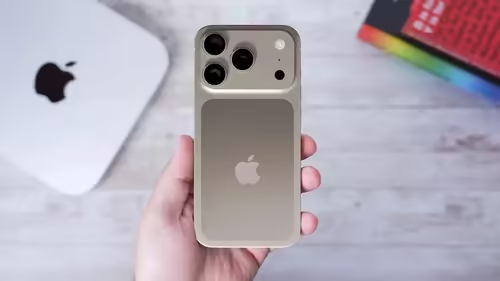
Is This Apple’s Most Ambitious Gadget Since the iPhone?
Rumors are swirling about a stealth project deep inside Apple Park that could mark the company’s boldest leap into artificial intelligence yet: the Apple AI Pin. According to recent reports, Apple is developing a compact, wearable AI device—roughly the size of an AirTag—that packs dual cameras, microphones, and a speaker to constantly observe, listen, and respond to your environment . If it launches (and that’s a big if), it could hit shelves as early as 2027, positioning Apple directly against OpenAI’s rumored AI hardware ambitions.
Table of Contents
- What Is the Apple AI Pin?
- Key Features and Specs (Rumored So Far)
- How It Compares to OpenAI’s Hardware Plans
- Why Apple Might Cancel the Project
- Potential Use Cases and Privacy Concerns
- Conclusion: Will the Apple AI Pin Become Reality?
- Sources
What Is the Apple AI Pin?
The Apple AI Pin isn’t just another smartwatch or earbud—it’s envisioned as a standalone, always-on AI companion you can clip to your shirt, bag, or lapel. Unlike the Apple Watch, which relies heavily on the iPhone, this device would operate independently using on-device and cloud-based AI to interpret real-world context in real time. Think of it as a personal assistant that sees what you see, hears what you hear, and speaks back when needed—without you ever pulling out your phone.
This aligns with Apple’s broader strategy to embed AI more deeply into its ecosystem following the launch of Apple Intelligence in iOS 18. But instead of just enhancing existing devices, the AI Pin represents a new product category altogether—one that could redefine how we interact with technology in public spaces.
Key Features and Specs (Rumored So Far)
While Apple remains tight-lipped (as usual), insiders and supply chain analysts have pieced together a preliminary picture of what the AI Pin might offer:
- Form Factor: Approximately the size of an AirTag (31.9mm diameter), designed to be clipped or pinned to clothing.
- Sensors: Dual cameras for depth perception and environmental awareness, multiple microphones for noise cancellation and voice capture, and a built-in speaker for audio feedback.
- AI Capabilities: Powered by a custom low-power chip optimized for on-device AI processing, likely leveraging the same neural engine found in A-series or M-series chips.
- Connectivity: Expected to support Bluetooth, Wi-Fi, and possibly ultra-wideband (UWB) for spatial awareness and device pairing.
- Battery Life: Likely limited due to constant sensing—possibly requiring daily charging or even a hot-swappable battery system.
Notably, there’s no screen. All interaction would be voice- or gesture-based, making it a truly ambient computing device—similar in philosophy to Humane’s controversial AI Pin, but with Apple’s signature polish and privacy safeguards .
How It Compares to OpenAI’s Hardware Plans
Apple isn’t operating in a vacuum. OpenAI CEO Sam Altman has been shopping around a mysterious AI hardware prototype to potential partners like SoftBank and Apple itself . While details are scarce, reports suggest OpenAI’s device may also be a wearable AI assistant.
The race is on: both tech giants want to own the “ambient AI” layer—the invisible interface between humans and intelligent systems. But their approaches differ. Apple prioritizes on-device processing and user privacy, while OpenAI leans heavily on cloud-based large language models. If Apple launches its AI Pin first, it could set the gold standard for secure, private AI wearables—something consumers increasingly demand amid growing data privacy concerns .
Why Apple Might Cancel the Project
Despite the excitement, don’t get your hopes up just yet. Apple kills more products than it ships—remember the Apple Car? The AI Pin is still in its early development phase, and internal sources confirm it could be scrapped if it fails to meet Apple’s stringent benchmarks for performance, usability, or market readiness .
Key hurdles include:
- Battery limitations for always-on sensing
- Thermal management in such a small form factor
- User adoption—will people really wear a camera-equipped pin all day?
- Regulatory scrutiny around always-on recording in public spaces
As one Apple insider told reporters: “It’s a moonshot. Cool in theory, but hard in practice.”
Potential Use Cases and Privacy Concerns
If successful, the Apple AI Pin could enable powerful new experiences:
- Real-time translation during conversations
- Visual assistance for the visually impaired (“There’s a coffee cup on your left”)
- Contextual reminders (“You’re near the pharmacy—don’t forget your prescription”)
- Hands-free note-taking in meetings or lectures
But these benefits come with serious privacy trade-offs. A device that’s always watching and listening—even if processed locally—raises red flags. Apple will need to implement ironclad privacy controls, like physical camera shutters, clear LED indicators when recording, and strict opt-in permissions. For deeper insights into wearable ethics, see our analysis on [INTERNAL_LINK:ethics-of-ai-wearables].
Conclusion: Will the Apple AI Pin Become Reality?
The Apple AI Pin represents a fascinating gamble—one that could either pioneer a new era of ambient intelligence or join the graveyard of ambitious prototypes. With a potential 2027 launch window, Apple has time to refine the concept, solve engineering challenges, and gauge market appetite. One thing is certain: if it ships, it won’t just be another gadget. It’ll be a statement about where Apple believes personal computing is headed next—away from screens and into the fabric of everyday life.
Sources
- Times of India: Apple is reportedly working on an AI Pin with cameras, microphone and speaker
- The Verge: Humane AI Pin review: A glimpse at the future—or a cautionary tale?
- Bloomberg: OpenAI’s Sam Altman is pitching AI hardware to tech giants
- Electronic Frontier Foundation: Privacy Implications of Always-On Wearables