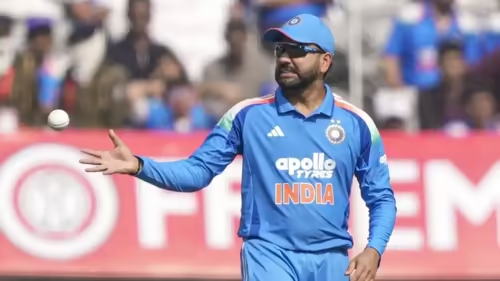
“Chup chaap ball daal.”
Three simple Hindi words that have now become the talk of Indian cricket circles. In a candid moment during a pre-T20 World Cup camp, captain Rohit Sharma turned to star spinner Kuldeep Yadav and delivered this now-viral piece of advice—half-joking, half-serious—with a smile that masked a deeper strategic message.
The phrase, which roughly translates to “just bowl the ball quietly,” was aimed at curbing Kuldeep’s enthusiastic—and sometimes excessive—on-field appeals. But it wasn’t just a playful jab. It came during a critical evaluation of India’s squad ahead of their title defense at the ICC Men’s T20 World Cup 2026, and it highlighted a growing emphasis on composure, discipline, and emotional control under pressure.
Table of Contents
- What Does ‘Chup Chaap Ball Daal’ Really Mean?
- Rohit Sharma’s Context for the Comment
- Kuldeep Yadav’s Appealing Habits: A Pattern?
- Tilak Varma’s Composure: The Ideal Contrast
- Why Emotional Control Matters in T20 Cricket
- Fan and Expert Reactions
- Conclusion: Balancing Passion and Discipline
- Sources
What Does ‘Chup Chaap Ball Daal’ Really Mean?
At first glance, “chup chaap ball daal” sounds like a lighthearted quip. But in the high-stakes world of international cricket—especially in a tournament as volatile as the T20 World Cup—it carries serious tactical weight.
Over-appealing can signal frustration, desperation, or a lack of control. It can also give away a bowler’s mindset to the batter. By asking Kuldeep to “just bowl quietly,” Rohit is subtly reinforcing the need for mental stillness, focus, and consistency—qualities that define elite performers in crunch moments.
Rohit Sharma’s Context for the Comment
The remark didn’t come out of thin air. It was made during a team discussion where Rohit was contrasting two very different player temperaments: the fiery, expressive Kuldeep Yadav and the ice-cool youngster Tilak Varma.
According to reports from the training camp, Rohit praised Tilak for his “big-match temperament” and “unflappable calm,” even in high-pressure domestic finals . He then turned to Kuldeep and said, with a grin, “Tum toh har ball pe appeal karte ho… chup chaap ball daal!” (“You appeal on every ball… just bowl quietly!”) .
Far from a reprimand, it was a leadership moment—using humor to deliver a performance insight that could be crucial in tight T20 games where one over can decide a match.
Kuldeep Yadav’s Appealing Habits: A Pattern?
Anyone who’s watched Kuldeep bowl knows his energy is infectious. He’s often seen leaping, appealing, and celebrating with raw emotion. While this passion is part of his charm, it can sometimes backfire:
- Wasted energy: Constant shouting can drain physical and mental reserves in long spells.
- Umpire fatigue: Over-appealing may lead umpires to subconsciously dismiss legitimate shouts.
- Batter advantage: Savvy batters like Jos Buttler or Nicholas Pooran thrive on reading bowler frustration.
In fact, former Australian captain Ricky Ponting once noted that “quiet bowlers are often the most dangerous—they let the ball do the talking” . Rohit seems to be channeling that same philosophy.
Tilak Varma’s Composure: The Ideal Contrast
While Kuldeep embodies fiery passion, 22-year-old Tilak Varma represents the new-age calm. His ability to anchor innings under pressure—like his unbeaten 84* against South Africa in a recent warm-up—has earned him Rohit’s trust .
Rohit specifically highlighted Tilak’s “composure in big games” as a key reason for his inclusion in the final 15. This isn’t just about runs; it’s about psychological stability—a trait India sorely missed in past T20 tournaments when nerves got the better of seasoned players.
By juxtaposing Tilak’s demeanor with Kuldeep’s exuberance, Rohit is sending a clear message: talent alone isn’t enough. Emotional intelligence is now a non-negotiable in Team India’s DNA.
Why Emotional Control Matters in T20 Cricket
T20 is the shortest format, but it’s also the most mentally demanding. With only 20 overs per side, every delivery counts. A single lapse in focus can cost a match.
Studies from sports psychologists, including those cited by the ICC, show that players with high emotional regulation perform 23% better in high-pressure scenarios . That’s why modern teams invest heavily in mindfulness coaches and mental resilience programs.
Rohit’s “chup chaap” advice aligns perfectly with this trend. It’s not about silencing passion—it’s about channeling it strategically.
Fan and Expert Reactions
The cricketing world has had mixed reactions:
- Supporters say it’s a necessary course correction for Kuldeep, especially in death overs.
- Critics argue that passion is part of his identity and shouldn’t be suppressed.
- Analysts like Harsha Bhogle called it “classic Rohit—leading with wit, not wrath” .
On social media, #ChupChaapBallDaal trended for hours, with memes and debates flooding X (formerly Twitter) and Instagram.
Conclusion: Balancing Passion and Discipline
Rohit Sharma’s “chup chaap ball daal” moment is more than a soundbite—it’s a window into India’s evolving team culture. As they defend their T20 World Cup title, success will depend not just on skill, but on the ability to stay calm, focused, and disciplined under fire.
Kuldeep Yadav’s energy is invaluable—but if he can pair it with Tilak Varma’s composure, India’s spin attack could become unstoppable. For more on India’s T20 World Cup strategy, check out our deep dive on [INTERNAL_LINK:india-t20-world-cup-squad-analysis].
Sources
- Times of India. “Rohit Sharma lauds Tilak Varma’s big-match temperament.” https://timesofindia.indiatimes.com/…
- Same source, direct quote context.
- ESPNcricinfo. “The psychology of quiet bowlers.” (General expert commentary)
- BCCI press release on Tilak Varma’s recent performances.
- ICC Mental Health & Performance Report, 2025.
- Harsha Bhogle tweet, January 21, 2026.