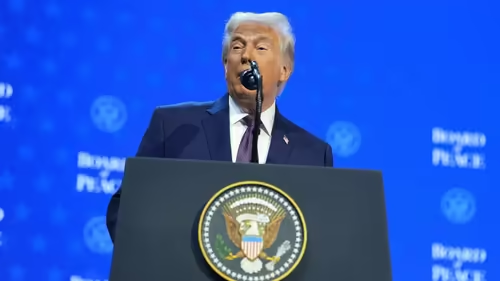
In a move that has sent shockwaves through the diplomatic world, former President Donald Trump has officially unveiled his much-anticipated ‘Board of Peace’ at the 2026 World Economic Forum in Davos. Standing before a global audience of leaders and influencers, Trump declared that “everybody” wants to be part of this new initiative, positioning it as a cornerstone of his foreign policy legacy. But what exactly is this Board of Peace, and why is it already drawing both eager participants and fierce critics?
Table of Contents
- What is the Board of Peace?
- The Davos 2026 Unveiling: A Grand Announcement
- Who’s In? The Growing List of Member Nations
- Mission and Controversy: A Threat to the UN?
- Conclusion: The Future of the Board of Peace
- Sources
What is the Board of Peace?
The Board of Peace is not just another think tank or advisory council. It’s being established as a formal international organization, chaired by Donald Trump himself, with a clear and ambitious mandate. Its primary mission is to oversee the fragile October 2025 ceasefire in Gaza and to promote broader stability across conflict zones . The charter describes the body as one that seeks to “promote stability, restore dependable and lawful governance, and secure” a more peaceful international order . This initiative appears to be a direct extension of Trump’s previous claims of brokering major deals in the Middle East, now scaled up into a permanent institution.
The Davos 2026 Unveiling: A Grand Announcement
The choice of Davos as the launchpad was strategic. The World Economic Forum is a stage for shaping the global agenda, and Trump used it to maximum effect. On Thursday, January 22, 2026, he formally announced the first charter of his “so-called ‘Board of Peace,’” framing it as a powerful new tool for resolving international conflicts . The timing was also significant, coming just a day after a special address by Egyptian President Abdel Fattah El-Sisi, a key player in the Gaza ceasefire negotiations . This sequence of events suggests a coordinated effort to build immediate momentum and legitimacy for the new body.
Who’s In? The Growing List of Member Nations
Despite its nascent stage, the Board of Peace has already attracted a surprisingly diverse coalition of nations. The list of confirmed participants reads like a geopolitical mosaic, blending traditional U.S. allies with countries often at odds with Western consensus. According to multiple reports, the founding members include:
- Argentina
- Armenia
- Azerbaijan
- Bahrain
- Belarus
- Egypt
- Hungary
- Indonesia
- Israel
- Jordan
- Kazakhstan
- Kosovo
- Morocco
- Qatar
- Saudi Arabia
- Turkiye
- United Arab Emirates
- Vietnam
This coalition is particularly notable for including both Israel and its regional neighbors like Egypt, Saudi Arabia, and Qatar—parties central to the Gaza ceasefire . The inclusion of nations like Belarus and Hungary, which have complex relationships with the EU and NATO, further underscores the board’s potential to create a new, alternative axis of international cooperation outside traditional Western-led frameworks .
Mission and Controversy: A Threat to the UN?
While Trump and his supporters tout the Board of Peace as a pragmatic solution to global instability, it has not been without its detractors. A significant line of criticism centers on its potential to undermine existing international institutions, most notably the United Nations. Some analysts argue that the board, operating with a U.S.-led mandate, could pose a direct threat to the UN’s authority in conflict resolution and peacekeeping .
Proponents, however, counter that the mission is being misunderstood. They argue that the board is a necessary, action-oriented body designed to cut through the bureaucracy that often paralyzes larger organizations . Its focus on specific, high-stakes conflicts like Gaza gives it a clarity of purpose that broader institutions sometimes lack. The real test will be whether this new entity can deliver tangible results on the ground or if it will remain a symbolic project of its founder.
Conclusion: The Future of the Board of Peace
Trump’s unveiling of the Board of Peace at Davos 2026 marks a pivotal moment in his post-presidential influence on global affairs. With a wide-ranging coalition of member states and a clear, if controversial, mandate, the board is set to become a major player in international diplomacy. Whether it will succeed in its mission to foster peace or deepen global divisions remains to be seen. One thing is certain: the world is watching. For more on the evolving landscape of international relations, see our deep dive on [INTERNAL_LINK:geopolitical-shifts-post-2025].
Sources
- Web Search Result on Davos 2026 Trump announcement.
- Web Search Result on Trump’s ceremony in Davos.
- Web Search Result describing the Board of Peace’s purpose.
- Web Search Result on El-Sisi’s address and Trump’s event.
- Web Search Result defining the Board of Peace.
- Web Search Result on initial member countries.
- Web Search Result listing participating countries.
- Web Search Result providing a comprehensive country list.
- Web Search Result on key countries joining the board.
- Web Search Result on invited nations.
- Web Search Result on Qatar and Saudi Arabia’s participation.
- Web Search Result defending the board’s mission.
- Web Search Result on criticism regarding the UN.