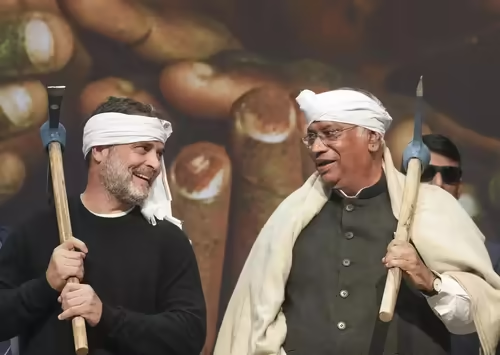
In a dramatic escalation of the political battle over rural welfare, Congress leader Rahul Gandhi has issued a stark warning: the newly introduced VB-G RAM G Act is not just a policy change, but a fundamental assault on India’s democratic fabric. Speaking at the National MGNREGA Workers’ Convention, Gandhi didn’t mince words, accusing Prime Minister Narendra Modi and the BJP of plotting to establish a “King’s rule” in the country.
His central allegation? That this new legislation is designed to systematically dismantle the Mahatma Gandhi National Rural Employment Guarantee Act (MGNREGA) and, with it, the very concept of Panchayati Raj—the bedrock of local self-governance in rural India. This isn’t just about jobs; it’s about who holds the power in our villages.
Table of Contents
- What is the VB-G RAM G Act?
- Rahul Gandhi’s Scathing Critique: From “Anti-Village” to “King’s Rule”
- The Panchayati Raj Power Struggle
- BJP’s Defense and the Political Battle Ahead
- Conclusion: What Does This Mean for Rural India?
- Sources
What is the VB-G RAM G Act?
Officially titled the Viksit Bharat – Guarantee for Rozgar and Ajeevika Mission (Gramin) Act, 2025, the VB-G RAM G Act is the government’s proposed replacement for the two-decade-old MGNREGA. Introduced in the Lok Sabha in December 2025, its stated aim is to modernize and strengthen the rural employment framework .
The government claims the new Act is a “gamechanger for rural India,” promising to shift the focus from mere wage employment to sustainable wealth creation and livelihoods [[14], [16]]. It even proposes to increase the guaranteed workdays from 100 to 125 per household per year . Proponents within the BJP argue it introduces greater transparency and accountability into the system .
However, the devil, as critics claim, is in the details of implementation and control.
Rahul Gandhi’s Scathing Critique: From “Anti-Village” to “King’s Rule”
Rahul Gandhi has been at the forefront of the opposition to this new law, launching a dedicated “MGNREGA Bachao Abhiyan” (Save MGNREGA Campaign) . His core argument is that the VB-G RAM G Act is fundamentally “anti-village” and “anti-poor” [[1], [2]].
He contends that the Act will effectively demolish the rights-based architecture of MGNREGA, which legally guaranteed work as a right to every rural household. Instead, he fears the new scheme will operate on a rationed, discretionary model where the Centre, not the local community, decides everything .
“PM Modi wants to finish the concept of Panchayati Raj… The BJP wants an India where the King decides everything,” Gandhi declared at the convention .
He has drawn a direct parallel between this move and the now-repealed farm laws, framing both as top-down impositions that disregard the voices of those most affected . He has even likened its potential impact to the economic shock of demonetisation . For Gandhi, this is a fight to protect the democratic rights of the poor against centralized, unaccountable power.
The Panchayati Raj Power Struggle
Gandhi’s warning about the end of Panchayati Raj is not made in a vacuum. The 73rd Constitutional Amendment was a landmark moment that devolved power to the grassroots level, giving Gram Panchayats the authority to plan and execute local development works, including those under MGNREGA.
The fear among critics is that the VB-G RAM G Act will recentralize this decision-making. By giving the Central government the final say on the type of work to be undertaken and the allocation of funds—with an alleged bias towards BJP-ruled states—it would strip the elected village councils of their autonomy . This, they argue, is a direct path to the “King’s rule” Gandhi describes, where a distant bureaucracy in Delhi dictates the fate of every village.
This concern is amplified by other recent actions in various BJP-ruled states, where there have been allegations of the party interfering in panchayat elections or diluting their financial powers, seen by opponents as a broader pattern of centralizing control [[26], [27]].
BJP’s Defense and the Political Battle Ahead
The BJP has firmly rejected these accusations. Union ministers and party leaders have dismissed the Congress’s campaign as a web of “lies” and misinformation designed to mislead the public . They argue that the VB-G RAM G Act is a necessary evolution, not a demolition, of the rural employment scheme.
According to the government, the new Act will lead to the creation of more durable and productive assets in critical sectors like water management, rural connectivity, and agriculture support, thereby creating long-term wealth rather than just short-term wages [[15], [16]]. BJP leader C.T. Ravi has accused the Congress of misleading the people and defended the changes as enhancements to the existing system .
As the bill moves through the legislative process, this debate is set to become a major flashpoint in Indian politics. It pits the BJP’s vision of a centrally-driven, efficiency-focused development model against the Congress’s defense of a decentralized, rights-based approach rooted in local democracy.
Conclusion: What Does This Mean for Rural India?
The controversy surrounding the VB-G RAM G Act is far more than a political slugfest. It strikes at the heart of how India chooses to govern its vast rural landscape. On one side is the promise of a more streamlined, asset-focused program. On the other is the fear of losing hard-won democratic rights and local control.
For the millions of rural workers who depend on these schemes for their livelihood, the stakes couldn’t be higher. The outcome of this battle will determine not just how many days of work they get, but who gets to decide what work is done in their own villages. Will it be their elected Panchayat, or a distant “King” in the capital? As Rahul Gandhi and the Congress mobilize their “MGNREGA Bachao Abhiyan,” the nation watches to see which vision for rural India will prevail. For more on the future of India’s social welfare schemes, see our analysis on [INTERNAL_LINK:rural-development-policies-in-india].
Sources
- Times of India: BJP wants King’s rule: Rahul Gandhi urges ‘poor’ to unite against VB-G RAM G Act
- The Hindu: Rahul Gandhi criticizes the VB-G RAM G Bill
- India Today: Anti-village, anti-poor? Rahul Gandhi warns Modi govt’s VB-G RAM G bill
- PRS Legislative Research: The Viksit Bharat – Guarantee for Rozgar and Ajeevika Mission (Gramin) (VB—G RAM G) Bill, 2025
- Business Standard: VB-G RAM G Act a symbol of transparency and accountability