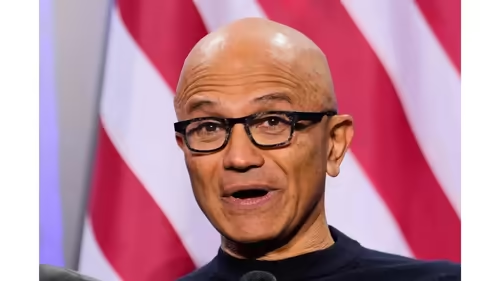
The AI gold rush is in full swing, but one of its most prominent leaders is hitting the brakes. Microsoft CEO Satya Nadella has delivered a sobering message to every company racing to build the next big AI model: **innovation alone isn’t enough**. In a series of recent interviews, Nadella has cautioned that the entire AI industry is on thin ice with the public and governments, and it risks losing its “social permission” to exist if it fails to prove its worth in the real world .
This isn’t just a philosophical musing; it’s a direct challenge to the current trajectory of AI development, which often prioritizes scale and novelty over practical, human-centered impact. Nadella’s core argument is simple yet profound: the enormous energy resources consumed by AI data centers must be justified by equally enormous benefits for humanity .
Table of Contents
- What Is ‘Social Permission’ and Why Does It Matter?
- Nadella’s Mandate for Real-World Impact
- The AI Energy Dilemma: A Growing Concern
- Beyond the Hype: Practical AI Applications That Deliver
- The Path Forward: Responsible AI Innovation
- Conclusion
- Sources
What Is ‘Social Permission’ and Why Does It Matter?
“Social permission” is an unspoken contract between technology and society. It’s the collective trust that allows a new technology to flourish, access resources, and operate with minimal friction. Think of it as society’s license to innovate. As Nadella bluntly put it, “If you’re going to use energy, you better have social permission to use it” .
This concept is crucial because AI, particularly large language models, is incredibly resource-intensive. The training and operation of these models require vast amounts of electricity, contributing to a significant carbon footprint. If this energy expenditure doesn’t translate into clear, positive outcomes for everyday people, the public backlash could be swift and severe. Governments might impose heavy regulations, consumers could reject AI products, and investors may pull back, effectively strangling the industry’s growth .
Nadella’s Mandate for Real-World Impact
Nadella isn’t just issuing a vague warning; he’s pointing to specific areas where AI must deliver. He has repeatedly emphasized that the technology’s success should be measured by its ability to create tangible improvements in three critical sectors: healthcare, education, and productivity .
For instance, in healthcare, AI could help diagnose diseases earlier, accelerate drug discovery, or personalize treatment plans. In education, it could provide personalized tutoring for students in under-resourced schools or help teachers manage administrative tasks. In the workplace, it could automate mundane chores, freeing up human creativity and strategic thinking. These are the kinds of concrete benefits that justify AI’s existence and its resource consumption. Without them, AI risks being seen as nothing more than a costly and environmentally damaging experiment .
The AI Energy Dilemma: A Growing Concern
The environmental cost of AI is no longer a fringe concern. A single training run for a large AI model can consume as much electricity as dozens of American homes use in a year. As the demand for AI services explodes, so does its energy appetite. This has placed the tech industry in a precarious position.
Nadella’s warning about losing “social permission” is a direct acknowledgment of this tension. He argues that the industry cannot simply assume it has a blank check to consume power. There must be a quid pro quo—a clear demonstration that the energy used is creating proportional value for society. As he stated, “We will quickly lose even the social permission to actually take something like energy, which is a scarce resource, and use it to generate… [models] that don’t do anything useful” .
Beyond the Hype: Practical AI Applications That Deliver
So, what does “doing something useful” look like? It means moving beyond chatbots that write clever poems and focusing on AI that solves hard problems. Here are a few examples of the kind of real-world impact Nadella is advocating for:
- Healthcare: AI-powered tools that can analyze medical scans with superhuman accuracy, catching tumors or other anomalies that a human radiologist might miss.
- Education: Adaptive learning platforms that tailor lessons to a student’s individual pace and learning style, helping to close achievement gaps.
- Productivity: AI co-pilots that can draft complex reports, summarize lengthy meetings, or manage intricate project timelines, giving professionals more time for high-value work.
- Accessibility: AI that can break down barriers for people with disabilities, such as real-time speech-to-text for the deaf or visual description tools for the blind.
These applications aren’t just theoretical; many are already in development or deployment. The key is to prioritize them and measure success not by technical benchmarks, but by their measurable impact on human well-being and efficiency.
The Path Forward: Responsible AI Innovation
Nadella’s message is a clarion call for the entire AI ecosystem—from startups to giants like his own company—to adopt a more responsible and human-centric approach. This means embedding ethical considerations and a focus on societal benefit into the very DNA of AI development, rather than treating them as an afterthought.
For businesses, this translates to a strategic shift. Instead of asking, “What’s the biggest model we can build?”, the question should be, “What’s the most meaningful problem we can solve?” This mindset aligns with a growing global consensus on the need for trustworthy and beneficial AI, as outlined by organizations like the OECD and the European Union’s AI Act. For more on the evolving landscape of AI governance, see our guide on [INTERNAL_LINK:ai-regulation-global-landscape].
Conclusion
Satya Nadella’s warning about **AI social permission** is a timely and necessary reality check for an industry riding a wave of hype. His message is clear: the era of building AI for AI’s sake is over. The future of artificial intelligence depends entirely on its ability to serve humanity in concrete, undeniable ways. By focusing on delivering real-world benefits in healthcare, education, and productivity, the AI community can earn and maintain the social license it needs to thrive. The alternative—being perceived as a net drain on society’s resources—is a future no responsible innovator should want.
Sources
- The Times of India: Microsoft CEO Satya Nadella’s message to every AI company
- Reuters: Microsoft CEO Nadella warns AI needs to prove itself useful
- OECD.AI Policy Observatory: OECD Principles on Artificial Intelligence