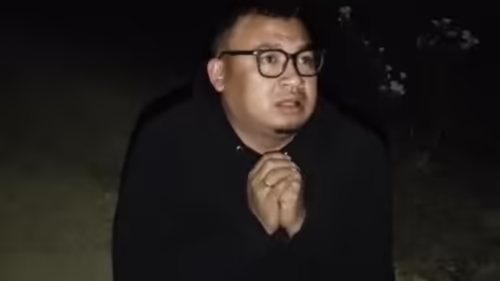
The already volatile situation in Manipur has taken a horrifying turn with a brutal, on-camera execution that lays bare the raw, unhealed wounds of the state’s ethnic conflict. A Meitei man, identified as Mayanglambam Rishikanta, was allegedly abducted by armed militants and shot dead in the Kuki-dominated Churachandpur district while visiting his wife . This latest act of **Manipur violence** is not just a tragic loss of life; it’s a stark reminder of the deep-seated divisions that continue to tear the state apart.
Table of Contents
- The Horrific Incident: A Life Lost on Camera
- Who Was the Victim?
- Manipur Violence: A Deep Dive into the Conflict
- Why This Shooting Is a Critical Turning Point
- The Path Forward: Challenges and Hopes
- Conclusion
- Sources
The Horrific Incident: A Life Lost on Camera
The details are as grim as they are clear. On January 21, 2026, Rishikanta, a 38-year-old resident of Kakching district, traveled to Churachandpur to be with his family . What followed was a nightmare. He was reportedly abducted by a group of armed men. A video circulating on social media shows the victim on his knees, hands folded in a desperate plea for mercy, before being executed by assault rifle fire in the darkness . The cold-blooded nature of the killing, captured in stark, terrifying detail, has sparked national outrage and renewed fears of a full-scale resurgence of the violence that has plagued the state since 2023.
Who Was the Victim?
Mayanglambam Rishikanta’s story is emblematic of the human cost of this conflict. He was a man caught between two worlds, married to a woman from the Kuki community. His very existence was a bridge between the warring groups. His murder sends a chilling message: that even personal bonds of love and family are no shield against the tide of ethnic hatred. His death is not just an isolated crime; it’s a targeted attack on the very idea of coexistence in Manipur.
Manipur Violence: A Deep Dive into the Conflict
To understand this tragedy, one must look back to the roots of the **Manipur violence**. The current cycle of bloodshed began in May 2023, triggered by a Manipur High Court order that appeared to support granting Scheduled Tribe (ST) status to the Meitei community, who are the majority in the Imphal Valley . The Kuki-Zo tribal communities, who already hold ST status and inhabit the surrounding hills, saw this as a direct threat to their land rights, political representation, and cultural identity .
What started as protests rapidly descended into horrific violence. Since then, the conflict has claimed over 260 lives and displaced tens of thousands of people from their homes . The state has been effectively partitioned along ethnic lines, with Meiteis in the valley and Kukis in the hills, and movement between these zones is fraught with extreme danger. This latest killing in Churachandpur, a Kuki-majority area, underscores the perilous reality for anyone perceived as an outsider.
Why This Shooting Is a Critical Turning Point
This incident is significant for several reasons:
- The Brazenness: The fact that the killing was recorded and shared indicates a level of impunity and a desire to send a message of terror.
- The Target: The victim was not a militant or a political figure, but a civilian visiting his own family. This blurs any remaining line between combatants and non-combatants.
- The Symbolism: Attacking a man in an inter-ethnic marriage is a direct assault on the possibility of reconciliation and a shared future for Manipur.
The ongoing demands from the Kuki-Zo community for a separate administration or even a “Union Territory” further complicate the political landscape and make a peaceful resolution seem increasingly distant .
The Path Forward: Challenges and Hopes
The central and state governments face immense pressure to restore order and deliver justice. A thorough and transparent investigation into Rishikanta’s murder is the immediate demand. However, the long-term solution requires addressing the core grievances of both communities. This involves complex negotiations on land rights, political autonomy, and constitutional safeguards. Until these fundamental issues are tackled with sincerity and political will, incidents like this will continue to occur. For now, the people of Manipur remain trapped in a cycle of fear and violence, their hopes for peace dimmed by the muzzle flash of an assault rifle in the night.
Conclusion
The on-camera execution of Mayanglambam Rishikanta is a devastating chapter in the ongoing saga of **Manipur violence**. It is a stark, brutal reminder that the ethnic fault lines in the state are not just political abstractions but deadly realities that claim innocent lives. As the nation watches, the urgent need for a genuine, inclusive, and lasting peace process has never been more critical. The alternative is a future where such tragedies become the norm, not the exception. For more on the historical context of regional conflicts, see our analysis on [INTERNAL_LINK:northeast-india-conflicts].
Sources
- The Times of India: Manipur violence: Militants shoot Meitei man visiting Kuki wife; shooting caught on camera
- Human Rights Watch: India: Death of Kuki-Zo Survivor Exposes Systemic Impunity
- Council on Foreign Relations: Finding a Way Out of Festering Conflict in India’s Manipur
- Frontline: What is really behind the violence in Manipur?