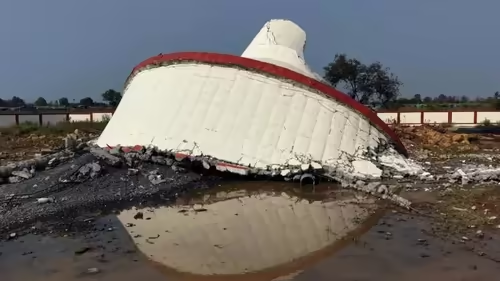
In a shocking turn of events that has sent ripples through Gujarat’s administrative corridors, a brand-new, state-of-the-art overhead water tank in Tadkeshwar village, Surat, came crashing down during a routine pre-inauguration test. The structure, valued at a staggering **₹21 crore**, was meant to be a lifeline for dozens of villages, not a symbol of systemic failure. This catastrophic Surat water tank collapse is more than just an accident; it’s a glaring red flag about the integrity of our public infrastructure projects.
Table of Contents
- The Catastrophic Failure in Tadkeshwar
- Arrests and Accountability: Who’s to Blame?
- Engineering Forensics: What Went Wrong?
- The Cost of Negligence: More Than Just Money
- Broader Implications for India’s Infrastructure
- Conclusion: A Call for Systemic Reform
- Sources
The Catastrophic Failure in Tadkeshwar
The incident occurred in Tadkeshwar village, a part of the Areth area in Surat district. The massive overhead reservoir, standing 15 meters tall with a capacity of 11 lakh liters, was constructed under the state’s Gaypagla Group Water Supply Scheme . Its primary mission was noble: to supply clean drinking water to as many as 35 surrounding villages . However, during its very first trial run—before any official ceremony or public use—the entire structure gave way, unleashing a torrent of water and debris . This wasn’t just a minor leak; it was a total structural failure that left the community without its promised water source and three people, including a child, injured .
Arrests and Accountability: Who’s to Blame?
The Gujarat government acted swiftly in the aftermath. In a decisive move, two senior government engineers, Deputy Executive Engineer Jai Chaudhary and Executive Engineer Rajnikant Chaudhary, were immediately suspended from their duties . The police launched a full-scale criminal investigation, leading to the arrest of eight individuals in total .
The accused are a mix of key players from both the public and private sectors, highlighting a potential nexus of negligence:
- Government Officials: The two suspended engineers are among those apprehended, facing charges of criminal breach of trust and cheating .
- Private Contractors: The main contractors from Jayanti Super Construction in Mehsana and officials from the PMC agency, Mars Planning Pvt. Ltd. in Ahmedabad, have also been arrested .
- On-Site Supervisors: Site supervisors who were directly responsible for overseeing the construction quality were also taken into custody .
This wide net of arrests suggests that the failure was not an isolated error but a result of a chain of compromised decisions and oversight.
Engineering Forensics: What Went Wrong?
While the police build their legal case, a separate and equally critical investigation is underway to determine the precise technical cause of the collapse. A team of structural experts from the prestigious Sardar Vallabhbhai National Institute of Technology (SVNIT), Surat, has been commissioned to conduct a thorough forensic analysis of the wreckage . Their report is eagerly awaited by authorities, as it will provide the scientific basis for understanding whether the failure stemmed from substandard materials, flawed design, improper construction practices, or a combination of all three.
Preliminary reports and the nature of the collapse point heavily towards severe lapses in quality control and adherence to engineering standards—a terrifying prospect for any public infrastructure project.
The Cost of Negligence: More Than Just Money
The financial figure of **₹21 crore** is staggering, representing a colossal waste of taxpayer money . But the true cost of this disaster extends far beyond the rupee value.
For the 35 villages that were counting on this tank for a reliable source of clean drinking water, the collapse is a devastating setback . It delays their access to a basic human necessity and erodes their trust in government promises. Furthermore, the physical danger posed by such a failure is immense, as evidenced by the injuries sustained during the incident . A structure of this size collapsing in a populated area could have led to a much greater tragedy.
Broader Implications for India’s Infrastructure
The Surat water tank collapse is not an isolated incident. It serves as a potent case study for a larger, more worrying trend across India: the prioritization of speed and cost-cutting over safety and durability in public works. This event underscores the critical need for:
- Independent Third-Party Audits: Mandatory, rigorous, and independent quality checks at every stage of a project, not just a final sign-off.
- Transparent Contracting Processes: Clear accountability in the tendering and awarding of contracts to prevent corruption and favoritism.
- Stronger Whistleblower Protections: Empowering on-site engineers and workers to report safety concerns without fear of reprisal.
Without these systemic changes, similar failures are not just possible—they are probable. For more on how to evaluate the safety of public infrastructure, see our guide on [INTERNAL_LINK:public-infrastructure-safety].
Conclusion: A Call for Systemic Reform
The image of a brand-new, multi-crore water tank lying in ruins is a powerful metaphor for a system in need of urgent repair. While the arrests in the Surat water tank collapse case are a necessary first step towards justice, they are not a solution. The real victory will come from implementing robust, transparent, and accountable processes that ensure every public rupee spent on infrastructure translates into a safe, durable, and functional asset for the people it was meant to serve. The people of Tadkeshwar and the 35 villages waiting for their water deserve nothing less.
Sources
- Times of India: 2 officials among 8 arrested for Tadkeshwar water tank collapse
- The Hindu: Overhead water tank collapses in Surat, child among 3 injured
- India Today: Surat water tank collapses during trial run, 8 arrested
- American Society of Civil Engineers (ASCE) – On Infrastructure Standards: https://www.asce.org/