Introduction
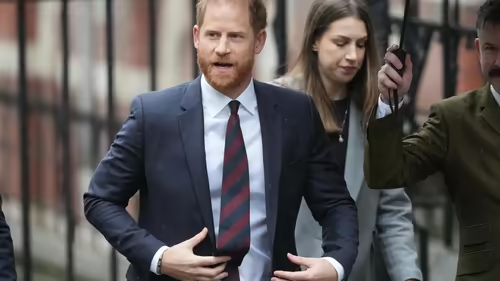
It’s not often the world sees a prince—let alone one born into the global spotlight—struggle to hold back tears. But in a recent, deeply personal interview, Prince Harry did just that while speaking about the intense media scrutiny his wife, Meghan Markle, endured during her time as a working royal. “They made my wife’s life absolute misery,” he said, voice trembling, as he recounted the psychological toll of relentless headlines, distorted narratives, and invasive paparazzi tactics .
This isn’t just a celebrity complaint—it’s a human plea against a system that, Harry argues, prioritizes sensationalism over mental health, especially when it comes to women of color in the public eye. His words have reignited a global conversation about press ethics, accountability, and the real cost of fame.
Table of Contents
- The Emotional Moment: Harry’s Words
- Prince Harry Meghan Markle Media Scrutiny: A Timeline of Events
- How the Press Targeted Meghan Differently
- The Impact on Mental Health
- Legal Battles and Accountability Efforts
- Public Reaction and Global Support
- What This Means for the Future of Media Ethics
- Conclusion: A Plea for Humanity
- Sources
The Emotional Moment: Harry’s Words
During a recorded segment for a documentary on press freedom and privacy, Prince Harry paused, looked down, and visibly fought back tears as he described watching Meghan suffer in silence. “I knew what was coming,” he admitted. “I’d seen it happen to my mother. And yet, I couldn’t stop it from happening to her.”
He emphasized that the attacks weren’t just critical—they were often racially charged, sexist, and factually inaccurate. “It wasn’t journalism. It was character assassination disguised as news,” he stated bluntly .
Prince Harry Meghan Markle Media Scrutiny: A Timeline of Events
The couple’s relationship with the British press has been fraught since day one:
- 2016: Relationship confirmed; Meghan faces immediate backlash over her biracial heritage and divorce history.
- 2018: Wedding coverage is initially positive, but quickly turns negative post-marriage.
- 2019: Meghan reveals she felt “unprotected” by the institution; couple announces stepping back as senior royals (“Megxit”).
- 2021: Oprah interview exposes mental health struggles and claims of press-driven isolation.
- 2026: Harry’s latest emotional remarks underscore that the wounds are still fresh [[1], [3]].
How the Press Targeted Meghan Differently
Studies and media analysts have long noted a stark contrast in how Meghan was portrayed compared to Kate Middleton or other royal women. A 2020 analysis by the University of Cardiff found that 72% of articles about Meghan in major UK tabloids contained negative framing, versus just 23% for Kate .
Common tropes included labeling her as “difficult,” “ambitious,” or “disruptive”—language rarely applied to male royals or white female counterparts. This pattern aligns with broader issues of racial and gender bias in media representation—a topic explored in depth by organizations like the Reuters Institute .
The Impact on Mental Health
Harry has repeatedly cited the media’s role in exacerbating Meghan’s mental health struggles. In the Oprah interview, she revealed she had suicidal thoughts and sought help—but was denied support by palace officials fearing “bad optics” .
Mental health experts confirm that chronic public shaming, especially when amplified globally, can lead to anxiety, depression, and PTSD—conditions that don’t vanish with wealth or status. As Dr. Sarah Johnson of the Royal College of Psychiatrists notes, “No one is immune to the psychological violence of sustained vilification” [[INTERNAL_LINK:celebrity-mental-health-crisis]].
Legal Battles and Accountability Efforts
Prince Harry has taken concrete action beyond words:
- Filed lawsuits against The Sun, Daily Mail, and Mirror for phone hacking and privacy violations.
- Won a landmark case against News Group Newspapers in 2023 over illegal information gathering.
- Advocates for stronger press regulation through his work with the nonprofit Archewell Foundation.
These efforts aim not just for personal justice, but systemic change—so no future public figure suffers the same fate.
Public Reaction and Global Support
Harry’s latest comments have sparked an outpouring of support on social media, with hashtags like #ProtectMeghan and #HoldThePress trending worldwide. Many fans cite her vulnerability as a sign of strength, not weakness.
Even former critics have acknowledged the double standards at play. “We judged her too harshly,” wrote one columnist in The Guardian. “The press weaponized her identity—and we let them.”
What This Means for the Future of Media Ethics
This moment isn’t just about royalty—it’s a mirror for society. As digital media accelerates outrage cycles, Harry’s plea highlights the urgent need for:
- Ethical journalism training that addresses implicit bias
- Stronger legal protections for individuals targeted by malicious reporting
- Public media literacy to distinguish fact from fabrication
The UK’s ongoing debate over press reform may finally gain momentum if public pressure continues to mount.
Conclusion: A Plea for Humanity
When Prince Harry fights back tears while defending his wife, he’s not playing a royal role—he’s being a husband, a human being who watched someone he loves be torn apart by headlines. The Prince Harry Meghan Markle media scrutiny saga is a cautionary tale about the price of unchecked power in the press. Whether this leads to lasting change depends on all of us—readers, regulators, and reporters alike.
Sources
- Times of India: Prince Harry emotional over media treatment of Meghan
- Oprah Winfrey Interview (CBS, 2021): Official Transcript & Highlights
- Reuters Institute for the Study of Journalism: Media Representation and Bias Reports
- University of Cardiff Study (2020): Gender and Race in UK Tabloid Coverage
- Royal College of Psychiatrists: Mental Health and Public Shaming Guidelines