Davos 2026 Row: When a Global Summit Becomes a Political Punching Bag
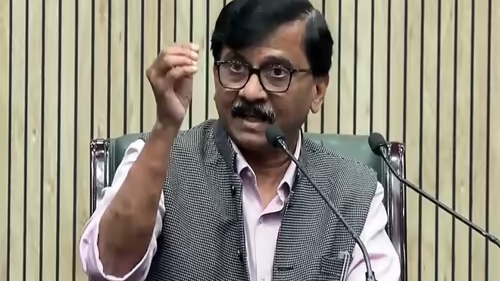
The pristine snows of Davos have become the unlikely backdrop for a heated political slugfest in India. At the heart of the storm is Maharashtra Chief Minister Devendra Fadnavis’s official trip to the Davos 2026 World Economic Forum (WEF), which Shiv Sena (UBT) MP Sanjay Raut has derisively labeled a “picnic.” This isn’t just a war of words; it’s a clash of visions about India’s place on the global economic stage.
Table of Contents
- Sanjay Raut’s ‘Picnic’ Jibe and Its Implications
- Amruta Fadnavis’s Sharp Rebuttal: Beyond the Headlines
- What’s Really at Stake in Davos 2026 for Maharashtra?
- The Bigger Political Picture Behind the Personal Attacks
- Conclusion: Davos or Distraction?
Sanjay Raut’s ‘Picnic’ Jibe and Its Implications
Sanjay Raut didn’t mince words. He called the entire concept of Indian chief ministers attending the WEF “ridiculous from an Indian perspective” . His core argument? That any business agreements or investments could just as easily be secured from the comfort of Mumbai, making the expensive trip to Switzerland an unnecessary extravagance—a mere “picnic in Davos” .
This criticism taps into a common public sentiment about elite forums like Davos, often perceived as out-of-touch gatherings for the global super-rich. Raut’s comments are clearly aimed at resonating with a domestic audience that might question the value of such high-profile international jaunts, especially when local issues demand attention .
Amruta Fadnavis’s Sharp Rebuttal: Beyond the Headlines
The response from the other camp was swift and scathing. Amruta Fadnavis, the CM’s wife, dismissed Raut’s remarks as completely “baseless and unfounded” . She went on the offensive, challenging the very premise of his criticism.
“I can never understand his language,” she retorted, before delivering her key point: “But I will say this much, someone who goes for a picnic does not hold conferences and meetings from 6 am to 11 pm” . Her statement was a direct attempt to reframe the narrative—from a leisurely trip to a grueling, high-stakes diplomatic and business mission.
She further emphasized that her husband’s presence at Davos 2026 was a strategic move to champion the state’s “Magnetic Maharashtra” initiative on a global platform, a crucial step for attracting the foreign direct investment needed to fuel the state’s ambitious goal of becoming a $1 trillion economy .
What’s Really at Stake in Davos 2026 for Maharashtra?
While the political barbs fly, the actual business being conducted in Davos tells a different story. The Fadnavis administration wasn’t there for sightseeing. On the very first day of the summit, Maharashtra announced a historic haul of $96 billion in investment commitments .
Key outcomes from the trip include:
- The unveiling of plans for a massive $11 billion ‘Innovation City’ .
- The signing of a major Memorandum of Understanding (MoU) with the Lodha Group .
- Promoting a $100 billion infrastructure pipeline designed to improve the ease of doing business in the state .
These aren’t abstract promises; they represent potential jobs, technological advancement, and economic growth for millions of Maharashtrians. The WEF provides a unique, concentrated environment where global CEOs, investors, and policymakers gather, making it an unparalleled opportunity to pitch a state’s vision directly to the world’s most influential economic actors. For more on how global forums drive local economies, see our deep dive on [INTERNAL_LINK:global-investment-summits].
The Bigger Political Picture Behind the Personal Attacks
It’s impossible to view this exchange in a vacuum. The timing is critical. With Maharashtra’s political landscape in constant flux, every public statement is a calculated move. Raut’s attack serves to undermine the Fadnavis government’s credibility and paint it as elitist and disconnected from ground realities.
Conversely, Amruta Fadnavis’s defense is not just about her husband; it’s about protecting the government’s flagship economic agenda. By highlighting the tangible results from Davos, she aims to shift the conversation from personal jibes to concrete achievements. This is a classic political maneuver: use a spouse’s public platform to deliver a message that might seem too defensive if it came directly from the CM himself.
Conclusion: Davos or Distraction?
The “picnic in Davos” controversy is a microcosm of a larger debate. On one side is the pragmatic view that engaging with global capital is essential for India’s development. On the other is the populist critique that such engagements are performative and wasteful. While Sanjay Raut’s comments may stir domestic sentiment, the $96 billion in deals signed by the Maharashtra government at Davos 2026 presents a powerful counter-argument . Ultimately, the true measure of the trip’s success won’t be in the political headlines it generates, but in whether these grand announcements translate into real-world projects, jobs, and prosperity for the people of Maharashtra.
Sources
- Times of India: ‘Ridiculous’: Sanjay Raut takes ‘picnic in Davos’ jibe at Fadnavis; CM’s wife hits back
- World Economic Forum Official Site: About the Annual Meeting
- Government of Maharashtra Press Releases on Davos 2026 Agreements