Table of Contents
- The Bold Claim at Davos
- Fact-Checking the $600 Billion Figure
- Apple and Toyota: The Investment Claims
- The Real Impact of Trump’s Tariffs
- Conclusion: Fantasy or Future?
- Sources
The Bold Claim at Davos
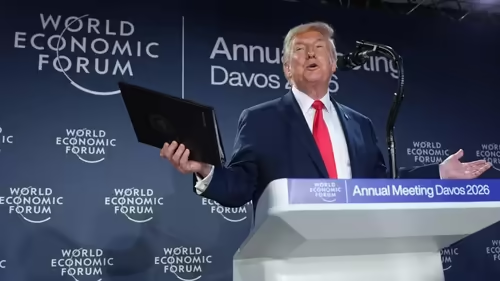
In a characteristically confident address at the World Economic Forum in Davos, former President Donald Trump dropped a bombshell economic prediction. He claimed the United States is on track to collect a staggering $600 billion in tariff revenue in 2026, with even larger inflows expected in the years to follow . This announcement, made to a room full of global elites, was framed as a direct result of his administration’s aggressive “America First” trade policies and the clarity provided by the recent election.
But what does this claim really mean for the average American, and more importantly, is it even plausible? Let’s break down the numbers, the promises, and the potential pitfalls behind this headline-grabbing statement.
Fact-Checking the $600 Billion Figure
The figure of $600 billion is not just ambitious; it’s unprecedented. To put it in perspective, total US federal government tariff revenue has never come close to this amount in modern history. In 2024, the US collected approximately $100 billion in tariff revenue . While that number surged to around $264 billion in 2025—a record high fueled by new tariffs—it still falls far short of Trump’s projection .
Even the most optimistic forecasts from financial analysts and government trackers suggest that while monthly tariff collections have indeed tripled—from about $7 billion to $25 billion between late 2024 and mid-2025—the annualized total would be closer to $300 billion, not $600 billion . Achieving Trump’s target would require either a massive, across-the-board increase in import volumes (which tariffs are designed to discourage) or an extreme escalation in tariff rates that could trigger a global trade war and domestic inflation.
This massive gap between the claim and the current trajectory raises serious questions about its foundation. Is it a negotiating tactic, a political talking point, or a genuine economic forecast? The historical data suggests the latter is highly improbable.
Apple and Toyota: The Investment Claims
To bolster his argument, Trump pointed to major corporate investments as proof of his policy’s success. He specifically cited Apple’s commitment to spend $650 billion in the US and referenced Toyota’s own investment plans .
Apple’s $650 Billion Pledge
While Apple has indeed announced significant new investments in the US, the details are crucial. In August 2025, Apple confirmed a plan to invest $600 billion over four years, which was later adjusted to a total of $650 billion . However, this isn’t a sudden, one-time cash infusion. It’s a long-term capital expenditure plan covering manufacturing, R&D, and supply chain development. Much of this investment was already in motion before the latest tariff announcements and is driven by a complex mix of factors, including market demand, supply chain resilience, and existing tax incentives—not solely by Trump’s policies .
Toyota’s Strategic Move
Regarding Toyota, Trump’s claim is more grounded in reality, but the scale is different. In November 2025, Toyota officially confirmed plans for an additional $10 billion investment in its US operations over the next five years . This includes a new $912 million investment to boost hybrid vehicle production in several southern states . While this is a significant vote of confidence in the US economy, it’s a far cry from the vague “major commitment” Trump described, and it’s part of a long-standing strategy by the automaker to localize production for the North American market.
The Real Impact of Trump’s Tariffs
Beyond the headline numbers, the true impact of these tariffs is more nuanced. On one hand, they have undeniably become a major new revenue stream for the federal government, a shift from their traditional role as a tool for protecting specific industries .
On the other hand, economists widely agree that the costs are often passed on to consumers in the form of higher prices for imported goods. Furthermore, while tariff revenue hit a record $236 billion in a recent period, they have failed to significantly reduce the US trade deficit, which remains stubbornly high . This suggests that the policy may be more effective at raising government funds than at reshaping the fundamental structure of American trade.
For businesses, the uncertainty surrounding future tariff rates can be a major deterrent to long-term planning and investment, potentially offsetting the benefits of any perceived “election clarity” that Trump mentioned.
Conclusion: Fantasy or Future?
Donald Trump’s $600 billion Trump tariff revenue claim is a masterclass in political rhetoric—bold, simple, and designed to project strength. However, when measured against historical data and current economic trends, it appears to be more aspirational than factual. The real story lies in the tangible, if smaller-scale, investments from companies like Apple and Toyota, and the complex, often hidden, economic consequences of using tariffs as a primary fiscal tool. As we move through 2026, the key will be to watch not just the revenue figures, but the broader health of the US economy and its position in the global market. For more on US trade policy, see our guide on [INTERNAL_LINK:us-trade-policy-explained].
Sources
- Times of India: Donald Trump at WEF Davos: US President projects $600 billion in tariff revenue
- Peterson Institute for International Economics: Tariffs Are Generating Meaningful New Revenue
- U.S. Treasury Department: Monthly Statement of the Public Debt
- Financial Times: Why Trump’s tariffs delivered record revenue but limited economic gains
- Apple Newsroom: Apple announces $600 billion investment in America
- Toyota Global Newsroom: Toyota to Invest Up to $10 Billion Additional in Its U.S. Operations