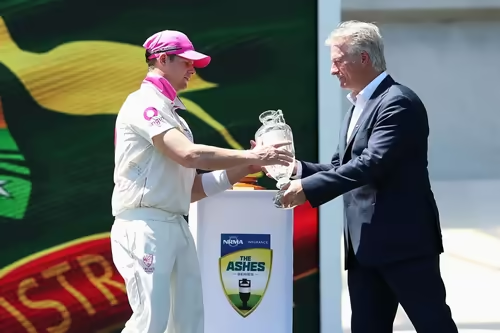
Introduction: The Two Souls of Modern Cricket
Cricket is at a crossroads. On one hand stands the timeless, five-day battle of skill, patience, and character—Test cricket. On the other, the explosive, high-octane spectacle of T20, where fortunes are made in minutes. Few understand this duality better than Steve Waugh, the former Australian captain who once called Test cricket “the ultimate challenge.” Now, as a co-owner of the Amsterdam Flames in the European T20 Premier League (ETPL), Waugh offers a refreshingly honest perspective: Test cricket is the pinnacle, but T20 ensures financial stability .
In an exclusive interview, the 60-year-old legend didn’t just defend the traditional format—he acknowledged the economic realities forcing today’s players to embrace the shortest one. His comments cut to the heart of a global debate: can cricket honor its heritage while embracing its commercial future?
Table of Contents
- Steve Waugh’s Dual Role: Traditionalist and T20 Entrepreneur
- Test Cricket vs T20: The Pinnacle Versus the Paycheck
- Why Test Cricket Will Survive (According to Waugh)
- The Financial Reality for Modern Cricketers
- Global Leagues and the Future of the Game
- Conclusion
- Sources
Steve Waugh’s Dual Role: Traditionalist and T20 Entrepreneur
Waugh’s position is uniquely balanced. As a player, he was the embodiment of Test grit—famously leading Australia through an era of dominance with unwavering focus on the red-ball game. Yet today, he’s actively investing in the T20 ecosystem as a co-owner of the Amsterdam Flames, a franchise in the fledgling European T20 Premier League .
This isn’t hypocrisy—it’s pragmatism. “I love Test cricket. It’s the purest form of the game,” Waugh stated. “But I also see that young players need security. T20 leagues give them that.” By backing new leagues, Waugh isn’t abandoning tradition; he’s ensuring the sport’s financial ecosystem can support it.
Test Cricket vs T20: The Pinnacle Versus the Paycheck
The core of Waugh’s argument lies in distinguishing between value and viability. He firmly believes that Test cricket vs T20 isn’t a competition of quality, but of context:
- Test Cricket = Legacy & Prestige: Winning a Test series, especially overseas, remains the gold standard for elite players. It tests every facet of a cricketer’s ability over time and pressure.
- T20 Cricket = Income & Opportunity: For most players outside the top 10 nations, domestic T20 contracts or league appearances are their primary source of income—often more lucrative than national team duties.
“You can’t ask a 22-year-old from a non-Test nation to turn down a $100,000 T20 contract to play first-class cricket for $500 a month,” Waugh explained. “That’s not realistic.”
Why Test Cricket Will Survive (According to Waugh)
Despite concerns about declining interest and packed calendars, Waugh remains optimistic about Test cricket’s longevity. His reasoning? The players themselves. “The best cricketers in the world—your Kohlis, your Smiths, your Root—still want to play Test cricket,” he said . “They see it as the ultimate challenge.”
He argues that as long as elite athletes value the format, fans and broadcasters will follow. The key, he suggests, is strategic scheduling: fewer, high-quality Test series with proper build-up and marketing, rather than diluting the calendar with dead rubbers.
The Financial Reality for Modern Cricketers
Waugh’s acknowledgment of T20’s financial role is crucial. Consider these realities:
- Income Disparity: A fringe international player might earn ₹5–10 lakh annually from their board but can make ₹1–2 crore in a single IPL season.
- Career Longevity: T20 skills (power-hitting, death bowling) have longer shelf lives than Test-specific techniques, allowing players to extend their careers into their late 30s.
- Global Access: Leagues like the ETPL, SA20, and ILT20 offer opportunities for associate nation players to compete professionally—something Test cricket rarely provides.
As [INTERNAL_LINK:t20-leagues-global-impact] analysts note, T20 isn’t just entertainment—it’s democratizing professional cricket.
Global Leagues and the Future of the Game
Waugh’s involvement in the European T20 Premier League signals a broader trend: the globalization of franchise cricket. These leagues aren’t just revenue streams—they’re talent incubators and fan-engagement engines. By bringing cricket to new markets like the Netherlands, they expand the sport’s footprint, which, in turn, can fund grassroots development—including pathways back to Test cricket.
However, balance is key. The ICC and national boards must ensure that league proliferation doesn’t cannibalize international calendars. Waugh advocates for a “structured ecosystem” where T20 funds the game, but Test cricket remains its soul.
Conclusion
Steve Waugh’s stance on the Test cricket vs T20 debate is neither nostalgic nor mercenary—it’s holistic. He recognizes that the soul of cricket resides in its longest format, but its body needs the financial oxygen that T20 provides. In a world where attention spans are short and wallets are tight, this dual-track approach may be the only way to preserve cricket’s rich heritage while securing its future. As Waugh puts it: “We don’t have to choose. We just have to manage both wisely.”