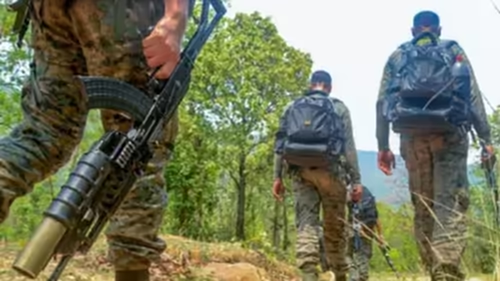
The tranquil mountains of Kishtwar have been transformed into a high-alert war zone. On the fifth day of Operation Trashi-I, a tense and deadly cat-and-mouse game reached a new peak as Indian security forces clashed with a group of foreign terrorists believed to be from the Pakistan-based Jaish-e-Mohammad (JeM) in the treacherous terrain of Singhpora’s dense forests . This isn’t just another headline; it’s a stark reminder of the persistent and evolving threat that continues to challenge India’s internal security apparatus in the volatile region of Jammu and Kashmir.
Table of Contents
- The Latest Encounter: Day 5 of Operation Trashi-I
- Who is Behind the Threat? Jaish-e-Mohammad in Focus
- Why Kishtwar? A Strategic and Challenging Battleground
- Operation Trashi-I: Objectives and Timeline
- The Human Cost of Counter-Terrorism
- Broader Implications for Jammu and Kashmir Security
- Conclusion: A Long Road Ahead
- Sources
The Latest Encounter: Day 5 of Operation Trashi-I
Intelligence inputs were the catalyst for this massive operation, which was launched on Sunday . By Thursday, the search team had cornered its target: a group of two to three heavily armed terrorists who had been hiding in the remote, forested upper reaches of the district . The ensuing gunfight was intense, forcing security forces to navigate not just enemy fire but also the perilous geography of the area. The terrorists, described as foreign nationals, are believed to have used the dense forest cover to their advantage, turning the landscape into a natural fortress .
Who is Behind the Threat? Jaish-e-Mohammad in Focus
All signs point to the involvement of Jaish-e-Mohammad (JeM), a designated terrorist organization with a long and bloody history in the region. The group’s primary objective is to separate Jammu and Kashmir from India and merge it with Pakistan . Recent intelligence has flagged JeM as being at the center of several active plots, including a major planned attack in Kashmir . The discovery of a fortified JeM bunker perched at an altitude of approximately 12,000 feet during this operation underscores the group’s sophisticated planning and its ability to establish deep, hidden sanctuaries in the most inhospitable terrains [[1], [27]].
Why Kishtwar? A Strategic and Challenging Battleground
Kishtwar, carved out of the Doda district, is the largest and one of the least populated districts in the Jammu division . Its geography is its defining feature—and its greatest security challenge. The entire district is a maze of mountains and dense forests, sharing borders with Himachal Pradesh to the southeast . This rugged, remote landscape provides the perfect cover for infiltrating terrorists looking to evade detection and regroup. Security officials have long maintained that foreign infiltrators remain a “major challenge” for the security grid in this area . The recent events are a grim validation of these concerns.
Key Features of the Kishtwar Terrain
- High Altitude: Operations often take place above 10,000 feet, posing severe physical challenges for troops.
- Dense Forest Cover: Provides excellent natural camouflage for hiding terrorists and their bunkers.
- Remote Location: Limited road access and communication infrastructure complicate logistics and rapid response.
- Proximity to Borders: Its location makes it a potential infiltration route from across the Line of Control.
Operation Trashi-I: Objectives and Timeline
Launched as a direct response to specific intelligence about terrorist activity, the primary goal of Operation Trashi-I is to completely sanitize the Kishtwar district of terrorist elements . The operation involves a coordinated effort from multiple security agencies, including the Indian Army and local police, who have established checkpoints and intensified vehicle inspections across the district . The discovery of a well-stocked hideout, complete with supplies like Maggi and rice, indicates the terrorists were prepared for a long stay, making the operation’s success even more critical .
The Human Cost of Counter-Terrorism
These operations come at a tremendous human cost. In the early days of Operation Trashi-I, a brave Indian Army havildar lost his life, and eight other jawans were injured, some critically, in a sudden grenade attack [[6], [8]]. This sacrifice highlights the immense risks our security personnel take every day to protect the nation’s citizens. Their courage in the face of such danger is the bedrock of our national security. [INTERNAL_LINK:jammu-and-kashmir-security-forces] [INTERNAL_LINK:indian-army-news]
Broader Implications for Jammu and Kashmir Security
The ongoing Operation Trashi-I is more than just a localized military action; it’s a significant indicator of the broader security landscape in Jammu and Kashmir in 2026. The fact that this is the first security force death in a counter-terrorism operation in the Union Territory this year suggests a possible resurgence in terrorist activity after a period of relative calm . It serves as a sobering reminder that the threat of terrorism, particularly from groups like JeM backed by external state actors, remains a persistent and serious challenge that requires constant vigilance and robust, adaptive strategies from our security establishment.
Conclusion: A Long Road Ahead
As Operation Trashi-I continues into its next phase, the eyes of the nation are on Kishtwar. The successful neutralization of the remaining terrorists is paramount, not just for the immediate safety of the local population but for sending a strong message against cross-border terrorism. However, the operation also underscores a harsh reality: the fight against terror in Jammu and Kashmir is a marathon, not a sprint. It demands sustained political will, advanced intelligence capabilities, and unwavering support for the men and women on the front lines who stand between us and chaos.
Sources
- Times of India. “In Jammu & Kashmir’s Kishtwar district, Operation Trashi-I unearthed a fortified Jaish-e-Mohammad (JeM) bunker…”
- NDTV. “Intelligence inputs triggered Operation Trashi-I in Kishtwar, Jammu & Kashmir…”
- Times of India. “Officials said a group of two to three terrorists, believed to be affiliated with the Pakistan-based Jaish-e-Mohammad (JeM)…”
- India Today. “An Indian Army havildar was killed and eight jawans injured during a counter-terrorism encounter…”
- The Hindu. “Jaish Terrorists Ate Maggi, Rice At Their Kargil Style…”
- Hindustan Times. “The operation triggered a gunfight that left one paratrooper dead and seven others injured…”
- The Wire. “They maintain that foreign infiltrators remain ‘a major challenge’ for the security grid…”
- Wikipedia. “Kishtwar district is an administrative district of the Jammu division…”
- ANI. “Security forces and terrorists engaged in a firefight in the Singhpora area of Chatroo, Kishtwar district…”
- Greater Kashmir. “Security has been tightened across the district, with checkpoints and vehicle inspections in place…”
- District Kishtwar, Government of Jammu & Kashmir. “District Kishtwar has its boundaries touching the valleys of Himachal…”
- Council on Foreign Relations. “Jaish-e-Mohammad (JEM), meaning Army of Mohammad, is a Pakistan-based Sunni terrorist group…”
- The Economic Times. “Intel input flags ISI-backed ’26-26′ terror plot…”
- The Print. “This was the first security force death in a counter-terrorism operation in the Union Territory in 2026…”
- Various news reports. “Security forces uncovered an underground Jaish-e-Mohammad hideout… located at a challenging altitude of 12,000 feet.”