Table of Contents
- A Diaspora’s Desperate Plea: The London Protest
- The Alarming Demographic Decline of Hindus in Bangladesh
- The Labour Party’s Response and Political Calculus
- Historical Context of Violence Against Minorities
- What Comes Next for UK-Bangladesh Relations?
- Conclusion
- Sources
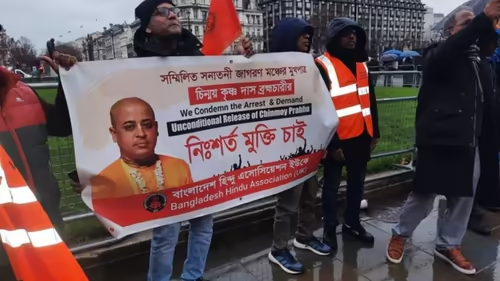
The cobblestones of Parliament Square in London recently echoed with a desperate plea from the South Asian diaspora. Hundreds of protesters, including People of Indian Origin and Bangladeshi Hindus, gathered to demand that the UK government, and specifically Prime Minister Keir Starmer, take concrete action against the Hindu persecution in Bangladesh . This wasn’t just a rally; it was a cry for help from a community witnessing the systematic erosion of its ancestral home.
The protest comes amid growing international concern over the safety of religious minorities in Bangladesh following a period of political upheaval. Organizers painted a grim picture of targeted violence, forced conversions, and a state apparatus they claim is either unwilling or unable to protect its most vulnerable citizens. Their central message was clear: the UK must move beyond statements of concern and leverage its diplomatic influence to stop what they describe as an ongoing crisis.
A Diaspora’s Desperate Plea: The London Protest
The demonstration was a potent mix of grief, anger, and hope. Chants of “Stop Killing Hindus” filled the air as protesters held placards detailing alleged atrocities and calling for justice . The primary target of their appeal was the newly elected Labour government, seen by many in the diaspora as a potential ally in championing human rights on the global stage.
Several Labour MPs were present at the event, acknowledging the deep concerns of their constituents. They pledged to maintain pressure on the Foreign Office to prioritize the protection of minorities in its dealings with the Bangladeshi interim government . This engagement, while welcomed, has left many activists wanting more—a formal condemnation from the Prime Minister himself and a clear action plan.
The protest also served as a stark reminder of the UK’s own diverse makeup. The voices in Parliament Square represent a significant voting bloc whose concerns about their countries of origin are increasingly shaping domestic political discourse. For the Labour Party, navigating this complex landscape requires balancing humanitarian principles with geopolitical realities.
The Alarming Demographic Decline of Hindus in Bangladesh
At the heart of the protesters’ anguish is a stark and undeniable statistic: the precipitous decline of the Hindu population in Bangladesh. In 1947, at the time of partition, Hindus constituted nearly 29% of the population. Today, that number has plummeted to a mere 7.5% to 8% [[9], [6]].
This isn’t just a matter of migration. While some have left seeking safety, the consistent downward trend over seven decades points to a deeper, more troubling reality. Government statistics themselves acknowledge a significant drop, with one report noting a 1.33% decline in the Khulna division alone between 2011 and 2022 .
Experts and activists argue that this demographic collapse is the direct result of persistent, systemic persecution. The exodus has been fueled by a long history of violence, discriminatory laws regarding property ownership (like the Vested Property Act), and social marginalization that makes daily life a struggle for many Hindu families .
The Labour Party’s Response and Political Calculus
The Labour Party has not been silent on the issue. Backbench MPs like Bob Blackman have been vocal advocates, raising the matter directly in Parliament as recently as January 15, 2026, to highlight the ongoing killings and persecution . Senior figures, including former Home Secretary Priti Patel, have issued strong condemnations, stating, “The murders of Hindus and the persecution taking place are wrong and must stop” .
However, the official stance from the Prime Minister’s office remains more measured. Keir Starmer’s government has condemned “all acts of violence” in Bangladesh but has stopped short of the specific, targeted language demanded by the protesters . This cautious approach likely stems from a desire to maintain a working relationship with the Bangladeshi government while urging it to uphold its own constitutional guarantees of religious freedom.
The political calculus is delicate. On one hand, there is a moral imperative to defend human rights. On the other, the UK must consider its broader strategic interests in the region, including trade and security cooperation. The recent protest is a clear signal that the diaspora will not let this issue fade from the political agenda.
Historical Context of Violence Against Minorities
To understand the current crisis, one must look back. The persecution of Hindus in Bangladesh is not a new phenomenon but a recurring pattern that intensifies during periods of political instability. Major outbreaks of violence occurred in 1964, 1990, 2001, and 2013, often triggered by local disputes that spiral into widespread communal attacks .
Following the recent departure of Prime Minister Sheikh Hasina, reports have emerged of mobs targeting Hindu homes, businesses, and temples, accusing the community of political affiliations . This latest wave of violence has created a climate of fear, with many families feeling they have no choice but to flee their ancestral villages.
The historical context shows that without strong, consistent international pressure and a genuine commitment from the Bangladeshi state to protect its minorities, these cycles of violence are likely to continue, further eroding the country’s rich pluralistic heritage.
What Comes Next for UK-Bangladesh Relations?
The ball is now in the UK government’s court. The protest has successfully amplified the issue, but the diaspora is waiting for tangible results. Potential next steps could include:
- A formal statement from Prime Minister Keir Starmer specifically condemning the Hindu persecution in Bangladesh.
- Increased diplomatic engagement with the Bangladeshi interim government to ensure the safety of minorities.
- Tying future development aid or trade agreements to verifiable improvements in human rights and religious freedom.
- Supporting international investigations into the reported atrocities.
The UK’s response will be closely watched not just by the diaspora, but by the entire international community as a test of its commitment to its stated values of democracy and human rights. For more on how global politics affects minority communities, see our analysis on [INTERNAL_LINK:global-minority-rights-crisis].
Conclusion
The protest outside the UK Parliament was a powerful moment that brought the distant crisis of Hindu persecution in Bangladesh to the doorstep of British power. It underscored a tragic demographic reality and a community’s desperate hope for international intervention. While Labour MPs have shown sympathy and pledged to keep the issue alive, the protesters’ demand for decisive leadership from Prime Minister Keir Starmer remains unfulfilled. The coming weeks will be critical in determining whether the UK’s response will be limited to words or will translate into meaningful action to protect a vulnerable minority facing an existential threat.
Sources
- Bangladesh Bureau of Statistics report on the decline in Hindu population in the Khulna division from 2011 to 2022.
- Historical analysis of the Hindu exodus from Bangladesh between 1964 and 2001.
- Current estimates placing the Hindu population in Bangladesh at approximately 9.6%.
- Bangladesh Population Census data showing a drop from 28% in 1941 to 7.5% in 2023.
- Statement from Priti Patel condemning the persecution of Hindus in Bangladesh.
- UK government’s call for the protection of religious freedoms in Bangladesh.
- MP Bob Blackman raising concerns about the persecution of Hindus in the UK Parliament on January 15, 2026.
- Reports on the “Stop Killing Hindus” protest outside the UK Parliament.
- Summary of the protest demanding Labour take action on Hindu persecution in Bangladesh, including the presence of Labour MPs.
- Statement on the distressing events following the departure of Prime Minister Sheikh Hasina, with mobs targeting minorities.