The dense, unforgiving forests of Kishtwar have become the stage for a high-stakes, life-or-death drama. Operation Trashi-I, now in its fourth day, is a relentless pursuit by Indian security forces to flush out and neutralize terrorists who ambushed a patrol, killing one brave soldier and wounding eight others. This isn’t just another counter-terrorism operation; it’s a critical test of strategy, endurance, and national resolve, unfolding just days before India’s 77th Republic Day celebrations—a time when the entire nation is on high alert.
Table of Contents
- The Kishtwar Ambush and the Birth of Operation Trashi-I
- Why Kishtwar Forests Are a Terrorist Haven
- Operation Trashi-I: Day-by-Day, A Tactical Breakdown
- Republic Day Security Lockdown Across J&K
- The Human Cost and Strategic Challenges
- Conclusion: The Road Ahead for Operation Trashi-I
- Sources
The Kishtwar Ambush and the Birth of Operation Trashi-I
On the night of January 18, 2026, a routine patrol in the Chhatru area of Kishtwar district was met with a devastating surprise. Terrorists, believed to be from the Jaish-e-Mohammed (JeM) outfit, launched a sudden and brutal ambush on the security forces near Sonnar village . The attack was swift and vicious, leaving Havildar Gajendra Singh of the Special Forces critically injured. He later succumbed to his wounds on January 19, becoming a martyr in the line of duty, while eight of his comrades were left wounded [[4], [9]].
In immediate response, the Indian Army and other security agencies launched Operation Trashi-I to cordon off the area and hunt down the fleeing militants. The operation, focused on the Sonnar village and its surrounding dense forest cover, has been ongoing with unwavering intensity ever since [[5], [8]].
Why Kishtwar Forests Are a Terrorist Haven
Kishtwar’s terrain is not just challenging; it’s a strategic nightmare for conventional military operations. The region is characterized by steep mountain slopes, thick, almost impenetrable vegetation, and a network of natural caves that provide perfect hiding spots for insurgents [[22], [25]].
Security forces have reported that these very conditions forced them to temporarily halt their search late on the first night of the operation due to poor visibility and the extreme physical difficulty of navigating the landscape [[20], [24]]. This rugged geography has historically been exploited by terrorist groups to regroup, store weapons, and launch attacks before disappearing back into the wilderness—a pattern that has complicated numerous anti-terror ops in the past .
Operation Trashi-I: Day-by-Day, A Tactical Breakdown
The operation has evolved from a reactive search into a massive, coordinated tactical effort.
- Day 1 (Jan 18): The ambush occurs. Operation Trashi-I is launched immediately, but the search is suspended at nightfall due to the dangerous terrain .
- Day 2 (Jan 19): The operation resumes at dawn with renewed vigor. A terrorist hideout is discovered and busted in Sonnar village, yielding crucial intelligence and some arrests [[5], [7]].
- Day 3 (Jan 20): Security forces intensify their cordon-and-search operation, combing every inch of the forested belt. The focus shifts to tracking the specific group responsible for the ambush .
- Day 4 (Jan 21): The hunt reaches its most critical phase. Additional troops and specialized units are deployed to close in on the remaining suspects, who are believed to be cornered but still highly dangerous .
Republic Day Security Lockdown Across J&K
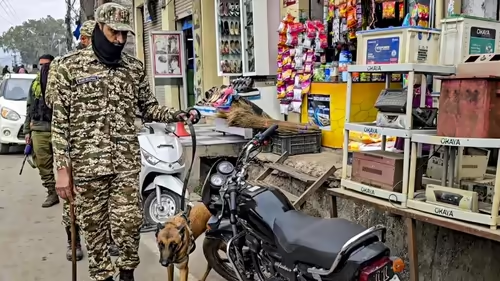
The timing of this operation couldn’t be more sensitive. With India’s 77th Republic Day on January 26, 2026, just days away, the entire Union Territory of Jammu and Kashmir is under an unprecedented security blanket. The Director General of Police, Nalin Prabhat, has personally reviewed security preparedness across the region .
A multi-tier security grid has been put in place, featuring:
- Intensified naka (checkpoint) checks on all roads.
- Mandatory frisking of vehicles and pedestrians in both the Kashmir and Jammu regions [[10], [15]].
- Deployment of advanced surveillance technology, including drones and high-resolution CCTV cameras [[13], [18]].
- Special focus on monitoring foreign nationals and suspicious movements near key installations [[INTERNAL_LINK:republic-day-security-india]].
This heightened state of alert is designed to prevent any potential infiltration or terror strike aimed at disrupting the national celebrations .
The Human Cost and Strategic Challenges
Beyond the tactical complexities, Operation Trashi-I carries a heavy human cost. The loss of Havildar Gajendra Singh is a stark reminder of the daily sacrifices made by our armed forces. His martyrdom underscores the perilous nature of their mission in these remote, hostile environments .
The strategic challenge for the security forces is immense. They must balance the need for a swift, decisive operation with the safety of their own personnel and the local civilian population. The terrorists, aware they are cornered, are likely to be at their most desperate and dangerous, capable of launching another suicidal attack at any moment .
Conclusion: The Road Ahead for Operation Trashi-I
As Operation Trashi-I pushes into its fifth day, the eyes of the nation are on Kishtwar. The successful neutralization of the remaining terrorists is not just a matter of regional security but a critical message of deterrence to all anti-national elements, especially on the eve of Republic Day. The bravery of our soldiers, operating in some of the world’s most difficult terrain, is a testament to their unwavering commitment to protecting the nation. The operation serves as a grim yet powerful reminder of the constant vigilance required to maintain peace in a complex and volatile region.
Sources
- Times of India: J&K: Op Trashi-I enters Day 4; hunt for ultras intensified
- The Indian Express: Army Havildar killed in Kishtwar encounter, anti-terror operation Trashi-1 on
- MaChance: Security Operations in Kishtwar
- Government of India, Ministry of Home Affairs: [EXTERNAL LINK: Official source for national security policy]