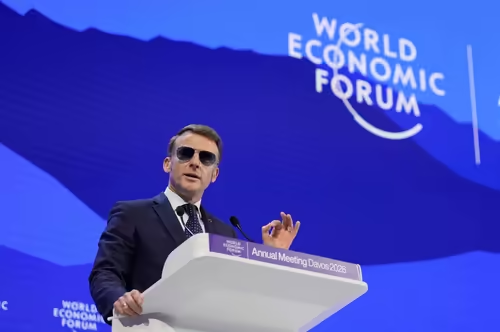
French President Emmanuel Macron has never been one to mince words on the global stage, and his recent address at the World Economic Forum in Davos was no exception. In a move that has sent ripples through international trade corridors, Macron delivered a clear and controversial message to Beijing: China is welcome—but only if it plays by a new set of rules.
His core demand? An immediate halt to the practice of “dumping”—flooding the European market with heavily subsidized, often sub-standard goods that undercut local industries and distort the competitive landscape. This isn’t just a trade complaint; it’s a strategic declaration of Europe’s intent to reclaim its economic destiny.
Table of Contents
- Macron’s Davos Message to Beijing: A Conditional Welcome
- The Dumping Dilemma: EU Concerns Over Chinese Subsidized Exports
- Beyond China: Macron’s Vision for European Economic Sovereignty
- What This Means for the Future of China-EU Trade
- Conclusion: A New Chapter in Global Trade
- Sources
Macron’s Davos Message to Beijing: A Conditional Welcome
Standing before the world’s most powerful business and political leaders, Macron’s tone was both diplomatic and direct. He acknowledged China’s role as a critical global player but drew a stark line in the sand. “This is a unique market, open to everybody without checking level playing field,” he remarked, highlighting the asymmetry in market access between the EU and China .
His message was two-fold. First, he actively encouraged more Chinese Foreign Direct Investment (FDI) into key European sectors like machine tools and automobiles. He believes that real investment, which brings technology transfer and creates jobs, is far more valuable than a simple export surplus .
Second, and more critically, he issued a stark warning against the current model of trade. He called out the “unsustainable” nature of China’s expanding trade surplus with Europe, which is largely fueled by state-backed subsidies that allow Chinese firms to sell products at artificially low prices . This practice, known as dumping, threatens the very survival of European manufacturers who cannot compete on an uneven playing field.
The Dumping Dilemma: EU Concerns Over Chinese Subsidized Exports
Macron’s comments are not made in a vacuum. They reflect a growing consensus within the European Union about the systemic risks posed by China’s state-driven economic model. The EU has long been concerned that heavy subsidies in China create a distorted market where price is not a true reflection of cost, but of state support .
This has led to a series of aggressive trade defense measures. The EU has launched multiple anti-subsidy and anti-dumping probes, most notably into Chinese electric vehicles (EVs), but also extending to other sectors like tyres for cars and trucks , . The fear is not just about unfair competition today, but about a predatory strategy for tomorrow—where Chinese companies drive European competitors out of business and then raise prices once they have a monopoly .
Macron’s demand for an end to the export of “sub-standard products” adds another layer to this concern. It’s not just about price, but about quality and safety standards that are fundamental to the European single market. Allowing a flood of non-compliant goods could undermine consumer trust and the integrity of European regulations.
Beyond China: Macron’s Vision for European Economic Sovereignty
While China is the immediate target of his remarks, Macron’s ultimate goal is far broader. His speech was a passionate plea for what he calls “economic sovereignty” for Europe . He envisions a continent that is not merely a passive market for others, but an active, strategic, and protected economic bloc capable of defending its own interests.
He urged Europe to reject what he termed a “neo-colonial approach” to its own economy, where it simply consumes what others produce without building its own resilient industrial base . For Macron, this sovereignty is built on three pillars: protection of critical industries, simplification of internal processes, and massive investment in future technologies .
This stance also implicitly critiques the United States’ own protectionist policies, such as the Inflation Reduction Act, which has been accused of luring European green industry across the Atlantic with massive subsidies. By calling for a sovereign Europe, Macron is arguing that the continent must chart its own course, independent of the economic dictates of either Washington or Beijing.
What This Means for the Future of China-EU Trade
Macron’s ultimatum sets the stage for a potentially tense but necessary renegotiation of the China-EU economic relationship. The path forward likely involves:
- Stricter Enforcement: Expect a significant increase in EU anti-dumping and anti-subsidy duties on a wider range of Chinese goods.
- Investment over Exports: A clear policy shift from Brussels and Paris will favor Chinese companies that invest in European production and R&D, rather than those that just ship finished products.
- Market Access Negotiations: The EU will use its leverage to demand greater reciprocal access to the Chinese domestic market, which remains notoriously difficult for foreign firms to penetrate .
For businesses operating in this space, the message is clear: the era of frictionless, unbalanced trade between China and Europe is ending. The new paradigm will be one of managed interdependence, with a strong emphasis on fairness, quality, and mutual investment.
Conclusion: A New Chapter in Global Trade
Emmanuel Macron’s message at Davos is more than a rebuke to Beijing; it’s a declaration of independence for Europe. His call to end the dumping of sub-standard, subsidized goods is the tactical front line in a much larger strategic war for EU economic sovereignty. By demanding a level playing field and championing real investment over mere exports, Macron is attempting to redefine Europe’s role in a world increasingly dominated by US-China rivalry. The success of this bold vision will determine whether Europe can remain a master of its own economic fate or become a mere bystander in the 21st century’s great power contest.
Sources
- Davos 2026: Special address by Emmanuel Macron, President of the French Republic [[1], [17]]
- Foreign Ministry Spokesperson Guo Jiakun’s Regular Press Conference
- Bloomberg: Macron Calls for More Chinese FDIs in Europe’s Key Sectors [[4], [6]]
- European Commission: EU-China Trade Relations [[8], [9], [12], [16]]
- World Economic Forum: Macron’s Call for European Economic Sovereignty at Davos [[18], [19]]
- Times of India: ‘China is welcome’: Macron sends message to Beijing