Bihar’s SIR Scheme Steals Global Spotlight
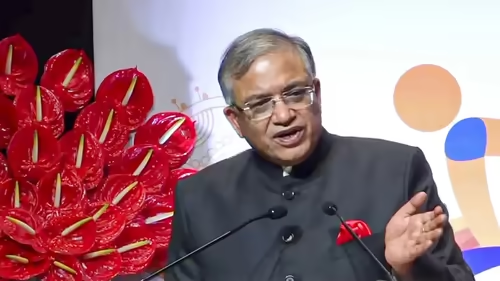
In a powerful moment of international recognition, India’s Chief Election Commissioner (CEC) recently showcased the success of the SIR in Bihar at a prestigious global election governance summit. Speaking before election officials from over 50 countries, the CEC held up Bihar’s Special Intensive Revision (SIR) drive as a replicable model for ensuring accurate, inclusive, and credible electoral rolls—a cornerstone of any healthy democracy.
This isn’t just bureaucratic praise. The SIR initiative has dramatically improved voter registration rates in one of India’s most complex and populous states, tackling long-standing issues like duplicate entries, missing names, and underrepresentation of marginalized communities. Now, its impact is being studied far beyond India’s borders.
Table of Contents
- What Is the SIR Scheme in Bihar?
- Why the CEC Called It a Global Benchmark
- How SIR Transformed Voter Registration in Bihar
- The Link Between SIR and SVEEP
- Global Reactions and Lessons for Other Nations
- Conclusion: Why SIR in Bihar Matters for Democracy Worldwide
- Sources
What Is the SIR Scheme in Bihar?
The Special Intensive Revision (SIR) is a targeted, high-effort voter list cleanup and expansion drive conducted by the Election Commission of India (ECI) in collaboration with state authorities. In Bihar, the SIR goes beyond routine updates—it involves door-to-door verification, mobile enrollment camps, and real-time data syncing to ensure every eligible citizen is on the electoral roll.
Unlike standard annual revisions, the SIR is deployed in phases where voter lists are historically inaccurate or exclusionary—particularly in rural, tribal, and urban slum areas. The goal? Zero eligible voter left behind.
Why the CEC Called It a Global Benchmark
At the recent International Conference on Inclusive Elections hosted by the Association of World Election Bodies (A-WEB), the CEC emphasized that the SIR in Bihar achieved what many democracies struggle with: scale, speed, and social equity.
“In a single cycle, Bihar added over 1.2 million new voters—many of them women, youth, and members of Scheduled Castes and Tribes who had been systematically missed,” the CEC noted . He contrasted this with countries where voter suppression or bureaucratic inertia leads to disenfranchisement.
What made Bihar’s model stand out was its integration of technology, community mobilization, and political neutrality—all while operating in a high-stakes, politically charged environment.
Key Achievements of the SIR Drive in Bihar
- 1.2+ million new voters added during the latest revision cycle.
- 98% household coverage through physical enumeration teams.
- Real-time Aadhaar-based validation to eliminate duplicates.
- Dedicated help desks for transgenders, migrants, and persons with disabilities.
- Zero political interference—monitored by independent observers.
How SIR Transformed Voter Registration in Bihar
Historically, Bihar faced challenges with “ghost voters” (fake or duplicate entries) and “missing voters” (eligible citizens not listed). The SIR tackled both simultaneously.
Teams of Booth Level Officers (BLOs)—local residents trained by the ECI—went door-to-door with tablets linked to the National Electoral Roll Purification and Authentication Programme (NERPAP). This allowed instant verification against Aadhaar and other databases.
Crucially, the drive prioritized inclusion. In districts like Araria and Kishanganj, where female voter registration lagged due to socio-cultural barriers, female BLOs conducted special evening camps. The result? A near 1:1 gender ratio in new enrollments.
The Link Between SIR and SVEEP
The SIR doesn’t work in isolation. It’s deeply intertwined with the Systematic Voters’ Education and Electoral Participation (SVEEP) program—an ECI flagship initiative to build electoral awareness.
While SIR ensures people are *on* the rolls, SVEEP ensures they understand *why* their vote matters. In Bihar, SVEEP used street plays, radio jingles, and school workshops to explain the revision process, turning registration into a community event rather than a bureaucratic chore.
This synergy has made Bihar a laboratory for democratic innovation. For more on how civic education boosts turnout, see our feature on [INTERNAL_LINK:voter-education-programs].
Global Reactions and Lessons for Other Nations
Election officials from Indonesia, Nigeria, and Peru expressed keen interest in adapting Bihar’s SIR model. “Most countries do top-down roll updates,” said a delegate from the International Institute for Democracy and Electoral Assistance (International IDEA). “Bihar’s bottom-up, hyper-local approach is revolutionary.”
According to International IDEA, nearly 1 billion people worldwide lack proper voter registration access . The SIR in Bihar offers a scalable, low-cost blueprint—especially for developing democracies with limited digital infrastructure.
Conclusion: Why SIR in Bihar Matters for Democracy Worldwide
The CEC’s spotlight on the SIR in Bihar is more than national pride—it’s a testament to how local solutions can solve global problems. In an era of rising voter apathy and electoral distrust, Bihar’s model proves that accuracy, inclusion, and transparency are not just ideals but achievable realities.
As democracies around the world grapple with legitimacy crises, the quiet success of Bihar’s door-to-door democracy builders may just be the playbook they need.
Sources
- Times of India: CEC cites success of SIR in Bihar at global meet
- International IDEA: Voter Registration Challenges Worldwide
- Election Commission of India: SVEEP and Electoral Roll Management