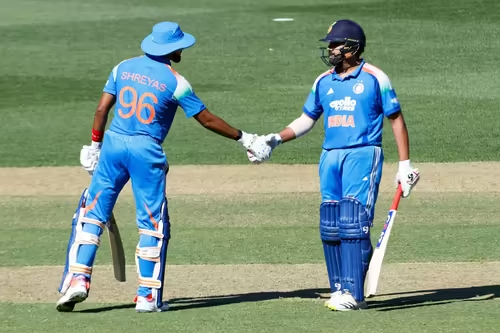
Rohit Sharma Breaks Silence on Shreyas Iyer’s T20 World Cup Omission
For the first time in over a decade, Rohit Sharma won’t be leading—or even playing—for India in a T20 World Cup. And while that reality is “strange,” as he admits, it hasn’t stopped him from reflecting deeply on the choices that shaped the current squad—especially the controversial Shreyas Iyer T20 World Cup omission.
In a revealing interview, the former captain didn’t shy away from the tough questions. When asked about Iyer’s absence, Rohit offered a blunt but telling explanation: “We needed someone… someone else.” It wasn’t personal, he stressed—but a calculated move driven by balance, form, and the evolving demands of modern T20 cricket.
Table of Contents
- Why Rohit Is Watching the T20 World Cup From Home
- The Real Reason Behind Shreyas Iyer’s Omission
- Rohit’s Leadership Philosophy: Selection and Trust
- How India’s Current Squad Was Built for Balance
- What This Means for Shreyas Iyer’s Future
- Conclusion: A Captain at Peace with Tough Calls
- Sources
Why Rohit Is Watching the T20 World Cup From Home
After stepping down as India’s T20I captain following the 2024 World Cup triumph, Rohit Sharma made it clear he wouldn’t be part of the 2026 campaign. His decision to retire from the shortest format was strategic—aimed at giving younger players room to grow under new leadership.
“It will be strange,” he confessed, “not being in the dressing room during such a big tournament.” But rather than dwell on nostalgia, Rohit has shifted his focus to mentorship and honest reflection—especially on the high-stakes world of team selection.
The Real Reason Behind Shreyas Iyer’s Omission
Shreyas Iyer’s exclusion from the T20 World Cup 2026 squad sent shockwaves through the cricketing community. A proven match-winner with experience in high-pressure games, many expected him to be a lock for the middle order.
But Rohit’s explanation cuts to the core of elite-level selection: it’s not always about who’s best on paper—it’s about who fits the puzzle.
“We needed someone… someone who could do X in those specific conditions, against those specific bowling attacks,” Rohit said, stopping short of naming names but making it clear the decision was tactical, not punitive .
This hints at a shift toward versatility—perhaps favoring a player who offers part-time spin, better fielding in the deep, or a more explosive power-hitting profile suited to the Caribbean or subcontinental pitches.
Key Factors That Likely Influenced Iyer’s Exclusion
- Role Over Reputation: The selectors prioritized defined roles (e.g., finisher, anchor) over all-round batting pedigree.
- Recent T20 Form: Iyer’s performances in domestic and franchise leagues may not have aligned with the team’s current strategy.
- Squad Balance: With multiple top-order batters and all-rounders, the middle-order slot became hyper-competitive.
- Fielding Demands: Modern T20 requires elite fielding—especially in boundary positions where Iyer has faced criticism.
Rohit’s Leadership Philosophy: Selection and Trust
One of Rohit Sharma’s most underrated strengths as captain was his emphasis on transparency. He revealed that every player left out was spoken to directly—no ghosting, no vague excuses.
“Open communication builds trust,” he said. “Even if they’re disappointed, they understand the ‘why.’ That’s crucial for team culture.”
This approach reflects a mature leadership style that values long-term cohesion over short-term comfort. For more on how captains manage squad dynamics, see our analysis on [INTERNAL_LINK:captaincy-in-modern-cricket].
How India’s Current Squad Was Built for Balance
The 2026 T20 World Cup squad isn’t just stacked with batters—it’s engineered for adaptability. With pitches varying from slow turners in India to flat tracks in the West Indies (a potential co-host), the selectors leaned into flexibility.
Players like Suryakumar Yadav, Rinku Singh, and even young talents like Tilak Varma offer 360-degree stroke play and the ability to accelerate from ball one. Meanwhile, all-rounders like Hardik Pandya and Axar Patel provide both batting depth and bowling options—something a pure batter like Iyer couldn’t replicate.
As ESPNcricinfo notes, “Modern T20 squads are built like Swiss Army knives—every player must serve multiple functions” .
What This Means for Shreyas Iyer’s Future
While the Shreyas Iyer T20 World Cup omission is a setback, it’s not necessarily the end of his international career. He remains a key figure in India’s ODI setup and could still feature in the 2027 50-over World Cup.
But the message is clear: in T20Is, legacy doesn’t guarantee selection. Performance, role clarity, and team needs reign supreme. Iyer now faces a critical window to reinvent his game—perhaps by adding a bowling option or sharpening his death-over hitting.
Conclusion: A Captain at Peace with Tough Calls
Rohit Sharma’s candid take on the Shreyas Iyer T20 World Cup omission isn’t just about one player—it’s a masterclass in leadership under pressure. By choosing honesty over diplomacy, he’s reinforced a vital truth: winning teams are built on hard truths, not sentimentality.
As India chases back-to-back T20 titles, fans can rest assured that every name on the squad list was chosen with purpose, precision, and a relentless focus on victory. And for Rohit? Watching from the couch might be strange—but it’s also a sign of a leader who knows when to step back and let the next generation rise.
Sources
- Times of India: ‘We needed someone…’: Rohit explains Iyer’s omission
- ESPNcricinfo: How India’s T20 World Cup squad was assembled
- ICC Official Site: T20 World Cup 2026: Tournament Preview