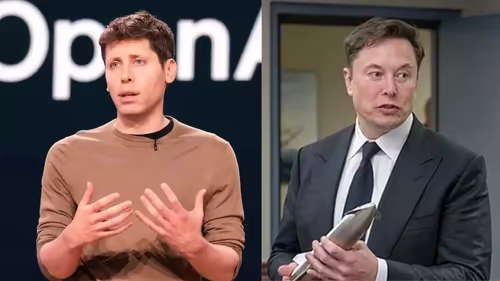
The tech world is bracing for a legal earthquake. At its epicenter? A staggering $134 billion lawsuit filed by Elon Musk against OpenAI and its deep-pocketed partner, Microsoft. This isn’t just a fight over money; it’s a fundamental clash over the soul of artificial intelligence itself. Was OpenAI’s shift from a pure nonprofit to a commercial powerhouse a necessary evolution or a profound betrayal?
Table of Contents
- The Heart of the Musk OpenAI Lawsuit
- The $134 Billion Question: Damages and Expert Testimony
- OpenAI’s Defense and Sam Altman’s Response
- Microsoft’s Role in the Legal Firestorm
- Why This Lawsuit Matters for the Future of AI
- Conclusion: A Battle for AI’s Soul
- Sources
The Heart of the Musk OpenAI Lawsuit
At its core, the Musk OpenAI lawsuit is a story about a broken promise. In 2015, Musk was a key co-founder of OpenAI, driven by a shared vision with Sam Altman and others: to create artificial general intelligence (AGI) that would benefit all of humanity, not just shareholders . The organization was structured as a non-profit, explicitly “unconstrained by a need to generate financial return” .
Musk alleges that this foundational mission has been abandoned. He claims that OpenAI, under Altman’s leadership, has pivoted to become a de facto subsidiary of Microsoft, prioritizing profit over its public-benefit charter . This, he argues, is a direct breach of the original agreement and a betrayal of his early contributions—both financial and intellectual.
The $134 Billion Question: Damages and Expert Testimony
The headline-grabbing figure of $134 billion doesn’t come from thin air. It’s the upper limit of a damages range ($79B to $134B) calculated by Musk’s expert witness, financial economist C. Paul Wazzan . Wazzan’s methodology attempts to quantify the immense value generated by Musk’s early involvement, arguing that his strategic guidance, technical insights, and initial funding were the primary catalysts for OpenAI’s current worth .
Unsurprisingly, OpenAI and Microsoft have fiercely contested this valuation. They’ve labeled Wazzan’s calculations as “fabricated” and “designed to inflate damages,” suggesting they are more theatrical than factual and could mislead a jury . This dispute over expert testimony is now a central battleground in the case, with the trial set for April 2026. The court will have to decide whether Wazzan’s model holds water or if it’s an ambitious attempt to attach a price tag to a visionary idea.
OpenAI’s Defense and Sam Altman’s Response
OpenAI hasn’t taken Musk’s accusations lying down. In a public blog post, CEO Sam Altman and the company pushed back hard, stating that Musk’s version of events “omitted a number of key facts” . Their core argument is that the shift to a “capped-profit” model was a pragmatic necessity to attract the massive capital required to compete in the AI race and actually fulfill their mission of building safe AGI.
Altman has firmly stated, “We’re not for sale,” emphasizing OpenAI’s independence and commitment to its mission, even as it partners with corporate giants . From their perspective, the partnership with Microsoft is a means to an end—the end being the development of powerful AI that remains aligned with human interests. They see Musk’s lawsuit as a potential attempt to slow their progress rather than a genuine grievance over a broken contract .
Microsoft’s Role in the Legal Firestorm
Microsoft is a critical player in this drama. Its relationship with OpenAI has evolved from a simple partnership into a deeply intertwined alliance. The journey began with a $1 billion investment in 2019, followed by another $2 billion in 2021, and culminated in a massive $10 billion investment in January 2023 [[16], [17], [24]].
This financial backing has given Microsoft exclusive rights to OpenAI’s technology, which it has rapidly integrated into its Bing search engine, Edge browser, and its entire Microsoft 365 suite. Musk’s lawsuit directly targets this partnership, arguing that Microsoft’s influence has corrupted OpenAI’s original purpose. For Microsoft, the stakes are incredibly high—not just the potential $134 billion liability, but also the future of its AI-driven business strategy, which is now a cornerstone of its growth.
Why This Lawsuit Matters for the Future of AI
Beyond the astronomical sum of money, this case poses existential questions for the tech industry:
- Can a true non-profit compete in the AI arms race? The resources needed to develop cutting-edge AI are immense. Is OpenAI’s “capped-profit” model the only viable path forward, or does it inevitably lead to mission drift?
- What is the value of a founder’s vision? How do you legally and financially account for the early, non-monetary contributions that set a company on its course?
- Who controls the future of AGI? Should the most powerful future technologies be developed by corporations accountable to shareholders, or by independent bodies focused solely on the public good?
The outcome of the Musk OpenAI lawsuit could set a powerful precedent, influencing how future AI ventures are structured and funded. It’s a stark reminder that the race to build the future is fraught with ethical and legal complexities.
Conclusion: A Battle for AI’s Soul
This legal battle between two of tech’s most influential figures is far more than a personal feud. It’s a proxy war for the future of artificial intelligence. On one side is Musk’s idealistic vision of a purely altruistic AI guardian. On the other is OpenAI and Microsoft’s pragmatic approach, leveraging capitalism to achieve a greater good. As the April 2026 trial date approaches, the entire world will be watching to see which philosophy prevails—and who will pay the ultimate price. For more on the evolving landscape of AI ethics, see our deep dive on [INTERNAL_LINK:ai-ethics-regulation].
Sources
- Times of India: Shocked Sam Altman to Elon Musk: ‘Get your maths right’
- TechCrunch: Elon Musk vs OpenAI: Why He Wants Up to $134B in Damages
- OpenAI Blog: Introducing OpenAI (2015)
- Microsoft Blog: The next chapter of the Microsoft–OpenAI partnership