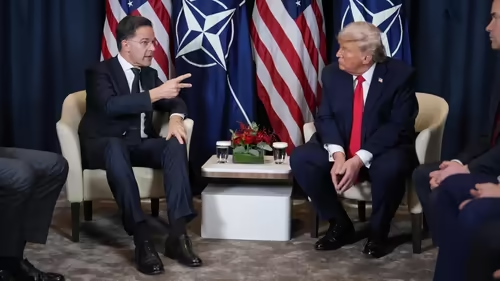
Just days after rattling transatlantic nerves with threats of sweeping tariffs tied to control over Greenland, former U.S. President Donald Trump has abruptly backed off—declaring instead that a “very productive meeting” has yielded a “framework for a future deal” with European allies. The sudden pivot, announced via his social media platform Truth Social, marks a dramatic shift in tone from a figure known for hardline negotiation tactics. But what exactly changed? And why does an icy, sparsely populated island matter so much to global superpowers?
Table of Contents
- The Greenland Tariff Threat That Shook Brussels
- Trump’s Reversal: A “Framework for Deal”
- Why Greenland Matters: The Arctic Geopolitical Chessboard
- Denmark’s Firm Stance and U.S. Diplomatic Realities
- Truth Social Diplomacy: Trump’s New Playbook?
- What’s Next for U.S.-EU Arctic Cooperation?
- Conclusion
- Sources
The Greenland Tariff Threat That Shook Brussels
Earlier this month, Trump sent shockwaves through diplomatic circles by announcing plans to impose new tariffs on European Union imports—effective February 1—unless progress was made on a deal concerning Greenland and broader Arctic interests. The move was widely interpreted as economic coercion, linking trade policy to geopolitical ambition. For many observers, it echoed Trump’s 2019 attempt to “buy” Greenland, which Denmark swiftly rejected as absurd. This time, however, the stakes appeared higher, with explicit threats of economic retaliation.
Trump’s Reversal: A “Framework for Deal”
In a post on Truth Social, Trump declared the planned tariffs would “not be moving forward” due to a “very productive meeting” that resulted in a “framework for a future deal” with European allies regarding Greenland and the Arctic region. While he provided no details about who attended the meeting or what the framework entails, the mere acknowledgment of a diplomatic breakthrough suggests behind-the-scenes talks may have defused the crisis.
This development is significant because it shows a rare instance of Trump de-escalating a trade threat without an immediate, tangible concession. It also raises questions: Was the tariff threat always a bluff? Or did European diplomats successfully negotiate a path forward that addressed U.S. strategic concerns without compromising Danish sovereignty?
Why Greenland Matters: The Arctic Geopolitical Chessboard
To understand the intensity of U.S. interest in Greenland, one must look beyond its 56,000 residents and vast ice sheets. The island sits at the epicenter of the rapidly warming Arctic—a region rich in untapped resources and critical shipping lanes.
Strategic and Economic Drivers
- Mineral Wealth: Greenland holds vast reserves of rare earth elements essential for electronics, defense tech, and green energy infrastructure—areas where China currently dominates supply chains.
- Military Positioning: The U.S. already operates Thule Air Base in northern Greenland, a key site for missile warning and space surveillance. Expanding influence could counter growing Russian and Chinese activity in the Arctic.
- Climate Change & New Routes: Melting ice is opening the Northwest Passage, potentially revolutionizing global trade. Control or influence over Arctic navigation is a long-term strategic prize.
As noted by the Center for Strategic and International Studies (CSIS), the Arctic is no longer a frozen frontier but a contested zone of 21st-century power competition .
Denmark’s Firm Stance and U.S. Diplomatic Realities
Denmark, which handles Greenland’s foreign and defense policy, has consistently maintained that the island is not for sale. Prime Minister Mette Frederiksen called Trump’s 2019 purchase proposal “absurd,” and that position hasn’t softened. However, Copenhagen has shown openness to deeper security and economic cooperation—on its own terms.
Crucially, Greenland’s government has been pushing for greater autonomy, including control over its natural resources. Any U.S. deal would need buy-in not just from Copenhagen, but from Nuuk—the capital of Greenland itself. This complex three-way dynamic makes any “deal” far more nuanced than a simple bilateral agreement.
Truth Social Diplomacy: Trump’s New Playbook?
Trump’s use of Truth Social to announce major foreign policy shifts—first the threat, now the retreat—highlights a new norm in digital diplomacy. Bypassing traditional channels like the State Department or press briefings, he communicates directly with his base, framing complex geopolitical maneuvers as personal victories.
While this approach energizes his supporters, it creates uncertainty for allies and adversaries alike. Was the “framework” real? Or was the entire episode a performative tactic to appear strong on national security ahead of the 2024 election? Analysts remain divided .
What’s Next for U.S.-EU Arctic Cooperation?
The claimed “framework” could signal a thaw in U.S.-EU relations on Arctic issues. Both sides share concerns about Russian militarization and Chinese “polar silk road” ambitions. A coordinated Western approach—focusing on scientific collaboration, environmental protection, and responsible resource development—could emerge as a constructive path forward.
However, without transparency, skepticism is warranted. If the “deal” is merely a vague understanding with no enforcement mechanism, the Greenland tariff threat could resurface if political winds shift again.
Conclusion
Donald Trump’s withdrawal of the Greenland tariff threat may ease immediate tensions, but it doesn’t resolve the underlying strategic scramble for the Arctic. Greenland remains a linchpin in a high-stakes game involving climate change, resource scarcity, and great-power rivalry. While Trump frames this as a win—“a very productive meeting”—the real test will be whether this “framework” translates into concrete, cooperative policies that respect Greenlandic sovereignty and promote regional stability. For now, the world watches closely as the ice melts and the stakes rise. Learn more about Arctic geopolitics in our deep dive: [INTERNAL_LINK:arctic-race-for-resources].