Table of Contents
- The Demographic Cliff: China’s Alarming New Reality
- Why Is China’s Population Collapsing?
- Failed Policies and Desperate Measures
- Global Implications of a Shrinking China
- Conclusion: A Future in Question
- Sources
The Demographic Cliff: China’s Alarming New Reality
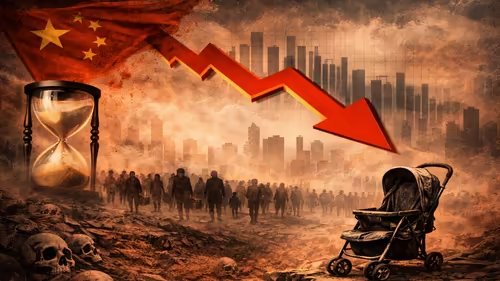
For decades, the world watched China’s explosive growth with a mix of awe and apprehension. Now, the narrative has flipped on its head. The latest data confirms a stark and terrifying truth: China’s population collapse is not a future threat—it’s a present-day emergency. In 2025, China’s population fell by 3.39 million, bringing the total to approximately 1.405 billion . This marks the fourth straight year of decline, and the pace is accelerating .
The numbers tell a story of a society at a breaking point. The birth rate has plummeted to a record low of just 5.63 births per 1,000 people in 2025, down from 6.39 in 2023 . This translates to a mere 7.9 million babies born last year—a figure that’s both astonishingly low for a nation of its size and a 17% drop from the previous year . For context, this is less than half the number of annual births in the United States, a country with less than a quarter of China’s population.
Why Is China’s Population Collapsing?
The roots of this crisis run deep, stemming from a toxic cocktail of long-term social, economic, and political factors.
The One-Child Policy Hangover
While officially ended in 2016, the legacy of the one-child policy casts a long shadow. It fundamentally reshaped Chinese society, creating a generation of “little emperors” and normalizing the idea of a single-child family. This cultural shift is incredibly hard to reverse.
Economic Pressures on Young Families
Today’s young Chinese professionals face immense hurdles. Skyrocketing housing costs in major cities, a fiercely competitive job market, and the soaring expense of education and childcare make the prospect of raising a child seem financially impossible for many. The dream of a better life for their children often feels out of reach, leading many to forgo parenthood altogether.
A Crisis of Confidence
Beyond economics, there’s a growing sense of disillusionment among China’s youth. Faced with a challenging economic outlook and limited personal freedoms, many are choosing to focus on their own lives and careers rather than start a family. This is a profound societal shift that no simple cash subsidy can easily fix.
Failed Policies and Desperate Measures
The Chinese government is not blind to the problem. In recent years, it has rolled out a series of increasingly desperate measures to boost its birth rate, but with little success.
These efforts include:
- Cash Subsidies: Many local governments now offer direct financial incentives for having children, though these are often too small to offset the true cost of raising a child.
- Expanded Parental Leave: Mandates for longer maternity and paternity leave have been introduced, but enforcement is spotty and can create a hiring bias against women.
- Universal Childbirth Coverage: A new policy promises to cover all childbirth medical expenses by 2026, a significant step to lower a key barrier .
Perhaps the most controversial move was the decision to impose a 13% sales tax on contraceptives while simultaneously offering tax breaks for childcare services . This heavy-handed approach, which essentially penalizes citizens for not having children, has been widely criticized as both ineffective and a violation of personal autonomy. It’s a clear sign that the government is running out of conventional policy tools.
A recent State Council directive outlined 13 new targeted measures to enhance support, but the fundamental question remains: can policy force a change in deeply held personal and economic decisions?
Global Implications of a Shrinking China
The consequences of China’s population collapse will ripple far beyond its borders.
Economic Slowdown
A shrinking workforce means lower productivity, reduced consumer spending, and a massive strain on the pension system as the elderly population grows. This demographic drag will inevitably slow China’s economic engine, impacting global supply chains and markets.
Geopolitical Shifts
A nation struggling with internal demographic decay will have fewer resources to project power abroad. This could lead to a recalibration of global power dynamics, potentially creating a vacuum that other nations may seek to fill.
A Cautionary Tale
China’s situation serves as a stark warning for other nations facing similar, albeit less severe, demographic trends. It highlights the extreme difficulty of reversing a fertility decline once it has taken hold in a modern, urbanized society. For more on global demographic shifts, see our analysis on [INTERNAL_LINK:global-aging-population-trends].
Conclusion: A Future in Question
China stands at a historic crossroads. Its population is not merely declining; it is collapsing at a pace that threatens its economic model, social stability, and global standing. The government’s current mix of financial incentives and coercive taxation is unlikely to reverse a trend driven by deep-seated economic anxieties and a generational shift in values. The world is watching as the Middle Kingdom grapples with a crisis that could define its 21st century.
Sources
- Times of India: Taxing condoms, cash subsidies: China’s population is not falling, it’s collapsing
- China National Bureau of Statistics (via various reports): Population and birth rate data for 2025 [[1], [4], [10], [12]]
- State Council of China: Directive on Enhancing Childbirth Support Services